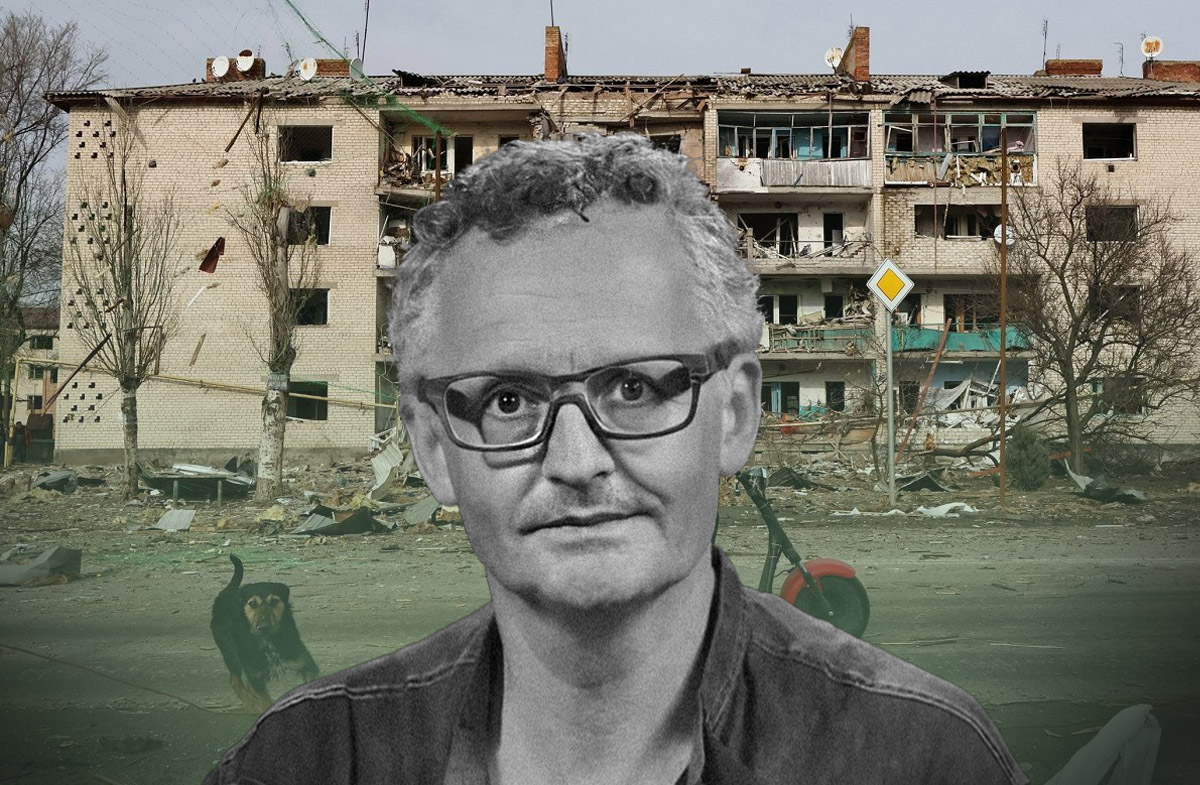
Alexei Yurchak
The war in Ukraine has generated extensive analysis focused on Putin's geopolitical strategy, post-Soviet resentment, imperial ambitions, and the pursuit of a multipolar world.
These perspectives are important but incomplete: they hardly consider what the war is doing within Russia itself. The war is a destructive invasion of Ukraine, but also a tool for transforming Russian society.
When the rapid regime change in Ukraine failed, and Ukrainians rejected the claim that Russians and Ukrainians are one people, the war was reinterpreted: first as an existential struggle for Russia's survival, and then as a project of rediscovering Russia as a civilization.
Reinterpreting the Goals
A striking feature of the Russian invasion is that its goals remain unclear. When Putin launched the invasion in February 2022, he called it a special military operation, emphasizing its limited scope and announcing two goals: protecting the people of Donbas and denazifying Ukraine. "Denazification" was an unusual term. Lavrov explained it as the removal of the "anti-people Nazi regime" in Kyiv so that Ukrainians could determine their own future. Then Putin changed the goal again: NATO's military infrastructure is approaching Russia's borders, and he has no choice. But when Finland and Sweden joined NATO (a direct consequence of the invasion), Putin stated that it didn't concern Russia.
The justification changed again when claims emerged about alleged Ukrainian biolabs near Russia's borders, supposedly developing weapons against Russians. And again, this supposedly left Putin with no choice.
The goals constantly change, and consequences are declared as causes. This cyclicality is not confusion. It is designed to make the question of goals irrelevant. The meaning of the war is not in its goals, but in the effect of its continuation as something given and inevitable
In October 2022, at the Valdai Club, the moderator directly asked Putin: you and Russian officials constantly say that the special military operation is going according to plan, but society doesn't understand what the plan is. Can you clarify this?
Putin responded not with clarification, but with a new reinterpretation. He said: when our troops advanced from the south, north, and in eastern Ukraine, it became clear that people in the historical territories of Novorossiya see their future with Russia. How could we not respond to this?
The statement was false, but it revealed a more important retroactive logic: the goal of the war appeared only after the troops occupied Ukrainian territory and encountered the local population.
In December 2023, in the program "Results of the Year with Vladimir Putin," viewers asked two questions: what are the goals of the special military operation and have they changed? In response, Putin returned to the long-forgotten denazification but did not mention NATO or biolabs. A year later, in the same program, he named other goals for the year: to liberate the Kursk region and achieve successes on the front line.
Both were consequences of the war, not its cause. The pattern is clear: the invasion is not based on a consistent threat. Its goals constantly change, and consequences are declared as causes. This cyclicality is not confusion. It is designed to make the question of goals irrelevant. The meaning of the war is not in its goals, but in the effect of its continuation as something given and inevitable. What is perceived as such does not invite judgment. It invites endurance.
At the Valdai Forum that year, Putin gave another explanation. Despite the occupation of Ukrainian territory, he insisted: this is not a territorial conflict. Russia is the largest country in the world by territory, and it does not need to conquer additional lands. The conflict, he said, is civilizational.
The claim that Russia is a unique civilization has deep roots, but the war has made it the central ideological core of the regime. By spring 2023, the new Concept of Russia's Foreign Policy officially described the country as a unique state-civilization. Putin explains that only a few civilizations are state-civilizations, each with its radically unique path of development.
The Kremlin journal "Russia in Global Affairs" wrote: if earlier Russia's priority was to become part of the "civilized world," now Russia has accepted the status of a state-civilization and emphasizes its unique identity.
Russia has long lived like a genie in a bottle, corked by Western fixation. Now the Russian civilization has broken free, and its European journey, lasting three centuries, is over.
Putin claims that the Russian state-civilization is an organic body that has developed over millennia. Unlike nation-states, it is not defined by borders. In the civilizational sense, Putin says, Russia has no borders. This body is governed by an internal civilizational code, or civilizational DNA.
These quasi-biological terms are not just metaphors. In this rhetoric, the state-civilization is treated as a special biological species. Different state-civilizations can interact but not mix.
The imposition of one civilization's values on another threatens civilizational death. As Putin says, preserving the planet's civilizational diversity is as important as preserving biodiversity.
This doctrine is institutionalized through the state program "Russia's DNA." The logo plays on the double helix of DNA and the double-headed eagle. In 2023, the program introduced mandatory seminars for teachers and university courses. The academic director of the program, Andrey Polosin, highlights two key elements of Russia's civilizational code: sacrifice and service to the Motherland. Alexander Kharichev, head of the presidential department for monitoring social processes, in the article "Who Are We?" claims that sacrifice takes precedence over all other values, including individual life.
Life Belongs to the State
The emphasis on sacrifice is framed not in religious but in quasi-biological terms. Individual life is subordinated to the civilizational body, like a biological cell to an organism. Vladimir Solovyov, a leading state propagandist, formulated it this way: life is greatly overestimated. Why fear the inevitable? Life itself has no value. It is worth living only for something worth dying for.
Putin depersonalizes death, blurring the line between politically produced death and natural mortality, and distances himself and the state from responsibility
This sacrificial logic was particularly evident at Putin's meeting with the mothers of soldiers killed on the front. Responding to one of them, Putin said the following:
«...Of course, this is a huge tragedy. But you know what comes to my mind? About 30,000 people die annually in traffic accidents, and about the same from alcohol. It happens. We are all mortal, all under God, and one day we will leave. The question is how a person lived. Some seem not to have lived at all — died from vodka or something else, and they are simply gone. But your son lived. Do you understand? His goal was fulfilled. So, he did not leave in vain. His life was meaningful. It achieved a result...»
After the ritual condolences, Putin depersonalizes death, blurring the line between politically produced death and natural mortality, and distances himself and the state from responsibility.
Then he distinguishes between meaningless and meaningful death. Those who die in accidents or from alcohol disappear unnoticed. But a son who died in Putin's war did not die in vain: his death "achieved a result" and "fulfilled a goal." But Putin does not specify either the result or the goal.
The disturbing message is that giving one's life to the state is meaningful in itself, without a goal and without the need for justification. Why has sacrifice, devoid of a goal, become a privileged channel for producing meaning and belonging in Putin's Russia? To answer, I turn to the French philosopher Georges Bataille. In his theory of sacrifice, Bataille draws on classical anthropology and shows how sacrifice can become meaningful in itself, independent of a goal.
In the book "Sacrifice: Its Nature and Functions," Henri Hubert and Marcel Mauss identified three positions: the sacrificer, who sanctions the offering; the victim, who is destroyed; and the community, which witnesses the act. Sacrifice is made meaningful not by destruction for a goal, but by the very staging of the ritual.
Bataille retains this triadic structure but expands its political significance. He defines sacrifice as a purposeless expenditure: destruction that is significant precisely because it serves no utility. Subjecting life to death without a goal, sacrifice transfers it to the sacred zone, beyond rational calculation. In this sacred zone, sovereign power is constituted.
The sovereign, according to Bataille, is not the one who maximizes outcomes, but the one who can sanction death and destruction without the need for a goal and justification. Sovereignty is not merely expressed through sacrifice — it is constituted by it.
Before applying this to Putin's system, the relationship between cultivating and destroying life, between biopower and what I call sacrificial sovereignty, needs to be clarified. Biopower describes governance organized around the optimization of life. At first glance, Putin's system may seem the complete opposite — a system that squanders and destroys life.
In reality, the connection is more complex. The state invests heavily in cultivating life: maternal capital, encouragement of birth rates, benefits for children of contractors and veterans, programs like "Russia's DNA." These are recognizable biopolitical mechanisms. But the relationship of power here is different.
The sardonic phrase "women will give birth to new ones" captures the simultaneous care of the state for life and its indifference to it
For the French philosopher, historian, and cultural theorist Michel Foucault, biopower partially displaces sovereign power. In Putin's system, on the contrary, sovereign power does not retreat. It captures and subordinates biopower, redirecting it to its own goals. Biopower is embedded in the structures of sacrificial sovereignty. Life is cultivated not as an end in itself, but as a means. It is optimized at the level of reproduction to be sacrificed at the level of sovereign power.
As the sardonic phrase goes: «women will give birth to new ones». It captures the simultaneous care of the state for life and its indifference to it.
Putin's system is sometimes described as necropolitics in the sense of philosopher and political theorist Achille Mbembe — a configuration in which death acts as a technology of governance. But it differs from necropolitics.
First, Mbembe associates death with clear political goals, whereas Putin's war is not anchored to a stable goal. Second, for Mbembe, the impact of death works through exclusion: the population is divided into those considered human and those cast outside the human and therefore can be killed. In Putin's system, exposure to death is framed as inclusion in the civilizational home, as the highest sign of belonging.
Therefore, neither Bataille nor Mbembe alone is sufficient. Bataille provides the logic of purposeless sacrifice, but not the modern apparatus that supports it on a large scale. Mbembe provides death as a technology of power, but through exclusion, whereas Putin's system operates through inclusion.
Economic Desperation and the Contract
This specific configuration of power I call sacrificial sovereignty. It is a form of power in which purposeless sacrifice on a mass scale becomes the organizing principle of governance. Here, exposure to death is not exclusion, but inclusion: the highest proof of civilizational belonging.
To die and kill for civilization — or to be drawn into its sacrificial logic on the home front — becomes meaningful in itself.
This logic extends to dissent. In the civilizational framework, opposition to the state is understood not as a political position or crime, but as a betrayal of one's own nature. Putin calls opposition "unnatural" and "disgusting." Therefore, even minimal acts of dissent — a "No to War" badge, a critical comment, a like on a critical post — are prosecuted under articles on "justification of terrorism" or "discrediting the army" with penalties ranging from 7 to 15 years.
It's not about controlling opinions, but about maintaining a "healthy civilizational organism." Here, the triadic structure of sacrifice is reproduced: Putin acts as the sacrificer, soldiers and civilians as victims, society as witness and participant.
The system constantly absorbs and replaces tens of thousands of lives as part of its normal functioning
Sacrificial sovereignty is a technology of governance institutionalized through the modern state apparatus. Nowhere is this more clearly seen than in the system of military contracts through which the Russian state sustains losses on the front. By March 2026, Russian military losses were estimated at 300-350 thousand killed (Ukrainian losses around 165 thousand) soldiers. To sustain losses of this scale without nationwide mobilization, the state developed a system of civilian contracts with the Ministry of Defense. Each region receives a quota from the center. Recruiters receive bonuses for each contract.
Most contractors are from vulnerable groups and depressed regions. Many are over 40, and now the number of those over 60 is growing.
The 2022 law allowed prisoners to go to war in exchange for amnesty, and the 2023 law extended this to detainees. Young conscripts are forced to sign contracts under false promises that they will remain in the rear. But on the front, many end up in frontal assaults.
Contractors are the largest, least trained, and most vulnerable to death group. About 20 percent of contractors die within a year. The system constantly absorbs and replaces tens of thousands of lives as part of its normal functioning.
At the same time, most men sign contracts formally voluntarily, under the influence of extremely high payments. In February 2026, the one-time bonus for a contract in St. Petersburg reached 4 million rubles, about 50 thousand dollars. With salary and combat payments, annual income could reach 7-8 million rubles. Contractors also have their credit debts written off. If a contractor dies, his family receives 10-15 million rubles in compensation. These amounts are much higher than anything such men can earn in civilian life.
In 2024, more than 400 thousand men signed contracts, and in 2025 the number was comparable. State propaganda simultaneously presents the contract as a lucrative job, male self-realization, and sacrificial duty. On billboards: "Victory will be ours. Hurry to get all the benefits and payments. Salary — 210 thousand. Become a hero. Compensation up to 10 million."
"Be worthy of great ancestors" — next to the promise of payments. "Do you want to earn like a real man? Contract service is a way to provide for your family, pay off debts, and close loans." These messages create a subject whose life gains meaning and dignity.
The first frame presents the war as a financial transaction. A man is offered to make a profitable choice: sell his life at a high price. The state buys not labor, but the willingness to die and kill in a war whose goals and justifications remain opaque. The second frame describes participation through heroic identity and family. Men fight not against something, but for something: not against a specific threat, but for family and children. In both frames, the literal meaning of the war is hidden. Who is the enemy? What is considered victory? It is not specified. Life becomes meaningful, heroic, moral, and valuable through sacrifice as such: to kill and be killed without clear justification.
It is important to hear how the contractors themselves describe their decisions. In 2024, journalists from the independent publication "Verstka" spoke with dozens of men at Moscow recruitment centers. One man said: "I've lived my life, but with this money, I can buy my son an apartment. If I'm killed — so be it." Another signed the contract because three of his comrades had already died. When asked if the war was fair, he replied: "What war can be fair? If we were defending the borders — maybe. But we went to foreign territory." A third signed the contract in memory of his son, who committed suicide after the front. A warehouse worker wanted to provide for his children. A factory director needed money for his father's surgery. An assembler said: "War is a political decision, not for me to decide. Maybe fair, maybe not. But salaries are low. If I earned 200 thousand rubles, I wouldn't go."
When journalists returned to the centers in February 2026, the answers had changed even more. A young man from a village in the Sverdlovsk region, unemployed for over a year, when asked what the war was about, said he didn't know. "You don't know what it's about, but you're willing to risk your life?" — "Yes." A mason from the Nizhny Novgorod region called the invasion unjust. When asked why he was going to an unjust war, he replied: "I don't know. I want to be a patriot."
This shows more than economic desperation. When a person calls the war unjust but says he wants to be a patriot, it is not a contradiction. These phrases relate to different registers. Patriotism becomes a reason to sign a contract, but not necessarily a reason to support the war. These reasons are rooted in relationships, obligations, love, and the desire to belong. They reflect fatalistic resignation: "I've lived my life," "if I'm killed — so be it."The state seeks to create a subject who agrees to die and kill without knowing why. This is sacrificial sovereignty in practice.
The Body of Double Exploitation
By signing a contract, a person does not exercise power but surrenders to it, offering life to a war whose purpose cannot be named. The state does not simply recruit: it creates conditions of desperation, duty, loss, grief, and the desire to belong, and then turns them into fuel for sacrifice.
On the front, contractors face a predatory parallel economy: officers often extort part of the contract payments. Refusal to pay can lead to being sent to the most dangerous assaults. Deaths are often not registered so that officers can continue receiving payments.
When sacrifice is detached from purpose, it no longer demands accountability. The body becomes a site of double exploitation: first of life, then of material resources.
The logic of sacrificial sovereignty descends down the hierarchy. This is not corruption, but a logical continuation of the system. How to think about these people ethically? It cannot be ignored that they go to war, where they will kill Ukrainian soldiers and civilians and participate in the occupation. Their responsibility is real, and it cannot be justified. But focusing only on individual responsibility risks obscuring the main point: moral judgment presupposes freedom.
In conditions of poverty, fear of punishment, limited information, and propaganda, the space for judgment narrows, though it does not close completely.
The contractor bears personal responsibility for violence. And political responsibility extends to the regime that constructed the conditions of his decision. These decisions, however mistaken they may be, remain within the moral universe of care, duty to the dead, love for the country, and the search for dignity. When they say: "War is a political decision, not for me to decide," — they express not nihilism, but delegate political judgment to the sovereign. This allows for the preservation of other forms of meaning related to family, work, and belonging.
This is reminiscent of what I previously described as living alongside the system or inside and outside the system: people inhabit the formal structures of the state but do not fully identify with them. The regime has not achieved the destruction of ethical agency but its reorganization.
The widespread narrative of complicity — the question "why don't Russians just refuse?" — completely misses this reorganization. It presupposes a subject whose moral beliefs are based on free choice. Sacrificial sovereignty employs a different subject: one whose ethical life remains genuine, but whose field of action is so narrowed by the state that for many, these values can only be expressed through a military contract. These decisions are not only individual and not only imposed from above. They are social: they spread through norms, habits, and efforts of people to keep life at a distance from the war.
How to Live with War
How is the war experienced within Russia? And can the absence of mass protests be considered support?
Claims of broad support are often backed by surveys. But in this context, survey data do not capture what they supposedly capture. Even a strict sociological organization cannot avoid the fact that discourse is shaped by the power of fear. Even the word "war" is criminalized and cannot be used in questions. But it's not just about one word, but about the entire discursive field.
The absence of mass protests does not necessarily mean support. Rather, it shows the success of the system: dissent has become too costly, and the war — as if an inevitable condition of existence
As Canadian philosopher Charles Taylor wrote, the survey situation presupposes a subject — bounded self, "bounded self," — with stable attitudes that can be extracted by a question. But speech doesn't work like that. Speech doesn't just convey internal states. It positions speakers in the social and moral field. When a respondent supports the army, it may express concern for a relative, an attempt to reduce risk, a desire to maintain dignity, not stand out, or delegate judgment to the state. Therefore, surveys reveal an apparent paradox: the majority states that they support the war, and at the same time, the majority wants it to end. These are not contradictory positions. These are situational speech acts oriented to different social registers. The absence of mass protests also does not necessarily mean support. Rather, it shows the success of the system: dissent has become too costly, political goals are opaque, and the war — as if an inevitable condition of existence. The deeper problem goes beyond surveys.
As British academic and geographer Nigel Thrift argued, representative studies see people as stable objects with beliefs. They miss that people are in constant becoming. A survey captures what people say at a given moment, but not what they are capable of under different conditions.
To understand how Russians live with the war, one must turn to ethnography. Since 2022, the Public Sociology Lab, or PS Lab, has been conducting field research in various regions. In the first weeks after the invasion, they found shock, disbelief, then disorientation and depression. Early expressions of opposition were quickly suppressed by criminal measures. Genuine grassroots mobilization in support of the war was rare from the start. Over three years, society became more depoliticized than mobilized. In safe contexts, people often say: "let them fight their own war." But when discussing geopolitics or sanctions, the same people may switch to a patriotic register and say that Russia must defend itself. These switches are not contradictions but reactions to uncertainty and an attempt to maintain normal life under authoritarianism. Military volunteering has also expanded: collecting things, weaving camouflage nets. This is often considered mass mobilization in support of the war. But ethnographers, themselves participating in these activities, report: motives are mainly local and personal — to help relatives survive, cope with loss, support social ties. There is little patriotic rhetoric, and it is often avoided. In everyday conversations, Ukraine, including the occupied territories, is called a separate country with its cultural and linguistic identity. What PS Lab documents is not direct complicity, not clear support, and not explicit opposition, but depoliticization. Depoliticization itself is a form of sacrifice: not of physical life, but of political agency, moral clarity, and public participation. It is a way to live alongside a war that cannot be stopped: to perform the required gestures but maintain an internal distance. This creates space for a form of politics that I call atmosphere.
Latent Politics
The doctrine of the state-civilization requires not only obedience but also affective identification. But analysis shows not identification, but fragmentation, demoralization, and detachment. In the gap between proclaimed unity and lived fragmentation, another type of politics is forming in Russia. This politics is not articulated and not organized. It exists as a shared sensibility of distance and refusal. The concept that best captures this state, I call atmosphere, drawing on the German philosopher Gernot Böhme and work in anthropology and cultural geography. Atmosphere is not a feeling inside individuals and not a property of things, not a social movement and not an ideology. It is a common quality of affect that arises between bodies and the environment: a diffuse state where a sense of collectivity appears before it is articulated, organized, or named.
Example: in 2025, 18-year-old musician Diana Loginova, performing under the name Naoko, regularly played on the streets of St. Petersburg with a guitarist and drummer, performing covers of songs by Russian musicians, some of whom were associated with political opposition. Passersby — mostly young, but not only — stopped. Spontaneous crowds gathered, sometimes up to a hundred people. Many sang along, moved to the rhythm, and recognized something unexpected in each other: not an organized collective, but a common sensibility.
Musicians did not call the performances political to avoid giving grounds for persecution. But the state also did not call the gatherings a protest because that would mean acknowledging that a spontaneous opposition to the war exists beneath the surface
This can be called atmospheric attunement: bodies enter into affective synchronization without prior organization, making a common sensibility collectively perceptible for a short time. Videos of these gatherings spread widely online. In October 2025, Naoko and the musicians were arrested. Authorities cited two songs. The first — "Soldier and Poet" by Monetochka — addresses a soldier in an unnamed war: "You are a soldier. And whatever war you are fighting — forgive me, I will be on the other side." The reference was obvious, though not directly named. The second — "Cooperative 'Swan Lake'" by Noize MC — contains the line: "I want to watch ballet, let the swans dance." For a Russian audience, this is instantly recognizable: "Swan Lake" was broadcast during Soviet political crises and the 1991 coup. Wishing for the swans to dance means hinting at the end of the regime. In both songs, the political meaning is conveyed through euphemism — recognizable but formally deniable. The performance and singing acted not so much through declaration as through affect, evoking a shared feeling that could not be openly expressed. Organizing persecution for such events is difficult: officials want to appear lawful. Therefore, the charge was changed from "discrediting the army" to "organizing an unauthorized mass event," allegedly obstructing pedestrians.
The defense responded that the gatherings were spontaneous. Musicians did not call the performances political to avoid giving grounds for persecution. But the state also did not call the gatherings a protest because that would mean acknowledging that a spontaneous opposition to the war exists beneath the surface. The state feared the space where people recognized that others felt similarly.
A skeptic might ask: can one street musician tell us something more than about herself? Two analyses need to be distinguished. One seeks representative attitudes, already visible and articulated. The other focuses on symptoms: moments when hidden processes become perceptible. As Nigel Thrift says, representative models miss what is just emerging and remains latent until conditions appear. It is important not only what people say about themselves but also what they are capable of. Such approaches did not capture the conditions that made the collapse of the USSR possible. Therefore, it seemed sudden: these conditions were latent and invisible to analysis focused on organized opposition.
Events around Naoko show not what Russians say in surveys, but what ordinary people can become capable of under certain conditions. Not a stable opinion, but an emerging capacity. A symptom does not say which part of the body is sick, but shows that something is happening beneath the surface. Spontaneous atmospheric attunements are symptoms of political capability that go beyond depoliticized detachment. They should not be dismissed as unserious; symptoms do not arise from nothing. They condense a diffuse state that is already present but not yet visible and named.
For strangers to spontaneously recognize something in each other and enter into affective resonance, a shared sensibility must already exist. The repeatability of symptoms is important.
Similar affective reactions arise in different places without organization. They are visible in other materials: contractors call the war unjust but sign contracts; volunteers help the front but avoid patriotic language.
The regime has achieved the production of bodies available for sacrifice and gestures of consent, but has not created full identification with the sacrificial logic as a lived moral orientation
Contradictory statements and switches in speech registers, described by PS Lab, do not indicate organized political mobilization, but point to latent political life — to what people are already capable of when conditions change. The regime of sacrificial sovereignty is a form of authoritarian governance. It is distinguished not only by using exposure to death as a technology of power but also by doing so in the form of purposeless sacrifice, turning death into the highest proof of civilizational belonging. And yet the system creates not only submission and depoliticization but also conditions for latent political life.
The regime has achieved the production of bodies available for sacrifice and gestures of consent, but has not created full identification with the sacrificial logic as a lived moral orientation.
As a result, society lives alongside its political life — not fully inside and not fully outside the goals of the state.
The late Soviet experience shows that such conditions can create the appearance of stability for a long time, but political rupture does not always require prior mass mobilization. It is enough for conditions to exist in which emerging political capability crystallizes and becomes publicly visible. Then what seemed like passivity or was measured by surveys as support may turn out to be accumulated political potential. And what seemed like stability may turn out to be just an interval before a rapid collapse.
Reference
Alexei Yurchak — a professor of anthropology at the University of California, Berkeley. He is also an affiliated faculty member of the Department of Slavic Languages and Literatures.
Born and raised in Soviet Leningrad, he was educated as a physicist, then moved to the USA and earned a PhD in cultural anthropology from Duke University. He is the author of the award-winning book "Everything Was Forever, Until It Was No More: The Last Soviet Generation" (Princeton University Press, 2005). His forthcoming book "Sovereign Flesh" is dedicated to the scientific, political, and aesthetic history of Lenin's body. He is also working on a series of articles on political anthropology dedicated to the foundations of Putin's regime and its war.
Video Version
Photo: bookamaro.com, AP, Andriy Andriyenko.