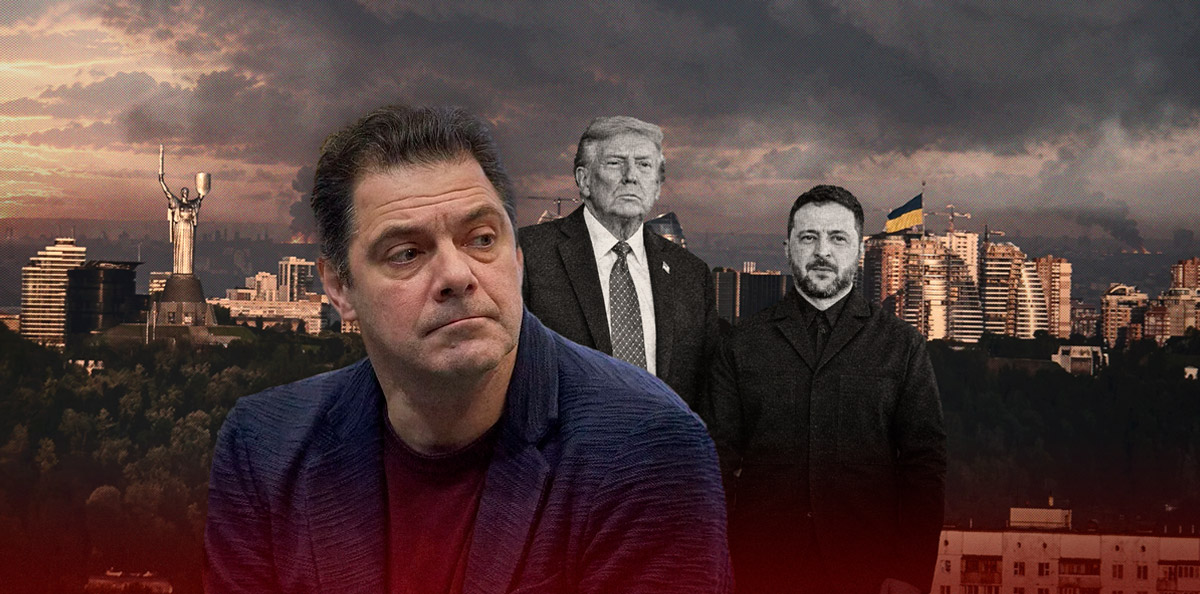
Kirill Rogov
In St. Petersburg, after an attack by Ukrainian drones, tens of thousands of residents were left without electricity, water, and heat. There were reports of explosions at oil depots and in the data center of "VKontakte." More than 550 drones attacked Moscow, causing a collapse at airports. The sides are delivering increasingly destructive blows, but the prospects for a peaceful resolution remain unclear.
Evgenia Albats: Kirill, Ukrainian President Volodymyr Zelensky for the first time (at least in my memory) spoke about the possible defeat of Ukraine and warned that in this case, the continent would face 20 million refugees from Ukraine. That's about how many are practically left in Ukraine, meaning all of Ukraine would move to Europe. The reason for his statement is that US President Donald Trump made a diesel deal with Putin and did not impose "hellish sanctions" against Russia, contrary to the law named after the late Senator Lindsey Graham. Moreover, Trump stated that Ukraine needs a new leader.
The US, at least according to world media, stopped supplying Ukraine with intelligence on ballistic missile launches from Russian territory for at least a few days. As Zelensky said, no one but the US has such a satellite group that could provide this information. The war in Ukraine continues, with both sides exchanging increasingly harsh and destructive blows. What do you think about all this? First of all, why does Trump need a diesel deal, considering that the US is the largest oil supplier to world markets?
Trump Mobilizes the Electorate
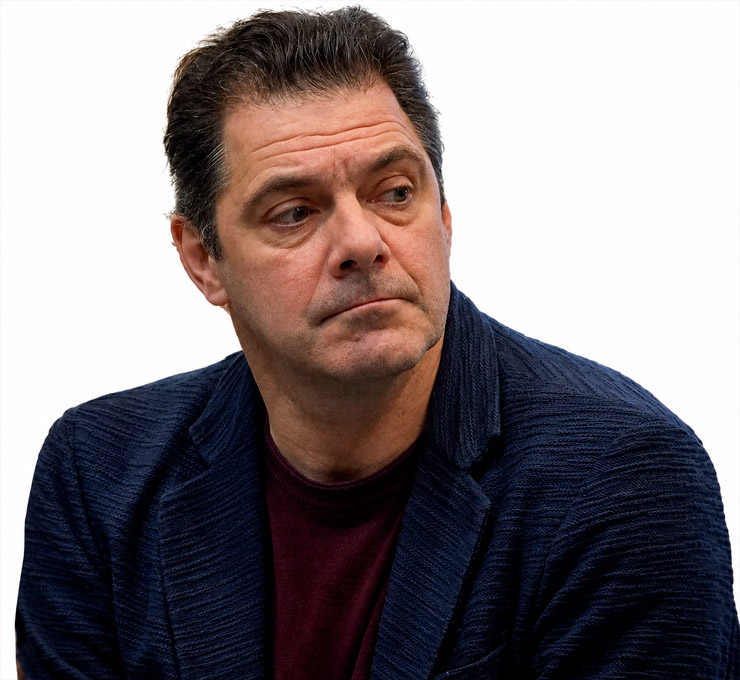 Kirill Rogov: I think this whole fuss is directly related to the elections in the US. It's purely a political technology story where Trump needs a scandal. He doesn't just need some diesel deal with Putin or a refusal to Zelensky in something, he needs the thesis that diesel prices in the United States are rising because Zelensky and Ukraine are hitting Russian refineries. This is a false, deceitful thesis designed to divert attention from the fact that high prices are the result of Trump's unsuccessful war in Iran. Such a diversion doesn't really work because people aren't that stupid, they know where the roots are. But Trump's political technologies are more subtle, even though they look very crude, they are more subtle in design. And Trump's idea and his political technologists are that when he makes a deal with Putin and puts
Zelensky in a ridiculous position, in a difficult position, then liberals, American and European, will attack him, not Trump. And that's what he needs because MAGA voters, right-wing voters in America, hate these very liberals in Europe and the United States the most. And when they come out with criticism of Trump on all screens, it mobilizes the Trumpists. This is now a key problem for Republicans and a key problem for Trump. They will undoubtedly lose the lower house. The question is, with what score will the advantage be, but in general, the difference is small.
And the important question is the Senate, where Democrats need four seats to get a majority. As of today, they are definitely getting two, and the other two are in question. A recent poll showed that among Republicans who are disappointed with Trump, mobilization is very low: if about 64% of Democrats plan to go to the polls, then among Republicans, it's about 46%. Accordingly, Trump needs to increase Republican turnout. His method is scandal, he becomes a red rag for liberals, and liberals become a red rag for Republicans, who go and vote against liberals for their Republican. That's roughly how I imagine this canvas from a political technology point of view.
This, however, does not mean that all the rubbish that Trump says in the process is harmless and that it will disappear without a trace after the elections. Trump is very organic in his gestures towards Putin. He has a whole cohort there, part of his administration, which advocates for such scenarios, for a deal scenario with Putin, scenarios of deals. This part of the administration is influential, it has certain power. And now the cards are falling in its favor because it is beneficial in the pre-election race. This does not mean that after the elections everything will pass like smoke and return to normal.
No, the political struggle between two approaches to this issue in the Trump administration continues and will continue. In this sense, Zelensky, I think, is absolutely right not to remain silent but to use this situation, which is truly monstrous, because in order to win in two states, Trump puts the residents of Kyiv under attack, limiting "Starlink" and seemingly allowing some interruptions with intelligence data. This is truly monstrous and immoral.
Trump's pre-election combination succeeds to some extent because the outcry around Kyiv, around this monstrous situation, really pushes the Iranian issue aside
Zelensky, on his part, plays the game as if on the field of alternative mobilization of American and European public opinion in support of Ukraine and against deals, agreements in the spirit of Trump. "Why not? Let's buy gas"—these sentiments exist in Europe among European right-wingers. Therefore, there is a real political struggle here. We must see that the pre-election combination that Trump has in mind succeeds to some extent because the outcry around Kyiv, around this monstrous situation, really pushes the Iranian issue aside.
Such outrageous things are happening that everyone drops Iran and starts talking about Zelensky. Trump is counting on this. Political technology does not cancel the broad political struggle between different discourses, in particular, the discourse of deals, some deals, some agreements, and what liberal politicians in Europe and the United States offer.
Evgenia Albats: It is generally accepted that midterm elections, congressional elections, which take place two years after the presidential elections and in which the ruling party usually loses, are primarily about domestic politics, primarily about the economy. And in this sense, various TV channels, regardless of their party affiliation or inclination, show figures that before the war in Iran, gasoline cost three something dollars, and now in California, it costs from 6 to 8 dollars per gallon (a gallon is just under 4 liters), and in the state of New York, almost 5 dollars.
These are, of course, completely wild numbers, considering that the US economy largely relies on automobile transportation. This is a hidden form of support for the oil industry. Therefore, it seemed to me that, as you rightly say, the topic of Iran has now disappeared from the screens altogether. But they don't talk much about Ukraine either. That is, when these statements were made, everyone was a little stunned. And, by the way, Trump's supporters in Congress were quite harsh about Trump's statement regarding Zelensky and the restrictions on the transfer of intelligence information, the use of the military component of "Starlink," which is necessary for drones to work.
And Ian Bremmer, the founder and president of the very famous political technology group Eurasia Group, rather a supporter of Zelensky, when he very sharply responded to Trump, said that Zelensky made a mistake, he should have let it pass. In the United States, it is believed that you should not pay attention to what Trump says. The most important thing is to get from him what you need. And now we have returned to the situation that was in the Oval Office when Trump and Vance attacked Zelensky about how he was dressed and that he had "no cards" on his hands.
Kirill Rogov: I saw this statement by Ian Bremmer, whom I respect very much, he is a smart and informed person. But Zelensky is also a smart and informed person. Zelensky has been stewing in this broth for 5 years. And he has won more than one battle on the international stage. Zelensky also won the situation in the Oval Office. Inside Ukraine, Zelensky's rating then soared one and a half times. And Europe reacted in exactly the same way. It wasn't about the suit. They were going to give him this bath in any case. And the question was only how he would take this bath.
He took it excellently. He took it as a person as if from the street, not knowing how to play these games, holding on to his very firmly. Sympathy was on his side. In this sense, I would not dare to condescendingly discuss what Zelensky is doing. He clearly knows what he is doing. He knows the layouts and what is what better than us. I don't want to say that Zelensky is doing everything right. I don't know. I'm just against saying: "Well, how does Zelensky not understand that it should have been like this and that?" Zelensky understands more than we do because he deals with this all the time.
And therefore I think he has some calculations, he is fighting for public opinion within the United States, which is why Trump eventually stopped attacking him and softened because he realized that he was not winning elsewhere either, and it was better this way. In this sense, it is better for Zelensky to have leverage to restore relations with Trump. One of the levers is public opinion within the US, including opinions about this situation and the situation in Ukraine among Republicans. And he periodically works in this field.
He goes on Fox News, gives interviews, constantly tries to talk to Republicans to split them in their attitude towards Ukraine because traditional Republicans do not share Trumpism and much in Trump. They endured it, but now the moment is coming when it may not make sense to endure it. They used to endure because Trump could bring voters to the polls. The situation was such that if Trump's voters came to vote for a Republican, he could win against a Democrat, and if they didn't come, he would lose.
Therefore, all Republicans found themselves very dependent on Trump at a certain moment. They all walked on a tightrope because in each specific case there are 5-7% of Republican voters who will do as Trump says. Trump was needed to bring these 5-7% (I'm speaking off the cuff), and whether they come or not, you win or lose. Everyone turns out to be dependent on him. Now the situation will change. Trump will be a lame duck.
If he doesn't have both houses at once, if they are both Democratic, he will be constantly overwhelmed with all sorts of investigations from Democrats who will constantly be airing his dirty laundry in these investigations. His rating is such that it is already unknown whether you need his support if you are a Republican. And in this sense, it may be more beneficial for Zelensky now to influence this part of the Republican electorate to tie Trump's hands and not let him move further along the path laid out for him by Kirill Dmitriev and Vitkoff.
Putin's Games
Evgenia Albats: Do you think there is some rational component behind all this? American and world media wrote that Kushner and Vitkoff brought completely different proposals for peace terms to the last meeting in the Kremlin, which are significantly tougher on Ukraine. As I understand it, Zelensky is being twisted to agree to leave the occupied territories and, in addition, to completely leave Donbas. Don't you think there might be something else behind this, that Putin could have offered Trump something?
For example, The Wall Street Journal came out with a headline that Putin is toying with the idea of holding a summit between Trump, Xi, and Putin, these three, to discuss the situation in Ukraine. But at the same time, Zelensky will not be included in the negotiations. Maybe Putin is offering Trump some rapprochement of positions with Xi because Xi's visit to Washington, as American media wrote, turned out to be generally unsuccessful for the American side?
Kirill Rogov: No. What can Putin offer Trump on the Chinese issue? Nothing. Putin is a vassal of China, and he cannot offer anything here. It seems to me this is a very strange story. Maybe they have some deals, maybe they want to talk about something with Iran, but I don't know. I don't have my source in either the Trump administration or the Putin administration, let alone Xi. But there are some realities. On the one hand, Trump can't do much with Ukraine. He can't cut off their intelligence data, it causes too much negative feedback.
Evgenia Albats: He cut it off...
Kirill Rogov: He cut it off for a couple of days, and not the entire flow. And, in general, we haven't seen any decisive actions yet. Besides, he doesn't need it. Trump at this stage is not at all such a fan of Putin as he seemed before. Putin is a threat to him in Iran. Putin annoys him in many places. This is a game with many boards and many logics. Why should Trump do something just for Putin's sake? For the Nobel Prize, as he once wanted—okay, that's a normal price. But just giving gifts to Putin is pointless.
And once again: we don't see any serious cut-off of intelligence data. They come with small symbolic breaks when there are conflicts to show who is the boss in the house. It's hard to imagine such a meeting when Xi Jinping, Putin, and Trump will decide the fate of Ukraine. Well, okay, they met. And what? And Ukraine and Europe do not agree with this.
You can't divide the world if you don't have the tools. And Trump, before dividing Europe with Putin and Xi, should first unblock the Strait of Hormuz
Evgenia Albats: Appeal to Yalta.
Kirill Rogov: In Yalta, there were Roosevelt, Churchill, and Stalin. All of Europe was filled with the troops of these three powers. Then it makes sense, you can divide the world. But you can't divide the world if you don't have the tools. And Trump, before dividing Europe with Putin and Xi, should first unblock the Strait of Hormuz. There's not much room for luxury here. It seems to me that today all this is not very important. What's important is how Ukraine will get through the winter and how it will respond to Putin's air capabilities. This is the urgent question today, and it needs to be addressed urgently, not postponed until the second half of November.
Therefore, Zelensky cannot afford to postpone the mobilization <of public opinion> to the second half of November. He needs to mobilize public opinion in favor of Ukraine today, to get something by winter, to develop the idea of some kind of counteroffensive. Ukraine urgently needs resources to respond to Putin's strikes in winter with such strikes that will be as painful for Moscow, for Russia, as the strikes on Kyiv, at least comparable to them. Then it will be possible to reach a backstage deal with Putin to limit strikes on infrastructure.
This is the strategy that Zelensky has. And I think he is following it together with the Europeans. And they understand that action is needed today to get additional ballistics in November, so that in December it will be possible to hit Russia, leaving Russian cities also without heat. This strategy is working, and the rest is just talk.
Evgenia Albats: But you know that Kyiv Mayor Klitschko suggested that Kyiv residents leave the city, the situation there is so dire. We talked about the situation in Ukraine, about how it quickly changed when the Armed Forces of Ukraine gained air superiority thanks to drones. You did a big study and published it on Re:Russia. It was amazing how everyone suddenly saw: Ukrainians, it turns out, can continue to resist. Even Trump said this, but then it turned out that Russia came up with drones with rocket engines and, as world media write, now has an advantage in the air.
Yes, of course, 550 drones were sent to Moscow, all airports stopped, there was an aviation collapse. Yes, 148 drones were shot down over St. Petersburg, oil depots were burning, and so on. But we see that Putin is not just destroying Ukraine's energy infrastructure, he is destroying the industry. He is hitting factories that he did not hit before, hitting in Dnipro, in Nikopol. How tragic is the situation in Ukraine now?
Kirill Rogov: It is not yet tragic, but it can become tragic. Such is war. It is very changeable. There is a race of technologies. In this sense, it is similar to the First World War.
Evgenia Albats: Before Verdun, during Verdun, or after Verdun?
Kirill Rogov: It is similar to the First World War in the sense that there was also a mad upgrade of ways to destroy people, which developed right during the war. They all increased their capabilities, and no one could stop because it seemed that if we just do this now, everything will be okay. All sides were engaged in this. So it doesn't matter whether it was before Verdun or after, the process itself is important, the development of the war, its logic. Indeed, at some point, the advantage was on Ukraine's side, it introduced some innovations that Russia was not ready for. Now Russia is coming up with an asymmetric response. It is in a different register. And the only way to move forward and survive is to come up with a response that will also be painful and new, and will work. This is how this war is arranged. This is its cruel logic.
Evgenia Albats: Zelensky is asking Trump for Patriots. He says that there is no other way to protect Ukrainians from ballistic missiles. He says that Ukrainians are developing their ballistic missiles, but it is not yet very clear when they will appear.
I read in various American publications that the US itself has a problem with Patriots, they have used them up in the war with Iran and now can't even help the Saudis in the war with the Houthis. So, Ukraine will not get Patriots. Putin will continue to destroy the energy infrastructure. It will not be possible to restore it quickly. And Putin, it seems to me, has moved to the scorched earth method. He understands that he will not be able to occupy all of Ukraine. He wants to destroy it. Therefore, I have a very tragic view of how the situation may develop in the next couple of months.
Kirill Rogov: Well, it won't reach the point in a couple of months. Indeed, the situation is very dramatic and very dangerous. But we have already been in desperate situations with Ukraine more than once. We'll see, we'll see. A little "Patriots" never hurt, but strategically this is not a scenario, no one has enough anti-missiles to withstand in the air, neither Europe, nor the United States, nor Saudi Arabia, nor Ukraine. The only strategy is to find weak spots in Russia's infrastructure, strikes on which will cause it such pain that Putin will agree to a tacit limitation.
After all, there are always tacit limitations on strike targets: they are not delivered to decision-making centers, they are not delivered to very harmful enterprises, the emissions and fires of which may be associated with an environmental disaster, they are not delivered to nuclear energy facilities. It is quite possible to achieve some more restrictions. For several years, they mutually did not touch the routes for delivering grain for export. And such restrictions are quite working. Ukraine needs to find Russia's vulnerable spots and gather enough strength to strike them and then exchange these strikes for limiting Russian strikes.
Therefore, it was completely unacceptable for Zelensky to pander to Trump in this idiotic rhetoric of his. Zelensky is going to exchange any restrictions only for one thing: for restrictions for Putin. And this is the main strategy for this winter, the main survival strategy. You can't play cat and mouse with this, as Trump would like during the elections.
The World on the Move
Evgenia Albats: It seemed that strikes on refineries, which led to a gasoline shortage, would play some role, but now even in the provinces, they are practically lifting limits, in Moscow, gasoline is quite available. Its quality is another question, but it is available, at least the queues are no longer 2 hours, but half an hour, let's say. But I honestly don't quite understand... Well, 25% of Russian oil has decreased, but we see that the world community is starting to stop seeing Putin as an outcast. Siluanov, the Minister of Finance, and now also Deputy Prime Minister, was present at the "G20."
The British Minister of Finance left Siluanov's speech in protest. Nevertheless, this is no longer just Dmitriev, who is engaged in shuttle diplomacy, but quite an official representative of the Russian government, and he is allowed at the "G20." It feels like the world is starting to move away. Everyone is so tired of this endless war that the world is starting to move away and quietly, quietly may start lifting sanctions and releasing Putin.
Kirill Rogov: The world is not so much moving away, the world is starting to slide, and it has long since started. And not because of this war and not because it is tired. This is international relativism, an immoral approach to everything, simultaneously mercantile and reckless, anti-liberal, not believing in the principles and ideals that dominated the Western world in the previous 30-40 years. This is the emerging reality, this is the struggle, this is the reaction that has raised its head. And these are people who say: "Why not? Why can't we trade if it's profitable for us, instead of fighting? Well, okay, whoever has the power was able to capture half of Ukraine. And what can you do about it?"
And in Europe, and in America, this logic is now rising, it is popular. This is the right-wing wave that is coming, it is called ultra-right, but I think that a more interesting word can be invented for it. Because there are traditional right-wingers, the same Giorgia Meloni in Italy, part of the Republicans in the United States, who stand on the right platform, but at the same time they have their own guidelines, where black is, where white is.
And there is this new tribe from Elon Musk to Trump and a mass of politicians in Europe who look at the world this way and propagate such a point of view. There is a struggle between these two positions. And it's not about Putin. The fact that they started forgiving Putin is, in a sense, a general trend.
Evgenia Albats: But this is inevitably connected with the war in Ukraine because at least European countries had to invest significantly more money in the military-industrial complex. In Poland, it's already 6% of GDP. And everywhere they are forced to increase military spending. Where do they get the money? They take it from the social pocket and transfer it to the military-industrial complex pocket. The British constantly talk about the need to arm, to prepare for war with Russia, for this we need to invest significantly more.
Even the current left-wing prime minister spoke about the need to spend significantly more on defense than we did before. In an interview with the co-chair of "Alternative for Germany" Alice Weidel, which she gave to the editor-in-chief of the magazine Economist, she openly says: "Ukraine has already lost this war, it cannot win". I literally spoke yesterday with my friends: Ekaterina Zhuravskaya*, recognized as the best female economist in Europe, says that in France, the leader of the right, Marine Le Pen, has practically already won, despite the fact that now the leader of the left, Mélenchon, is actively promoting protests that have already acquired a very unpresentable character, as always happens when street riots begin.
Nevertheless, Le Pen is also against helping Ukraine. In fact, in Europe, only the UK, Germany, and Italy are firmly ready to support and finance Ukraine. But it is obvious that if France falls away, if Merz, who has a very low rating in Germany, at some point gives power to "Alternative for Germany"—what will happen?
Kirill Rogov: It will be very bad. If we talk about European layouts, you did not mention the group of Scandinavian countries, which are still quite firmly on the pro-Ukrainian positions and largely determine the European climate in this regard. France is politically, of course, very important, although practically it gave very little money for Ukraine's military needs. Undoubtedly, its role was very important in the EU structures, in supporting the EU's pro-Ukrainian position. Of course, everything hangs by a thread. And we are in a very interesting but very alarming moment in history.
Although there is a question here. In particular, if Le Pen comes to power in France, there may be some shift in position. Here are two opposing themes. The first is that we need to spend money on armaments, on defense, the second is that the far right is rushing to power and ready to forgive Putin. These are two parallel and two competing processes. On the one hand, there is the militarization of European consciousness, and it is, by the way, beneficial to centrists because centrists say: "We must strengthen our European unity".
But in a new quality—as a defense against Putin. And therefore, we must invest in defense. And those who say they are loyal to Putin are kind of enemies of Europe, they make it defenseless. This is partly already being taken into account by the far right, they are forced to slightly adjust their position because the idea that all of Europe is now preparing to defend against Putin is also gradually covering European public opinion. This is again a moment of struggle. So even if the right comes to power, say, in France, I'm not sure that Europe will turn off the path of rethinking and reconstructing its defense. And this trend is very strong. It is also not only related to Putin. It is related to the fact that for 25-30-35 years Europe enjoyed the peace dividend and did not invest in defense.
Evgenia Albats: So you don't think we are expecting a new Chamberlain who will say: "I brought you peace". Ukraine will be forced to agree with Russia now. For this, we will pander a little to Putin. Another Molotov-Ribbentrop Pact.
Kirill Rogov: I don't see it that way. Maybe it can happen, probably. But I don't know how to guess about it. It seems to me that the idea of rearming Europe is very strong. It is stronger than the question about Putin. It is really connected with the fact that Europe has not been engaged in this for many decades. And in the meantime, the balance of world forces has changed, and economic power has largely flowed into the so-called global South, medium powers. If before the ratio was such: the West was 70% of the world economy, and the global South was 30%, now it is completely different, and this must be taken into account.
It turns out that all these countries are capable of arming themselves, that they are building up muscles, that in general, war is changing, its technological nature is beginning to change radically, and everyone will be forced to react to this. In this sense, there is no alternative to the new arms race because the world is unbalanced, everyone is engaged in rearmament, and everyone will be forced to participate in it.
The China Factor
Evgenia Albats: Kirill, I had <famous economist> Sergey Guriev* at my seminar at New York University, speaking to a very large audience. I asked him: if you exclude China from the equation, how long could Russia continue this war? He replied that Russia would lose very quickly because without China's help in supplying spare parts and components for military needs, chips, and so on, it would not last long. But the second interesting thing he said was that Xi, in his opinion, is a restraining side in relation to Putin: Putin could decide to use tactical nuclear weapons, but China is categorically against it, and in this sense, it restrains Putin. What do you think about this?
Kirill Rogov: There is such a version, there is such an opinion. How fair it is, I don't know. It seems quite plausible to me, but I would say that this is not limited to this. There are other restraining factors, in particular, certain types of Ukrainian strikes. If they are provided with appropriate missiles, and possibly even without this, they can strike Russian territory in a sense commensurate with weapons of mass destruction. There are very dangerous chemical enterprises; there are nuclear facilities; and, in general, there are such places in the infrastructure that in such a situation in response could be hit.
Evgenia Albats: And you don't think this will untie Putin's hands?
Kirill Rogov: No, on the contrary. But the point is different. We are talking about what restrains Putin from using tactical nuclear weapons. Sergey Guriev said that China restrains him. I don't argue with that, I think that's the case. But there is also the argument that in response, Ukraine can strike some objects in Russia that their effect will be equal to the use of weapons of mass destruction.
The Time of the Weak
Evgenia Albats: If, at Zelensky's request, you were offered to write a medium-term strategy for Ukraine: "Rogov, I read your Re:Russia, you calculate everything". Now you have calculated that the most expensive thing in this war for the Russian budget is payments to contractors and especially the dead. There are 12 million for each. Katya Gordeeva* told me that this is for officers, well, it doesn't matter. You just calculated it. And now he tells you: "Write me my steps, how and what Ukraine needs to do to persuade and prevent a catastrophe in the world public opinion that has swung to the fact that Ukraine is losing the war and is generally on the verge of losing sovereignty." What would you say to Zelensky? I am asking you quite seriously because I think about this all the time, and I just don't understand what they can do.
There is no alternative today to figuring out how to inflict comparable harm on Russia in winter to exchange this and agree on a moratorium on damage of a certain kind
Kirill Rogov: I've actually already talked about this in the context of our conversation today. And it seems to me that Zelensky knows and in this case does not need my advice. There is no alternative today to figuring out how to inflict comparable harm on Russia in winter to exchange this and agree on a moratorium on damage of a certain kind. This is generally a general problem of world military-international relations. Zelensky has nothing else today. How long can Ukrainians endure this? The Kyiv School of Economics is building a new campus underground. Schools underground.
They are great, they are looking to the future. And strategically... we'll see, we'll see. Ukraine should have lost a long time ago, but it is not losing. And it is not losing because a race of new weapons, new technologies, I would say, new military technologies has begun. And in this race, Ukraine found itself ahead. When you start something completely new, you can suddenly get the opportunity to become a leader in it and be on the same level with superpowers because everyone is at the starting point. And this, by the way, is why Putin can attack Europe in the near future.
We explained in one of our texts that now Europe also has no protection from anything. Now is the time of the weak. The weak can win wars, at least not lose wars badly. Ukraine can not lose to Russia. Iran can not lose to the United States. Russia can today threaten Europe and not lose to it. This is possible today, when a technological race has begun, a race of military technologies. In a few years, those powers that have greater economic potential will already have such developments on a new technological military platform that the weak will not be able to fight them.
But now is just a turning point. And first of all, Ukraine is not losing and has not lost the war for 4 years, which in itself is some incredible event, unthinkable. No one could believe it. Alice Weidel says that Ukraine has already lost this war, and helping it is just spending money. And 2 months after the start of the war, it was, and 2 years after the start, and today they say that it has already lost. We'll see, we'll see. But the mechanism is cruel because in this new technological platform, new technologies of war, countries are constantly gaining experience, moving forward, and acquiring more and more terrible weapons of mutual destruction. Now it is a weapon of mutual economic destruction.
Now nothing is practically happening on the ground. They run somewhere, shoot at each other, 6 kilometers there, 5 kilometers here, they captured Ivanteevka, well, some kind of laughter. But in the air, mutual destruction of economic infrastructure is happening. And now they have started competing in this. It should reach the point when wars end when wars stop: you understand that you will take another step and achieve this, and he will take a step and achieve that, and it will be endless, and you all lose and lose. The illusion of an easy victory disappears.
Now Putin has again come up with a story of an easy victory. Every year he comes up with a story of an easy victory. Last year he was supposed to win because Trump will stop giving money to Ukraine. Ukraine will not have resources, will not have American military aid. Europe will not be able to help it. Zelensky will not have soldiers on the front line, and that's it, and Putin won, he is in the check.
It didn't work out. Now he has come up with the idea that he will destroy the infrastructure, and the whole country will freeze, and everyone will surrender to him. Zelensky, Europe, the reasonable part of America have a choice: this must not be allowed. This is the point we are at.
Video Version
* Evgenia Albats, Kirill Rogov, Sergey Guriev, Ekaterina Zhuravskaya, Kateryna Gordeeva are declared "foreign agents" in the Russian Federation. Guriev and Zhuravskaya are included in the list of "terrorists and extremists."
Photo: lrt.lt / K. Rogov's social networks.