Sergei Guriev. Photo: Bryan Bedder / Unfinished Live / Getty Images
Evgenia Albats: Sergei, thousands of people are asking the same question: why doesn't Putin stop, why does he continue the war in Ukraine and can the visible deterioration of the situation in the Russian economy stop him?
Sergei Guriev: Why does Putin continue the war in Ukraine? Because he thinks time is on his side. Whether he is right or not, his idea is that the later he negotiates, the stronger his negotiating position will be. He believes that continuing the war is in his interest.
Will the Russian economy collapse? The answer is no, it will not collapse. The Russian economy is market-based, its macroeconomic position is not catastrophic. The budget deficit, despite all the problems, would be the envy of the US government or many European governments. There are many problems in the Russian economy, but it will not lead to a collapse like in 1991. However, there is a real slowdown in the economy. Continuing this war is becoming increasingly difficult. One important observable indicator of Putin's success is progress on the battlefield. The fact that Putin is achieving some progress on the battlefield convinces him that time is on his side. And if economic pressure can slow this progress or freeze it for a significant period of time, it could indeed change his calculation and force him to negotiate.
There is a consensus among economists that the West could have gone further in terms of imposing sanctions and especially enforcing them. As well as providing more military support to Ukraine. This would indeed change Putin's calculation, restrain his actions, and lead at least to freezing the conflict.
Economy in War
At first glance, the Russian economy is not doing too badly. There has been no collapse. Measured GDP has not actually collapsed. In 2022, growth was negative, but it was minus 1%. In 2023 and 2024, growth was about 4% per year, which again would be an outstanding growth rate for many developed economies and even emerging markets. Since then, the economy has slowed down, but it is not falling apart.
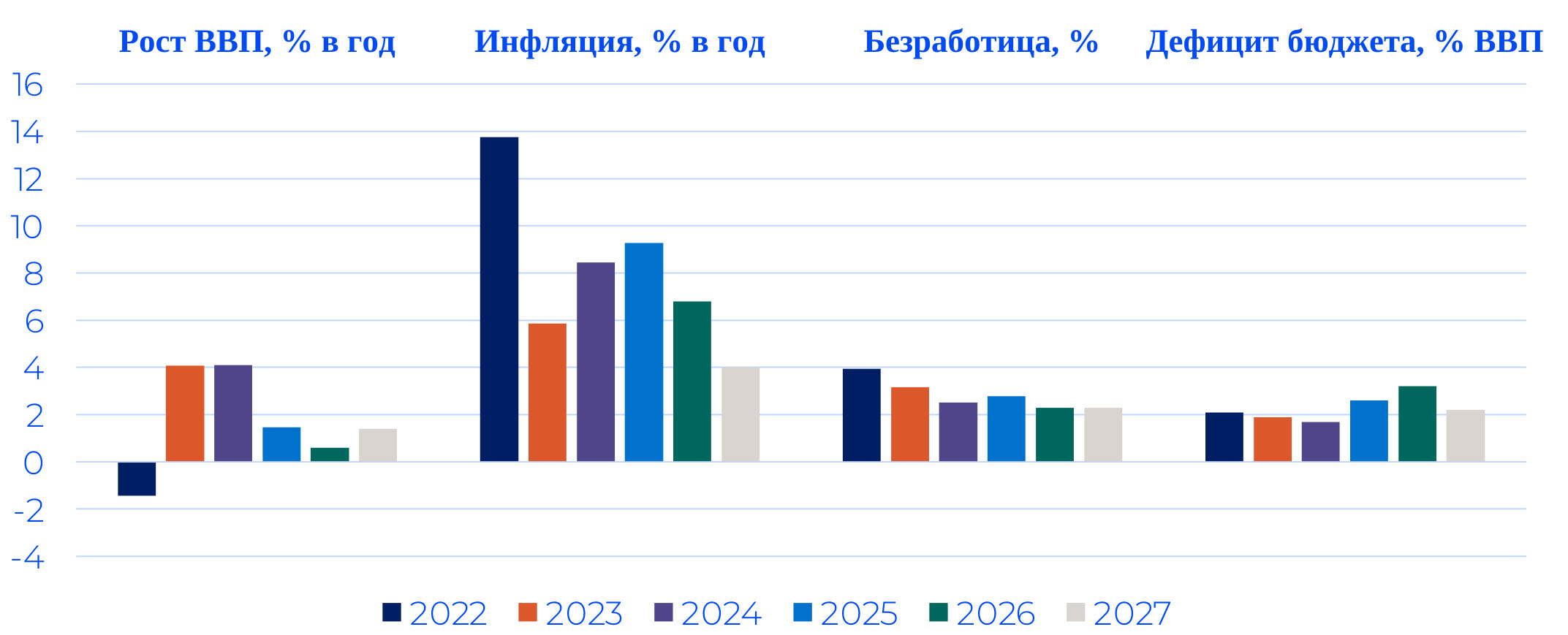
The standard of living is definitely declining, and it is significantly lower than before the war, but measured GDP, which includes the production of ammunition, recruitment of soldiers (who die in Ukraine, and their families receive money for this), production of missiles and missile shells—all this contributes to measured GDP. And it creates the impression that the economy is growing, even though the standard of living is not. Inflation is also not catastrophic. Although there is reason to believe that inflation is understated.
And this is not a mistake, it is a feature of an economy that is at war. Essentially, when the Russian government pays cash to weapons and ammunition manufacturers, then this weaponry and ammunition disappear on Ukrainian fields, from a monetary policy perspective, it is simply equivalent to handing out cash to citizens who produce nothing. Because for the domestic civilian economy, the production of ammunition and weapons does not contribute to the aggregate supply. But overall, there is reason to believe that inflation is actually higher. And part of the evidence for this is that the Russian Central Bank keeps interest rates much higher than nominal inflation. Unemployment is lower, and sometimes Vladimir Putin proudly announces this. Unemployment is 2.3%, again, the envy of many governments around the world, but in fact, it is not good. It shows that Russia is facing a serious labor shortage, which is not surprising given how many people have left Russia, how many people have died in the Ukrainian war, how many people can no longer work, and therefore there is a serious labor shortage in the military sector. The Russian army is also trying to recruit soldiers to send them to Ukraine, and of course, the civilian sector is experiencing a labor shortage.
Russia has depleted its accumulated military stockpile. Before the war, the National Welfare Fund was over 6%, now it is below 2% of GDP, and Putin says we can no longer spend it to avoid going to zero
The budget deficit at this stage is under control, it is 2–3% of GDP, not that high. However, there is a difference. If a country has a budget deficit of 6% of GDP, people start asking questions, but you can still sell government bonds to the whole world. In the Russian case, there is no external market for government debt. Russia is cut off from the global financial system, so financing the deficit is more difficult.
Essentially, Russia has depleted its accumulated military stockpile. In 2023–2024, the state aggressively spent funds on financing the war, on the military machine, and measured GDP grew by 4%. Essentially, Russia was increasing war financing using the National Welfare Fund, reserves, and the economy was growing. Now it has reached its limit. There is no further growth, the economy is stagnating. Before the war, the National Welfare Fund was over 6%, now it is below 2% of GDP, and Putin says we can no longer spend it to avoid going to zero. And that is why the budget deficit creates a problem for Putin.
How expensive is this war? Russia is a large country, and financing this war is not actually insanely expensive. For Ukraine, military spending is tens of percent of GDP. In Russia, we are probably talking about 4–5% of GDP, about additional incremental war expenses. So when they say the Russian economy is militarized, it's not quite true. It is not even as militarized as the Soviet economy, where the defense sector was 15–20% of GDP. But it's important to note that the phenomenon of 2025–2026, when the Russian economy ran out of steam, imposed limits on how much Putin can spend on the war.
They said: Putin has no limits on how much he can pay soldiers, how much he can pay weapons and ammunition manufacturers. But in fact, there are limits, and quite strict ones. We saw this in the 2026 budget: he had to reduce the share of GDP he spends on the war. And this was a very useful reminder that economic pressure can reduce resources for financing the war.
But there are also demographic problems. There are sanctions that impose technological constraints. And, of course, there is political pressure: dissatisfied elites and dissatisfied people. The Russian demographic pyramid on the chart looks strange. Usually, this pyramid looks like a Christmas tree. Now we see a demographic gap in the age from which soldiers are usually recruited.
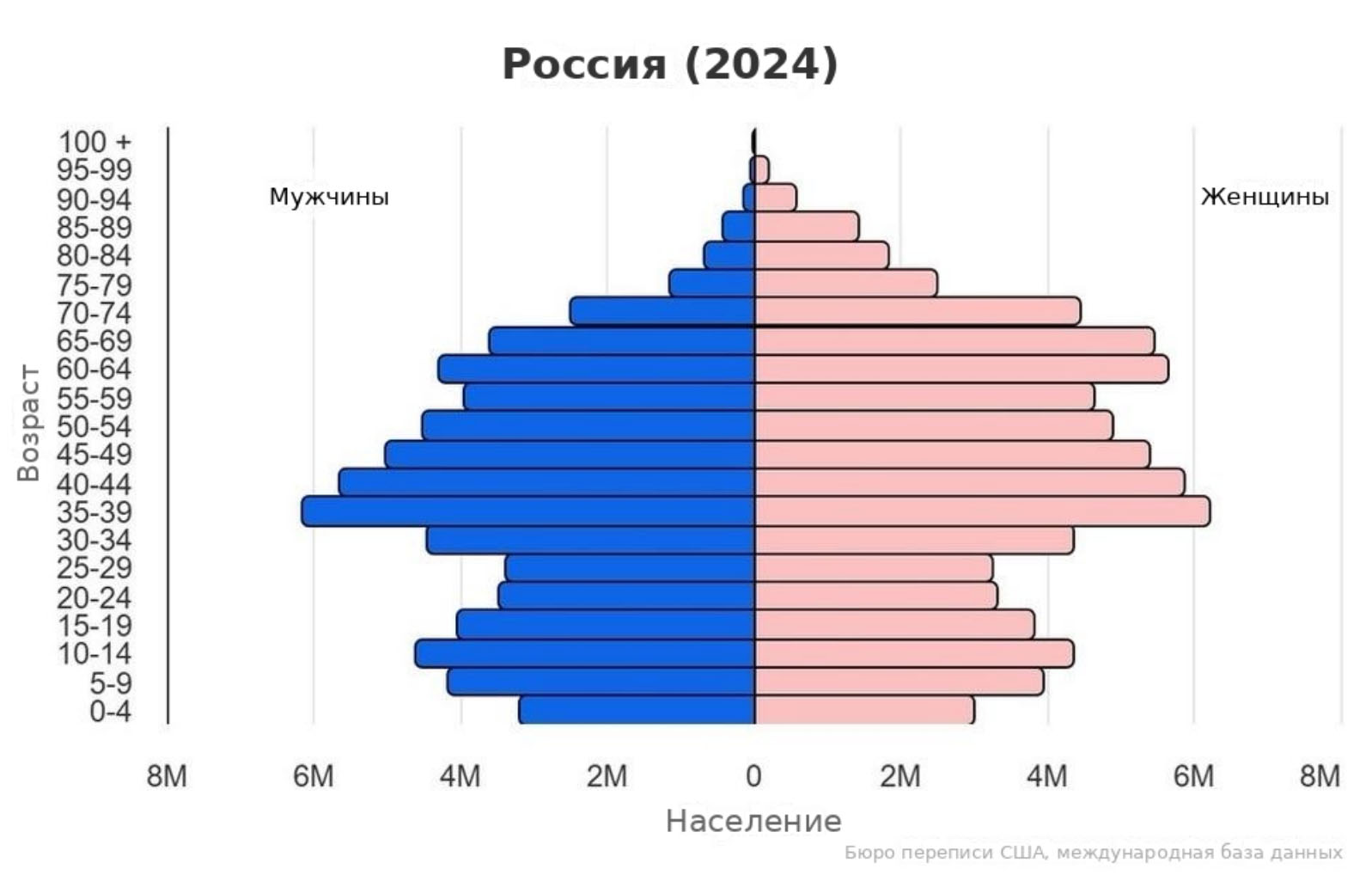
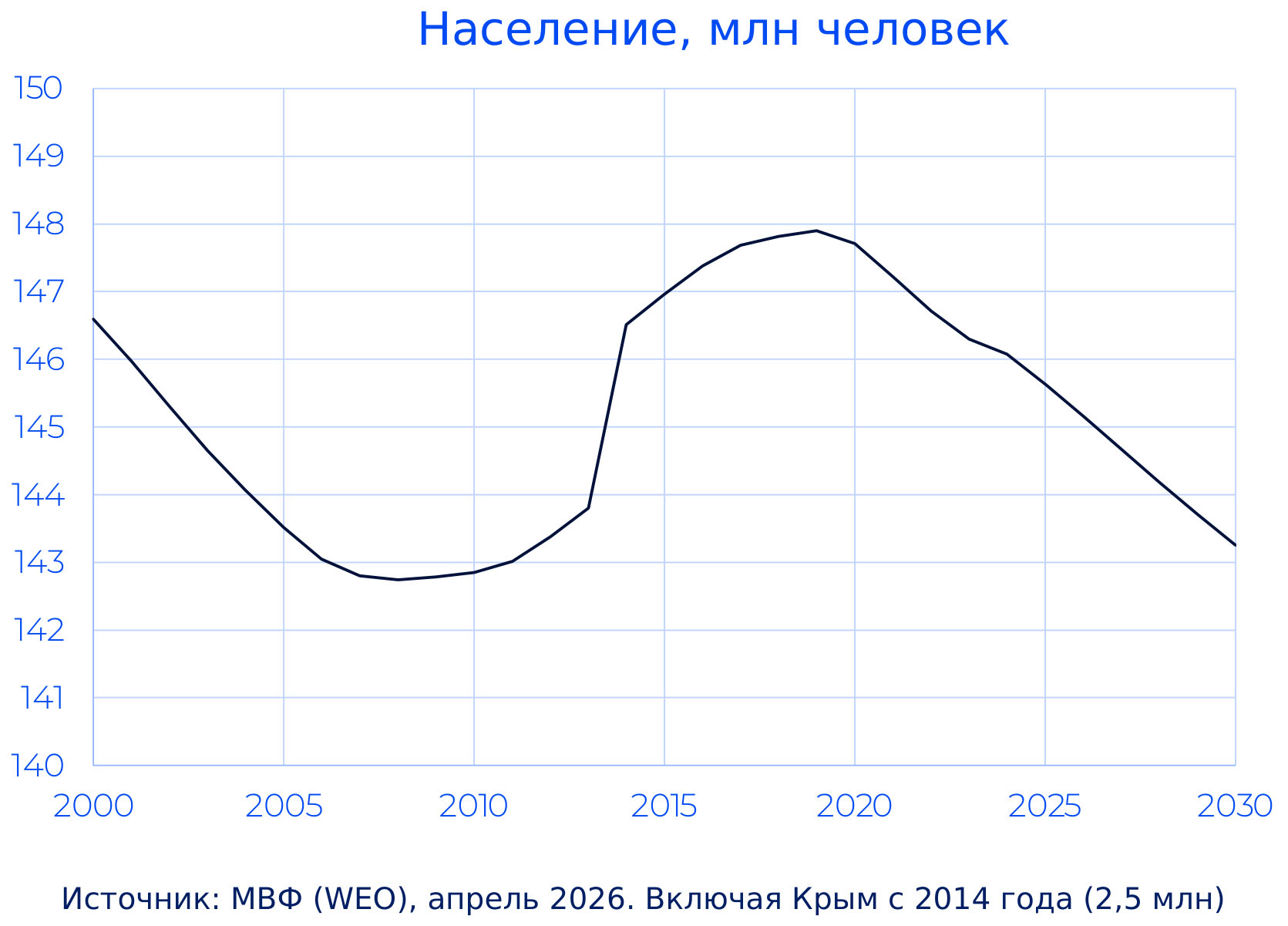
These are young men in their early twenties. In Russia, this generation is small. This goes back to the 1990s when people were reluctant to have children, and actually goes back even further to the 1940s, so the gap has been growing all the time. For Putin, this demographic situation is not very good in itself, but in recent years there has also been an overall population decline. The population of Russia was declining until the second half of the 2000s. And then Putin actually reversed this trend by spending much more on supporting birth rates. There is a jump in 2014: the IMF actually added 2.5 million people to Russia due to the annexation of Crimea. So the real chart was 2.5 million lower. But what is important on this chart, we see that the population has been catastrophically declining in recent years and, according to IMF forecasts, will continue to decline in the next few years.
There are no demographic pockets where Putin could cheaply replenish his army. One of the circumstances is that no one in Russia is happy about this war. We don't really trust polls now, but still, some of them do a more thorough job of identifying trends in what ordinary Russians think. Russian Field, an independent polling agency, tries to create a representative sample, surveys Russians, and I think the levels here are not as informative as the dynamics.
Most Russians now say they want to start peace negotiations. The latest poll in this series is February 2026. You can see what has changed over the years. Only 38% say: we need to continue the war. And there are many people who just don't pick up the phone, who are against the war, but they are not on this chart. So the chart underestimates the level of resistance to the war.
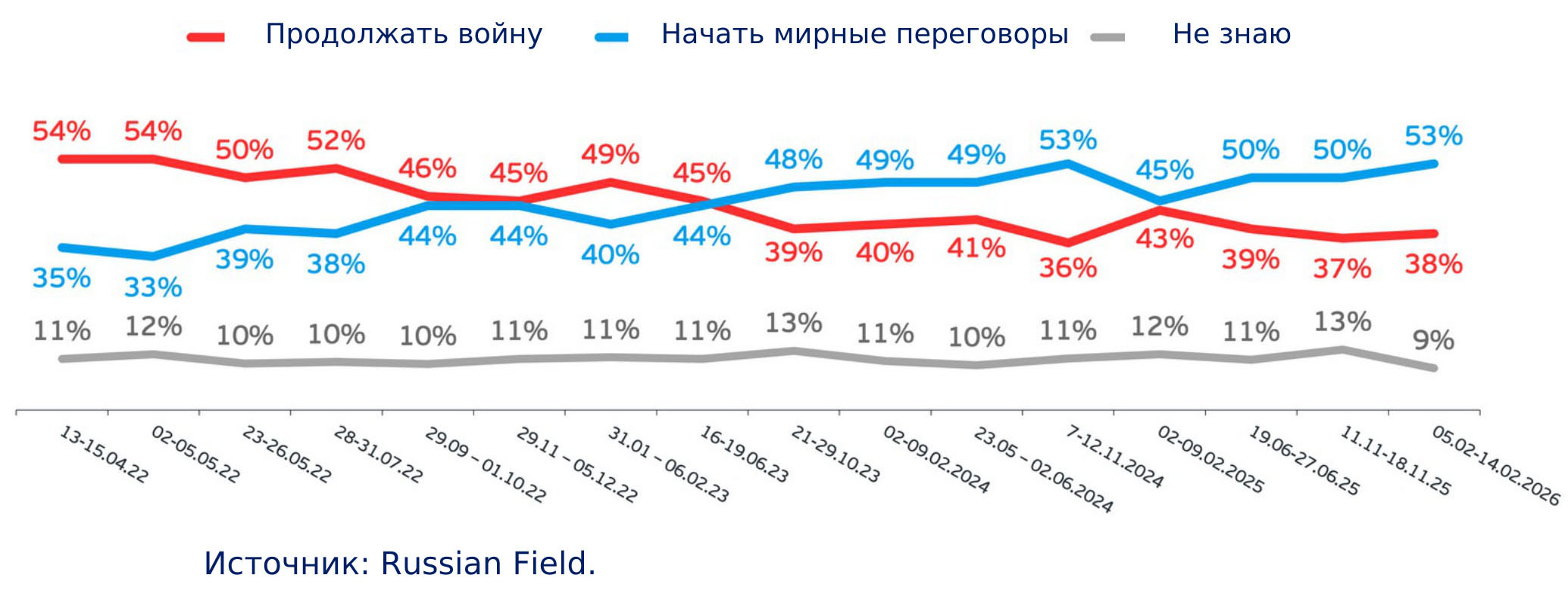
From the side of the elites, something has also changed in 2026. High-ranking officials of the Putin regime and business people around Putin have begun to publicly talk about the need to end the war. This is a very new phenomenon, these people understand perfectly well that Vladimir Putin does not like it when too much is said. Nevertheless, people say that the war is expensive, undermines economic growth and investment, and they kind of say: we have no real idea of how the war should end, but for our business, for managing the city, for managing the bank, for managing a large business conglomerate, it would be good if the hostilities ended.
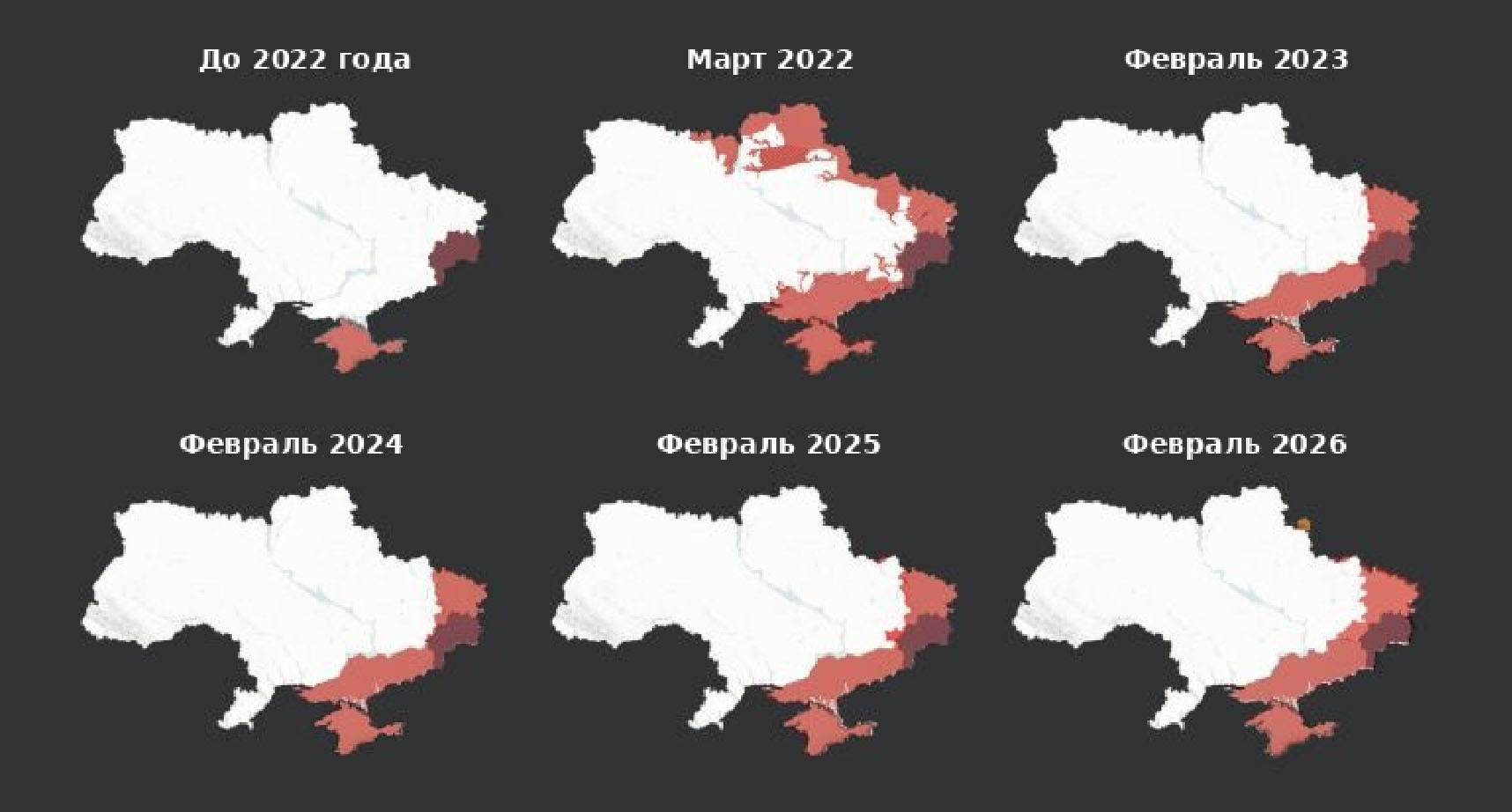
So actually, there was a big change in 2025–2026. As I said, Putin has one indicator that is the main indicator for him of whether he is doing well, namely progress on the battlefield. His idea is that if the army continues to advance, maybe at some point the Ukrainian front line will collapse; maybe if people in Kyiv are bombed all the time, the Ukrainian government can be overthrown, and that will be a victory. But we see that progress on the battlefield, however slow it was in 2023 and 2024, completely stopped in 2026. In the last couple of years, you need a microscope to see any difference between the invasion maps. This is a very important point because if the front line does not change and Putin has no military strategy that convinces himself that there is a chance to move the front line and break the will of Ukrainians to resist, then internal pressure will force him to negotiate.
Saving Oil
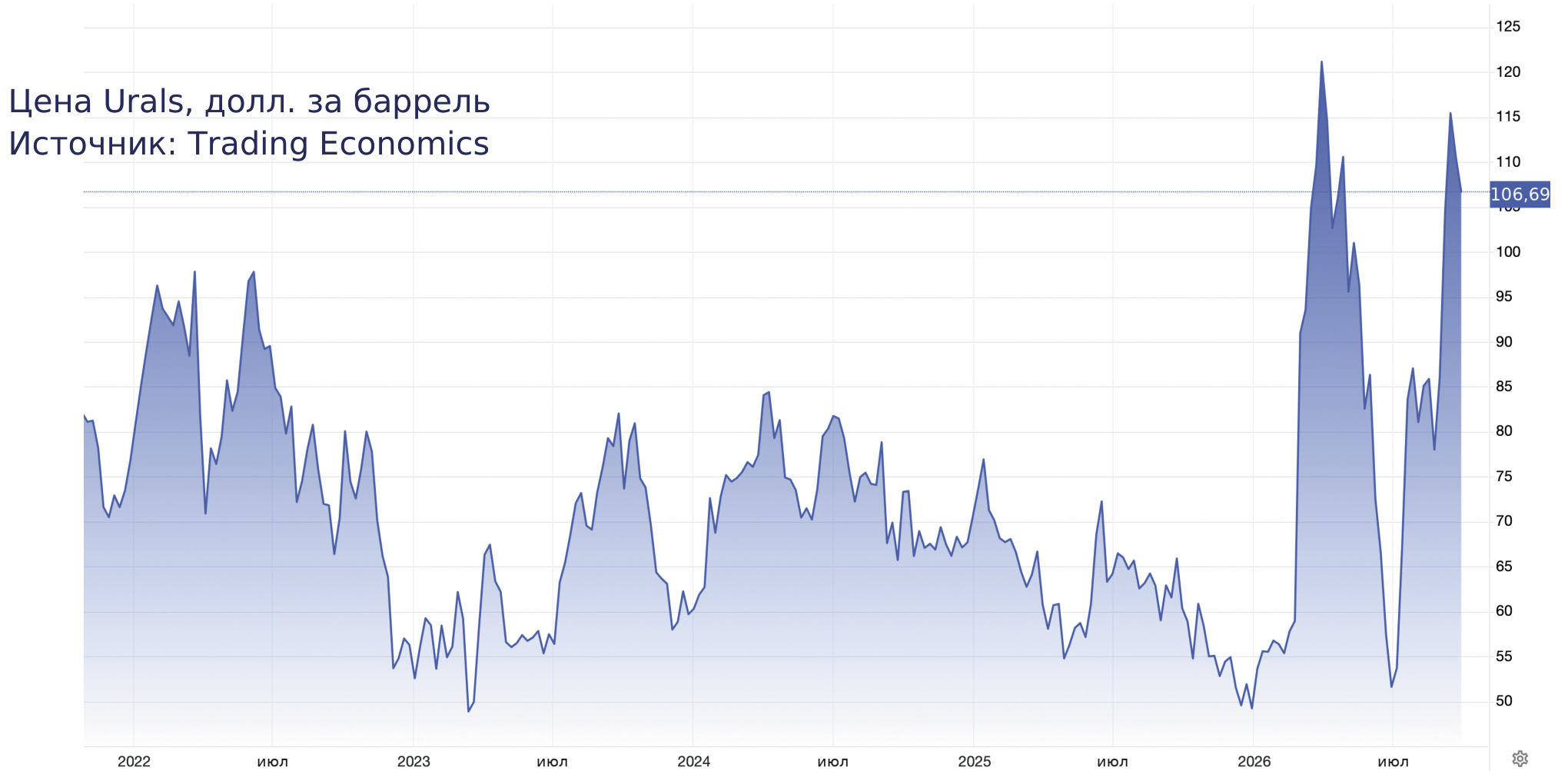
But 2026 was different in many dimensions. The war in the Middle East doubled the price of Russian oil. In some years of the war, there was a huge discount between the price of Russian oil and the market price of Brent or WTI. In 2026, in some months, this discount disappeared because the world needed oil, and even Russian oil was in demand. At the beginning of 2026, it was $50 per barrel. Today it is $106 (as of October 1, 2026 — NT). Some peaks were up to $120. Doubling the price of Russian oil gives about 3% of GDP in the form of windfall cash profits. This was a gift that Putin received this year.
Putin also counts on cracks in the coalition imposing sanctions. We see the rise of various political parties that he likes in Western countries. The coalition is still functioning, the coalition is still united, but who knows what will happen next year, in a year, in two years. And perhaps even if these parties are not in power, they will push the parties in power to be more flexible towards Putin and ease sanctions. This is also part of his calculation. Another part is air defense in Ukraine, whose stock is running out. We hear how desperately President Zelensky is asking for Patriot ammunition, and he cannot get it because much has been used in the war in the Middle East. The world is actually running out of Patriot missiles. This is quite scary because people who travel to Kyiv say the situation is much worse now than at any point in this war. Eric Schmidt, former CEO of Google, who spends a lot of time in Ukraine trying to help Ukrainians, returned 3 or 4 weeks ago and wrote an article expressing his concern.
There is a change in Russia's military capabilities. Today everyone is talking about jet drones that are just too fast for Ukrainian air defense technologies. And this is a serious challenge. People are talking about the upcoming very difficult winter, which will be much harder than the previous one. Putin assumes that Ukrainians will break. He openly says: I will double my efforts. He wants to get a stronger negotiating position when talking with President Trump or other potential negotiators.
There are hybrid attacks on Europe. Incidents in the UK, in Germany, in Poland. In the Baltic countries, in Sweden, in Germany, they are thinking about building hospitals for the upcoming war with Russia. The feeling of an approaching war is becoming more real
One of the changes in recent weeks is the appearance of the 2027 budget, which Putin kind of says: I am not afraid to cut non-military spending by percentage points of GDP because I want to increase military spending to unprecedented levels. Whether this will happen or not is a question because political and economic pressure inside Russia may force him to revise the budget. But at least this is what is laid out in the documents. If this budget is approved, it is a signal that Putin is going to continue the war. He doesn't care about healthcare and education inside Russia. He cares about breaking Ukraine this year. And finally, there are hybrid attacks on Europe. Incidents in the UK, in Germany, in Poland. In the Baltic countries, in Sweden, in Germany, they are thinking about building hospitals for the upcoming war with Russia. The feeling of an approaching war is becoming more real. I don't think Putin has the resources for a ground war with NATO. But he is sending a signal that hybrid attacks will continue. He needs European countries not to send air defense, ammunition to Ukraine.
The Main Weapon of the West
What needs to be done to stop Putin and send a signal to whoever comes after him with ambitions to violate international borders? One of the things that must be done at all costs is to enforce sanctions. Sanctions undermine Putin's economic power and impose real constraints on his ability to wage war. Of course, Ukraine should receive any weapons that the West has because Ukraine is on the front line in this struggle between Putin and the West. Deterrence capabilities in Europe are very important. Putin must know that he should not even try to start a war with NATO.
We see that Putin still has human capital, technological capabilities are developing at a very high speed both in Ukraine and in Russia, but in the last few months, Russia has gained an advantage. Ukrainians say they can develop ballistic missiles by the end of 2026, and then they themselves will gain an advantage. But at this stage, Putin's human capital is not yet exhausted, and therefore it is worth encouraging people fleeing from Putin.
We must understand that this is not the last war. And the whole idea of deterrence is that imposing costs on violators should signal ambitious rulers that breaking international rules is expensive. If Putin wins this war, it will have dramatic and catastrophic consequences for some other parts of the world where non-democratic regimes want to break the rules of the game. And in this sense, it is not just a war for a few cities in the Donetsk region. It is also a matter of global peace.
Zelensky's Cards
Evgenia Albats: Ukraine has destroyed an estimated 25% of Russia's oil refining capacity. And long lines have formed at gas stations across Russia. People in Moscow recall the fuel shortage that existed in the late 1980s, right before the collapse of the Soviet Union. In response, Russia is using ballistic missiles to destroy Ukraine's industrial base. There are two points of view: the first believes that Putin can destroy the Ukrainian economy faster than the Russian economy deteriorates, the second is that Ukraine must continue to show the West that it can resist. That Zelensky has cards in his hands. Otherwise, Western support will cease, and with it, Ukraine's sovereignty. What is your opinion?
Sergei Guriev: I think both statements are true. Indeed, the situation is quite bleak. Ukraine has big problems with missile defense. Western media were very optimistic in the first half of 2026. Zelensky really had cards in his hands, in mid-June Ukraine struck a refinery in Moscow. This was a big success for Zelensky, and indeed, it led to a gasoline shortage across Russia. But then the situation turned around due to jet drones and ballistic missiles falling on Ukrainian cities. From a humanitarian point of view, this is a tragedy, and this is what is now being talked about in the West. But Putin is also targeting the industrial base. Ukrainians produce drones, and Putin strikes at drone production facilities. This is less reported because it is unclear where these facilities are located, whereas photos from Kyiv are easily available. But it is quite likely that Putin is going to destroy energy infrastructure, transport infrastructure, and production facilities. A few weeks ago, he hit a train near the Polish border, showing that he is ready to destroy railways, which are fundamental to the functioning of Ukraine's economy.
So the first point of view is confirmed. As for the second—yes, Ukraine needs to resist for the West to continue supporting it. It is argued that Ukraine will create its own ballistic missiles and will be able to hit missile installations, launch sites inside Russia, and therefore limit Putin's ability to launch ballistic missiles. But so far, this is just an expectation, it has not yet materialized. But indeed, Ukrainians, if they want to resist, will have to perform these miracles, and quite soon.
Evgenia Albats: You mentioned that there may be pressure on power within Russia. Did you mean that Ukrainian drones have brought the war to Russian territory, and Russians can no longer consider it a distant special military operation? Will there be political consequences from this? Can ordinary Russians really influence Putin, given that there are repressions across the country? Just a few days ago, one of the best Russian electoral politics specialists, Alexander Kynev*, was arrested and accused by the FSB of state treason. People are very afraid. What kind of internal pressure do you expect?
Sergei Guriev: You are right. There is fear. There are massive repressions. People are afraid quite rightly. On the other hand, they are less and less inclined to be enthusiastic about this war, which means that Putin needs to pay more money to recruit soldiers, and many will try to leave, many will try to resist mobilization and the production of weapons and ammunition. Many people just don't want to be part of this. And now they are starting to talk about Russia after Putin. Not openly, but let's remember the story with Andrey Melnichenko, one of the richest Russians, who told The Economist that Russia after Putin is possible. That is, people now understand that they should at least avoid committing war crimes now because they want to survive this regime and be able to say: we were not part of it.
And this creates problems for Putin in waging war and makes it more expensive to continue military production and military operations. Essentially, this is passive resistance. Active resistance is very costly, repressions are a real thing. But I think there is no enthusiasm. And Putin, of course, looks at polls. I interpret the importance of these polls and internal conversations in Putin's ministries as follows: when the scenario in which Putin actually breaks Ukraine or advances on the battlefield is off the table, the front line stagnates long enough, and Putin sees that even after this difficult winter, Ukrainians do not capitulate, then many more people will start saying—look, we have not made progress in the last two years, despite all the advances in military capabilities. Maybe we should start negotiating and freeze this war.
Evgenia Albats: A few weeks ago, there were so-called elections to the State Duma, or rather, electoral events. They were marked by massive fraud. In some districts, the United Russia party was credited with at least 20% more votes than it received, and some candidates reportedly received 99% of the votes, which, as we know, is simply impossible. What was the purpose of this farce?
Sergei Guriev: Well, Putin is a very conservative person. Maybe we all become more conservative with age, but he has been in power for 26, and overall even 27 years. Why fix what isn't broken? I've always had elections, he thinks, they've always worked for me. Yes, probably needed to throw in more ballots this time. But why change anything, right? Putin's regime has always been a dictatorship of manipulation, he has a large apparatus of bureaucrats who conducted these elections, who are involved in manipulating information, propaganda, censorship. Now the regime is based on fear and repression. This changed a few years ago. But the bureaucrats tried to tell Putin: elections still matter. We still need the media. We shouldn't go back to Stalin's times, they think, because they want to remain useful. And this is normal bureaucratic inertia, where Putin could close all these departments and just use repression. But these people are still trying to play these games. And he says: okay, if you insist, why don't we hold these elections? It doesn't cost much, but you can tell your Western or Eastern partners that I am a democratically elected leader.
Dictatorship and Sociology
Evgenia Albats: In regimes like Russia, sociology doesn't really exist. I left Russia at the end of August 2022, but when I was in Moscow, some sociologists called my mobile phone (and all mobile phones are tied to a SIM card known to the FSB) and asked me who I would vote for if elections were tomorrow. I always answered—for Navalny**. But now, I think people behave smarter and for pragmatic reasons will not say what they think. So what polls are you talking about?
Sergei Guriev: There are people like you who still remain in Russia and say what they think. For whatever reason. So one of the things we did in our book Spin Dictators and in other studies with Daniel Treisman, is how to determine Putin's support without forcing every individual to tell you exactly what they think and believe. The way you do this is called a list experiment. Imagine that in a room you give the left side a list of four politicians and ask: "How many of these four do you support?" And there is no Putin on this list. And then I give the other half a list of five politicians, these four plus Putin. I don't ask who you support, I just ask: out of this list of five people, how many do you support? So, I don't know who of you supports or hates Putin, but by comparing the result on the left and the result on the right, I can measure the average level of support for Putin among the population. We conducted these experiments before 2022, and many political scientists in Russia conducted such studies. Then, before 2022, polls and these list experiments showed similar results. There was a difference of about ten percentage points. But mostly, when Pulse gave you 70% <support>, list experiments gave 60%, something like that. After 2022, some list experiments were also conducted. And they gave a result of about 45% support for Putin when polls gave 80%. So the gap has increased significantly. But still, some people say they are for peace negotiations.
Evgenia Albats: Yes, but for peace negotiations, they say, "on our terms." That is, we keep the territories we occupy in Ukraine, and in this case, people will accept peace negotiations.
Sergei Guriev: Well, Putin doesn't want peace negotiations at all, so by saying this, a person is already kind of contradicting Putin. But another thing I would advise sociologists working in Russia today is—don't ask about the war. Don't ask about Putin, ask about budget constraints. The question would be something like this. You know we have a budget deficit, so budget resources are limited. Would you prefer these limited budget resources to be directed to education and healthcare or to the military and police? And unsurprisingly, over the last three to four years, most Russians say: to education and healthcare. About a third say the military and police are more important. And here you are not actually declaring anything, you are just clearly stating your economic preferences. But we can conclude from this poll that the population, the Russian public does not support the war. So I say the most important thing is the trend. Levels may be significantly distorted. Even, as I said, maybe by 40 percentage points, who knows? But the trend in recent years is very clear.
Evgenia Albats: You were a kind of intellectual supporter of broad sanctions, both individual and sectoral. And yet last week, at the request of France, Luxembourg, and Belgium, the European Union lifted sanctions on Alisher Usmanov, one of the main financial sponsors of the Kremlin, and banker Mikhail Fridman. Neither of them publicly condemned the war or Putin's actions. Is this corruption, stupidity, or pragmatism that I don't understand?
Sergei Guriev: Yes, I was involved in developing sanctions in the US, France, the UK, the European Union. And we had debates when we had Fridman, also about sanctions. We disagree on many things, but one thing I would mention is about publicly condemning the war. This is unsafe, including for people like Usmanov and Fridman, who are closely watched by the president and can be accused of state treason. We can probably name two people who have publicly spoken out against the war since 2022. One is Oleg Tinkov, the other is Arkady Volozh. It took Volozh more than a year to speak out—after he took 7,000 engineers from his company abroad.
France, Luxembourg, Belgium decided to lift sanctions on two individuals who are businessmen, not KGB officers. This was an interesting outcome that shows that these people still matter and are still important to Putin's regime. In the case of Usmanov, as I understand it, there was an agreement between Macron and Aliyev, the president of France and the dictator of Azerbaijan, on the release of French prisoners. The second case, banker Mikhail Fridman, is interesting in that he filed a lawsuit against Luxembourg and Belgium, and they managed, to avoid litigation, to convince the entire European Union. I don't know, maybe something else is happening. But it's important to remember that these businessmen are also under sanctions from the UK and the US. And even if EU sanctions are lifted, it doesn't mean life will suddenly improve and Mikhail Fridman will be able to travel to London, where he has a huge house. And, frankly, I think Mikhail Fridman has done a lot of good for Ukraine. In previous years, when the war began, he sent a letter to people inside his company, saying: my heart is with Ukraine, this war is brutal and unjust. But he did not publicly speak out against the war. I know a couple of people who did this, who donated millions to Ukrainian refugees, and then themselves fell under Ukrainian sanctions.
Evgenia Albats: Critics of the proposal put forward by Dmitry Muratov*, editor of the now-banned "Novaya Gazeta" and Nobel Peace Prize laureate, to release Russian political prisoners in exchange for lifting some sanctions, argue that any easing of sanctions against Putin will cost the lives of even more Ukrainians. Others believe that ensuring the release of political prisoners, whether in Russia, Belarus, or Venezuela, justifies these efforts. What is your position?
Sergei Guriev: I think it matters which sanctions will be lifted. The West as a whole has imposed 15,000 sanctions against Russia. This is more than the total number of sanctions imposed on all countries in the world combined in recent history. So many sanctions can be lifted, and much will still remain in force. Of course, for humanitarian purposes, it would be good if people in Russian prisons were released. But sanctions do help contain Putin. They help limit Putin's ability to wage war.
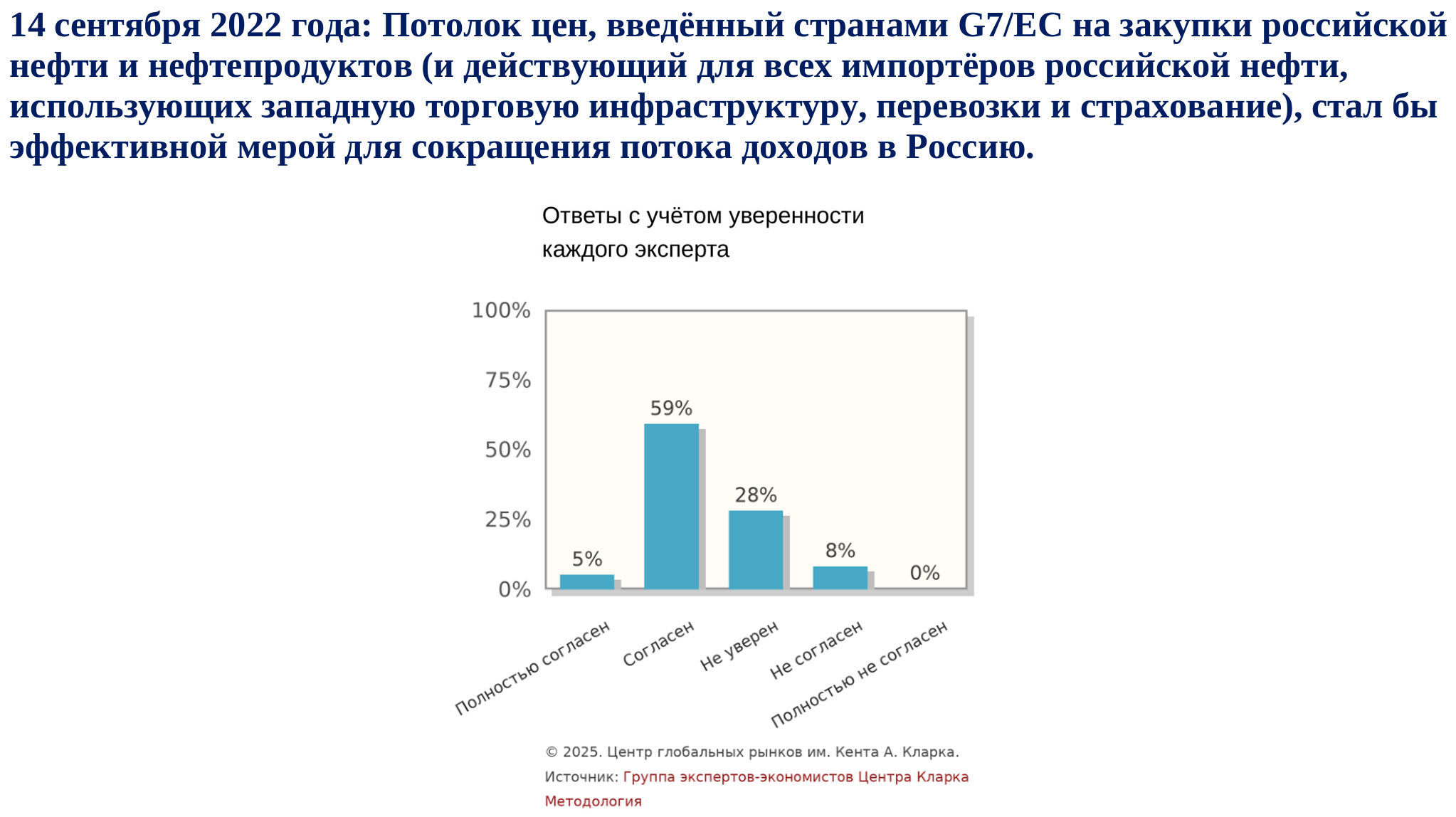
Many people would say that sanctions did not stop the war, sanctions failed. But actually, it was an unrealistic expectation. The realistic expectation is to compare the world with sanctions and without sanctions. And here Dmitry Muratov is absolutely right. Imagine that Putin has no restrictions on obtaining Western military technologies. Imagine a world where Putin's sovereign reserves, Central Bank reserves in dollars, are not frozen and he has $300 billion more in his pockets. Imagine that he has no restrictions on selling his oil for many years. He really had such an opportunity in 2022 because oil sanctions came into force only in December 2022. So my forecast would be: if there were no sanctions, he might have already won this war, probably already in 2022. So it's important to remember that sanctions do save lives. I think if you lift sanctions on Usmanov or Fridman, it's less dramatic than if you return $200–300 billion to Putin or give him access to military technologies. So there are sanctions and sanctions.
Evgenia Albats: Yes, but it creates a precedent. Putin received a message that he can arrest a couple more Americans, French, or any foreigners, and then exchange them for sanctions relief.
Sergei Guriev: I agree, and I do not recommend Americans or French to travel to Russia.
The Power of Sanctions
Evgenia Albats: There is a widespread opinion that Western aid to Ukraine from the very beginning was limited because they wanted not a quick victory for Ukraine, but the exhaustion of Russia in this war. The West allowed Putin to advance so far and wage this war for so many years. Why?
Sergei Guriev: First of all, the West did not want to send its soldiers, there was and is no desire to engage in a direct conflict with Russia. President Biden has always said: we want to help Ukraine, but we do not want to start World War III.
I must say that I am part of a project where we conduct surveys of leading economists in public policy at <the oldest higher business school in America> Chicago Booth, which constantly surveys American and European economists on basic questions. For example, do you think this trade war will help the world?
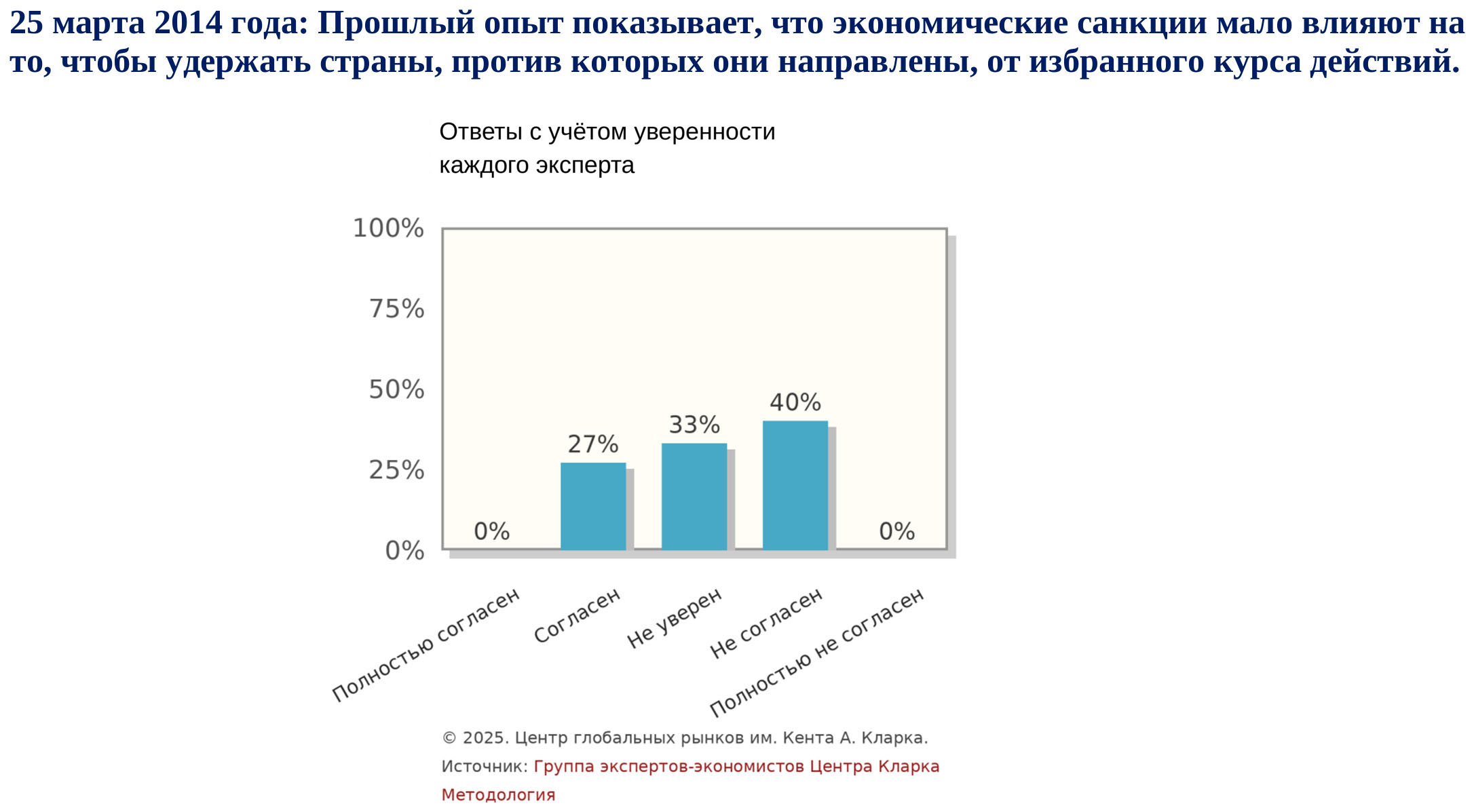
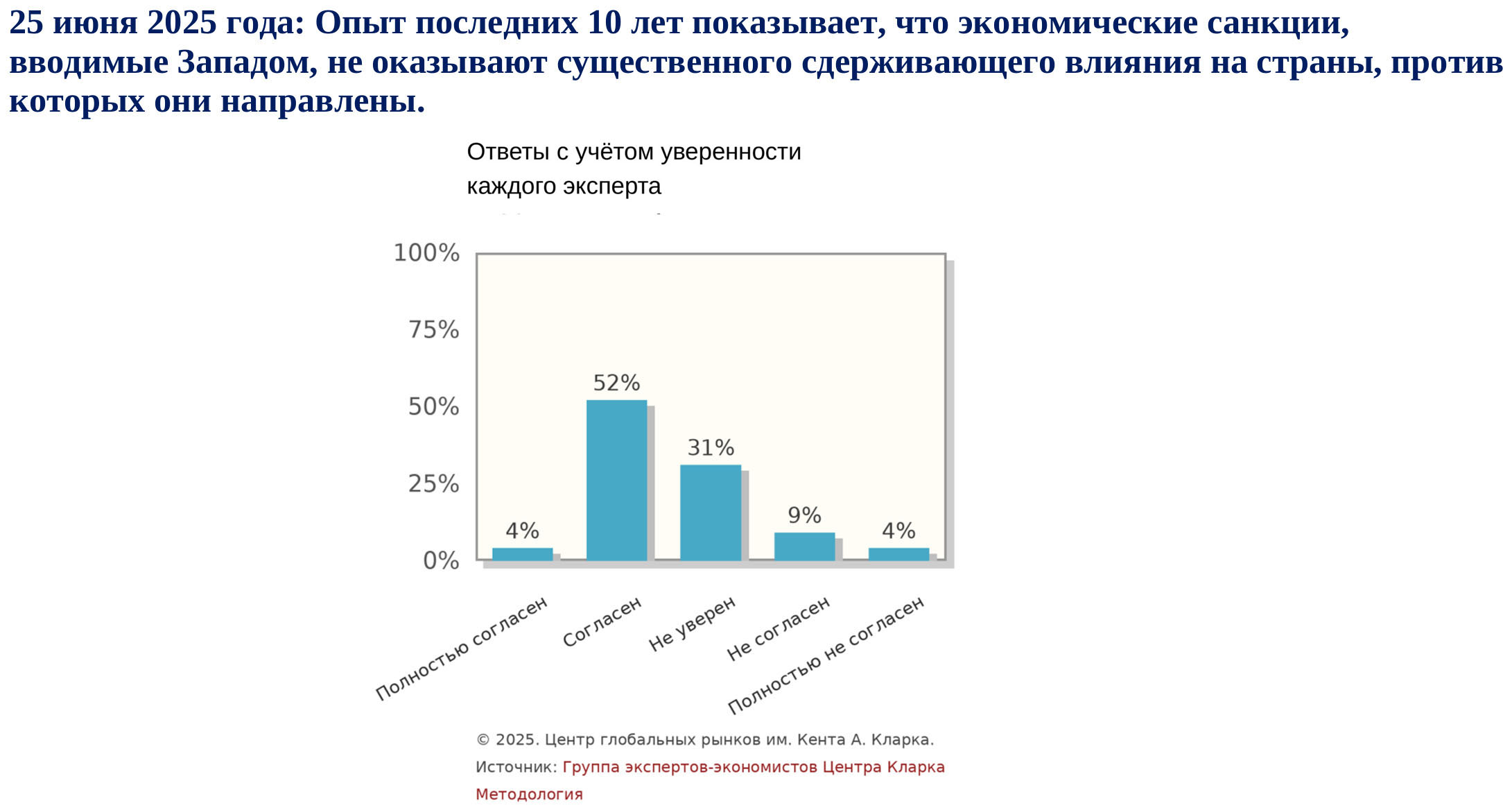
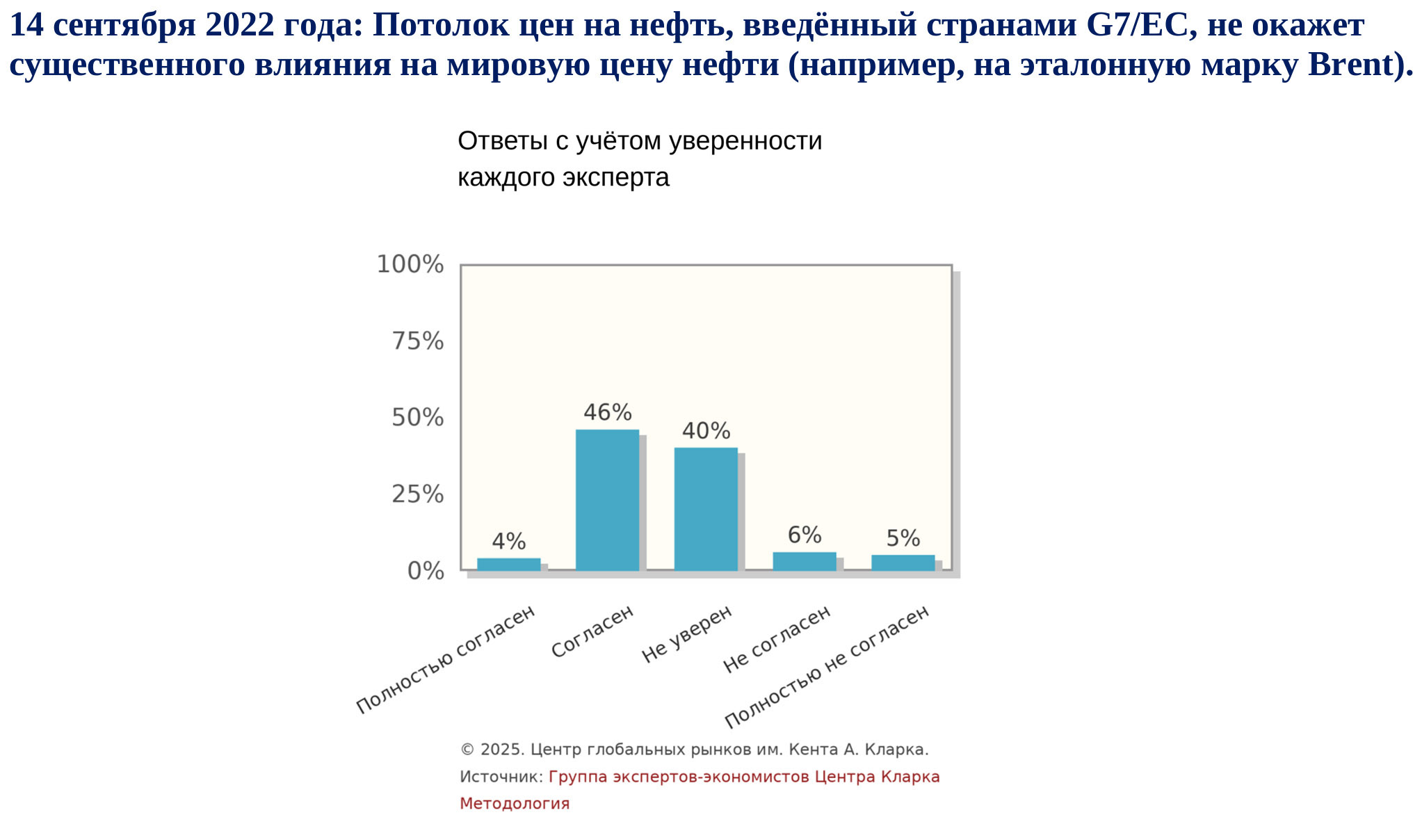
Or about whether green investments will really slow down global warming, and so on and so forth. But there are also questions about sanctions, and one of the sets of questions we proposed to this group was: if the G7 imposed a full energy embargo in 2022, would Russia's military and economic situation be significantly worse. This question was on the agenda, and I participated in the debates along with <a well-known economist> Oleg Itskhoki, we wrote a number of columns, but also talked to politicians at closed meetings.
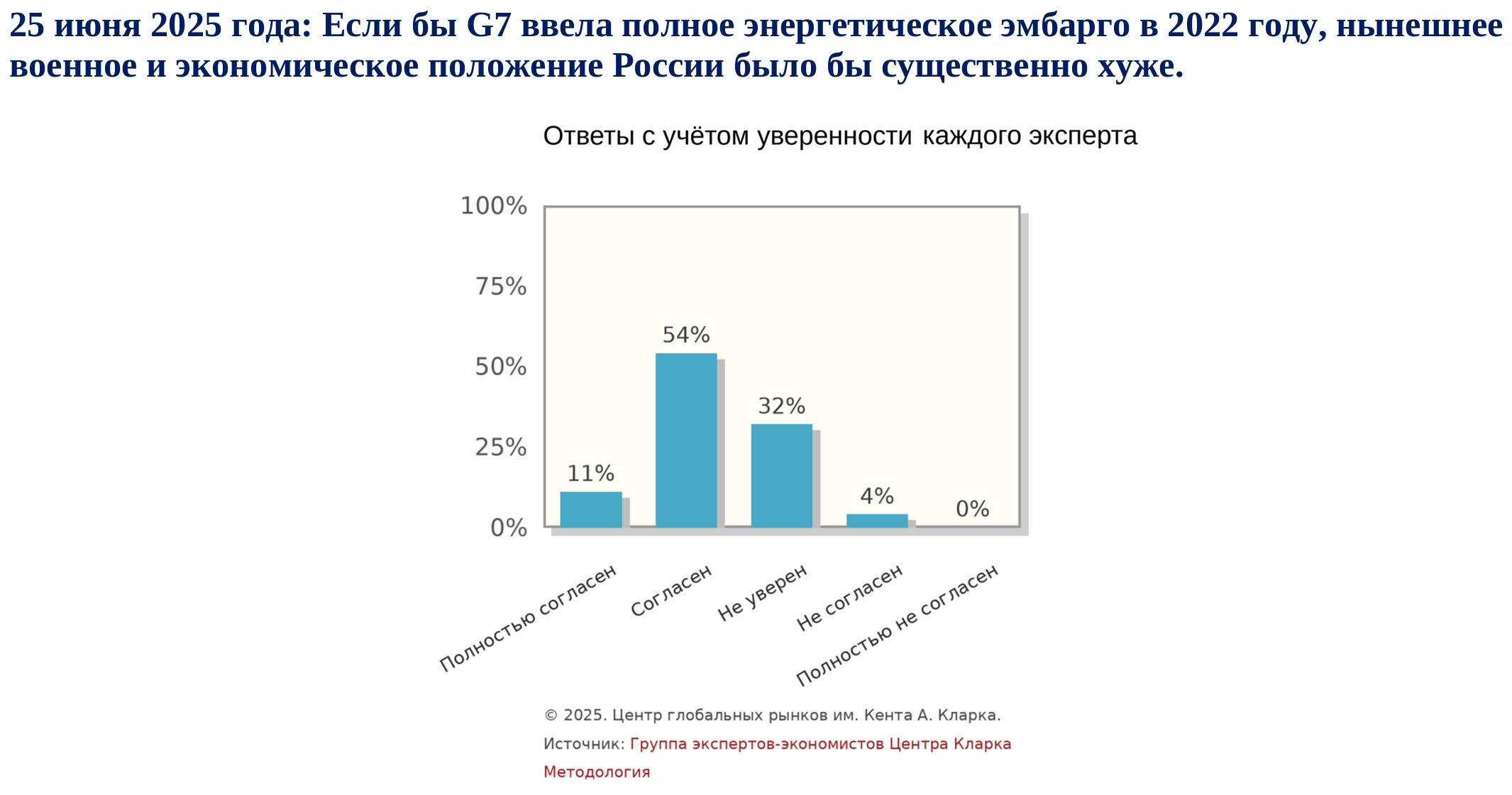
This group of leading economists agrees with such a statement: 54% "agree", 11% "completely agree", 32% "not sure", and almost no one "disagrees". So, if the West had the will to slow down Putin's advance, a full energy embargo would be a good idea. And our point of view with Itskhoki would be: it would be painful in the short term, but the war would end sooner.
And then another question we asked back in March 2022 was whether this would lead to a high risk of recession in Europe, and the answer is yes, it would be a political cost for European politicians.
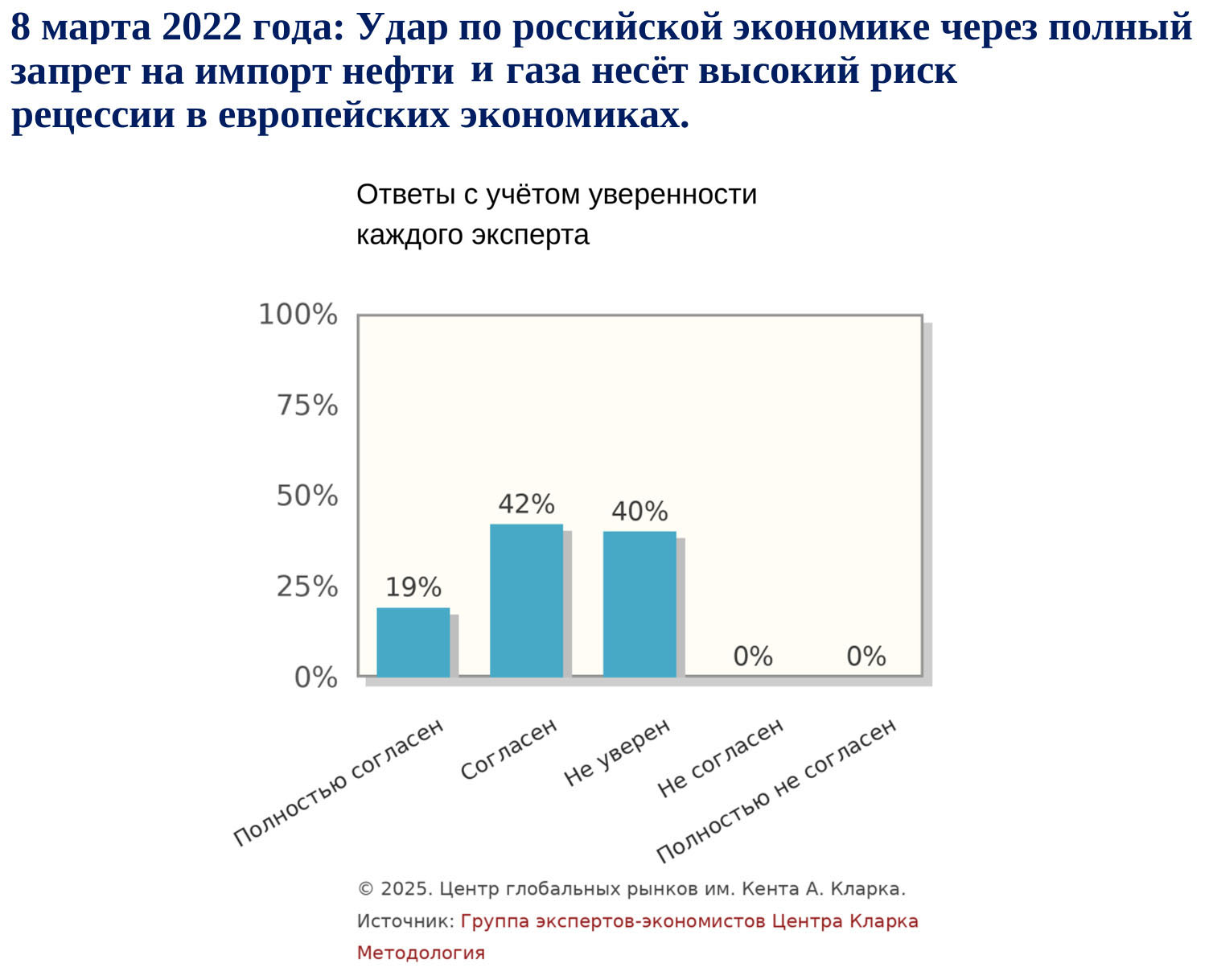
And when we talked to European politicians at closed meetings, they said: we do not want to cause economic pain to our voters. And it was so clear! We will do this, they said, we will impose oil sanctions, but a year later. If you think about the cost of delaying this for a year, Putin received about 230 billion oil dollars in 2022. Which is roughly equal to the same amount of money that was frozen in Central Bank reserves. This is the calculation at that time.
Yes, it was a compromise, European politicians said: our voters are more important than Ukrainian voters. That's it. They were basically elected to promote the welfare of Europeans. We tried to convince them that a longer war would be even more painful for welfare. But not everyone believed us.
There was a research paper by several German economists who argue that a full embargo would cost Germany a maximum of 3 percentage points of GDP decline. This is not a little. But the embargo would stop the war immediately. And then eventually the West settled on setting a price cap on oil, which is harder to enforce. But in the end, it worked, at least for a year or so. In general, it all came down to the fact that for the European economy it would be too expensive to impose a full embargo, so we will not do it this year.
When is the End?
Evgenia Albats: How long can the Russian economy sustain the war before it collapses?
Sergei Guriev: As I said, I don't think the Russian economy will collapse. And it all depends not only on the economy but also on military capabilities. If Putin believes that his military technologies are sufficient to continue the offensive, he will try to do so. But again, economic pressure can limit his ability to produce new military technologies and recruit soldiers. But much of this really depends on how dissatisfied the people around Putin are.
As a researcher of dictators, I can tell you that being a dictator is a dangerous job. And many people do not die in their beds. Therefore, there are many dissatisfied people around Putin. He is very good at what he does. He has lasted 27 years. He invests in his security and thinks about it 24/7. So far, he has been successful. But every dictator is alive until he is dead...
Evgenia Albats: Thank you, this is very optimistic.
Video Version
* Evgenia Albats, Sergei Guriev, Alexander Kynev are declared "foreign agents" in the Russian Federation. Sergei Guriev is also included in the list of "terrorists and extremists".
** Alexei Navalny is on the list of "terrorists and extremists".