 Vladimir Putin received a letter that his press secretary «slipped» to him. He does not name the author of the letter, just as he did not name his opponent Alexei Navalny. The reaction to the letter was full of irony, with the Russian president calling Volodymyr Zelensky «Rambo: First Blood», and likening himself to comrade Stalin, addressing the military: «Work, brothers!» No truce, no peace agreement, no acknowledgment of economic problems. For Putin, everything is fine, as he was ready to continue, so he continues, which was evident even in 2025 when a naive Trump believed that negotiations were negotiations, and not just a typical cover operation by the security services. The hours-long plenary discussion at the St. Petersburg forum left a strange impression: the autocrat (and the fact that the country is an autocracy was finally openly stated on one of the panels by Dugin) seems to seriously believe that the country is «developing», although the criterion of development of the «own scientific base» is now drones. The USSR launched Gagarin into space, the Putin regime launches drones into the sky, and considers air defense systems a factor of economic reliability.
Everyone, of course, missed the monotonously read speech by Uzbek President Shavkat Mirziyoyev on the economic development of the republic, which sounded like a screaming dissonance to Putin's speech: this is how investments are attracted, this is how a peaceful economy is built, Tashkent becomes an international financial center, not Moscow.
No one writes to the retired Colonel V. V. Putin, except for the unnamed «author of the letter». Meanwhile, Zelensky expressed in the message, to which, of course, there could be no other response but a negative one, one important analytical, specifically analytical thought: «... the war is your personal choice». Essentially, this is a repetition of the thought of Valentin Falin, one of the most sophisticated Soviet diplomats, who was involved at least in building special contacts between the USSR and the FRG during the détente period. His postulate was: «Confrontation is not fate, but a choice». And the period of détente confirmed this. Subsequent events — sliding into confrontation — also confirmed it. And this confrontation cost the Soviet Union its collapse, which actually occurred long before Mikhail Gorbachev came to power: the empire could not bear the burden of confrontation expenses and collapsed under the weight of its own elderly bitterness. The real death of the empire occurred long before 1991: perestroika was just the final chord, and its failure is not Gorbachev's fault — «everything was already destroyed before us», as said in a cult Soviet film.
Resentment, bitterness, offense for not being recognized as equal, victim complex — all this played a role in Putin's choice, which might not have been. If there had been a rotation of power in the country. If society defended its rights, and the subjects behaved like responsible citizens. If cowardly and impotent elites did not compromise with political power. If Putin were not obsessed with national-imperial messianism, the most archaic intention that can only be characteristic of a political leader, increasingly resembling either an aging Stalin or an elderly Franco, who saw a «Masonic conspiracy» everywhere, or Salazar.
Political tourists Whitcoff and Kushner are coming to Moscow again. In which restaurants have they not yet sat with Kirill Dmitriev? Maybe they should visit «Tasty and That's It», formerly «McDonald's», to see what dear Muscovites eat? What do they want to hear from Putin? The same formula — troop advancement occurs every day (almost four and a half years), so a truce is unacceptable. The simple idea that any effective contacts are only possible against the backdrop of a truce, because the death of people, flying drones, and missiles create an unacceptable environment for negotiations, contributing to their disruption, is not accepted by Putin. And therefore, he does not want negotiations, does not see any sense in them.
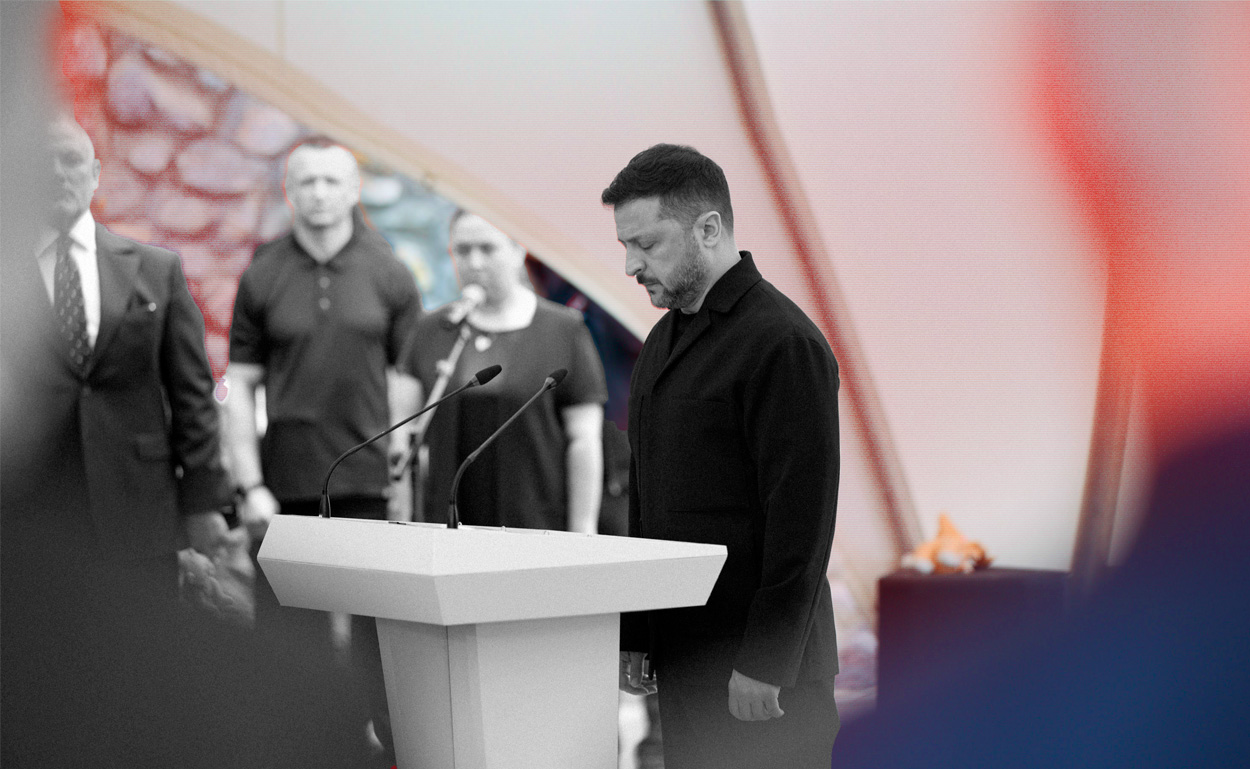
Volodymyr Zelensky. Photo: president.gov.ua
Even if they begin, even if a peace formula is found, they then run into another stumbling block: Putin with his 26-year (more precisely, 27-year, since August 1999, when he became acting prime minister — successor) rule is a legitimate leader, and Zelensky is not legitimate, because there were no elections in Ukraine. (Given that under combat conditions and in a situation where millions of refugees have left the country, holding elections, real elections, not imitation electoral events, as in the case of a semi-totalitarian regime, is impossible.) Therefore, Zelensky's signature under a peace agreement, from the point of view of the Russian autocrat, is irrelevant. So what will Trump's envoys talk about in the Kremlin then?
Soviet diplomacy was strong in building secret channels and simultaneously direct lines of communication with «unfriendly» (in today's terms) states. After telling a secret story about a meeting with an unnamed businessman who was going to Kyiv, Putin indignantly noted that he could not authorize him to establish contact. But that's exactly how things were done in the adult, not infantile-boyish world of political diplomacy. It was such envoys who participated in building détente, negotiated peace, pulled people out of prisons, and even prevented nuclear catastrophe. And here the retired colonel is not ready to meet halfway, so what are all these trips of American realtors for?
This is some kind of vicious infinity. The theory of relativity according to Putin. Four-plus years of confrontation are perceived not as Groundhog Year, but as Groundhog Day. And this day from dawn to dusk does not end. Putin is the master of time. He stopped it. And the lives of millions of people pass in vain. If this life, of course, is preserved — considering the expansion of the «safety» space, when drones are already flying into neighboring European countries: the special military operation is conducted, so to speak, in a generally dangerous way.
And all this is applauded by the well-dressed, overly well-fed audience of the St. Petersburg International Economic Forum with European and American freaks expressing gratitude to the leader of the personalist regime, who made his choice and is not ready to abandon it. This is applauded by the representatives of the Russian «elite» sitting in the front row, who just during the panel discussions cautiously dared to speak the truth about the poor state of the Russian economy and its subjects — people who make not missiles, but what is needed for life, not for death. This is an anecdotal audience — in the sense of an old Soviet joke: «Tomorrow at 11 everyone should be at the square for the execution. Any questions?» — «Yes. Should we bring our own rope and soap, or will the union provide it?»
Yes, the union. Of oligarchs. It already provides. They were recently asked to help the «special operation» with billions. And the oligarchs did it, although it only means that their factories will burn, and also produce not what is in demand on the domestic market. And who is to blame? It's... Nabiullina's fault, as Chubais once was. It's good that Elvira Sakhipzadovna had a valid reason that allowed her to avoid participating in this parade of freaks and celebration of obsequiousness.
* Andrey Kolesnikov is considered a «foreign agent» by the Ministry of Justice of the Russian Federation.