«Having reached a strategic dead end, the Kremlin team simply raises the stakes and moves to escalation — excessively increasing the risk».
Gleb Pavlovsky, 2016
 Influential American columnist David Ignatius in his column in the «Washington Post» suggested that Putin, losing and being cornered, feeling the wall at his back, becomes more dangerous and may decide on a war with Europe while it is still unprepared for a direct military conflict. That is, following the path of «Karaganovism» — climbing higher and higher up the «escalation ladder». The same was recently written by Eugene Rumer, director of the Eurasian program at the Carnegie Endowment (recognized as both a «foreign agent» and «undesirable» in Russia): after the end of the hot phase of confrontation with Ukraine, after all the failures, even if they are declared a victory, Putin will become more vindictive in his resentment.
Of course, the position of his regime as a result of the «special operation» has gradually deteriorated due to problems in the economy, a decrease in the level of security (NATO is now «at the gates»), the country's toxicity, and the lack of strategic allies (with very serious reservations, China can be called such). All these circumstances can provoke the regime to desperate steps like a battle with Europe. Incidentally, it is worth recalling the internal front, where it is practically easier to vent anger and resentment on internal «enemies». As Gleb Pavlovsky wrote ten years ago, «there are no restrictions on the degradation of domestic policy at all». And he was right — the domestic political «auto industry» has not yet invented a reverse gear, it is an inaccessible technological innovation for it.
If Putin Wins
In 2025, a book by military analyst Carlo Masala titled «If Russia Wins» (meaning in Ukraine) appeared on the shelves of Western bookstores. It describes precisely the scenarios feared by Ignatius and Rumer: 2028, «early in the morning the city wakes up from explosions. Two Russian brigades invade Narva from the north and east». Such a scenario exercise no longer seems incredible, rather, arguments against such a development have to be sought.
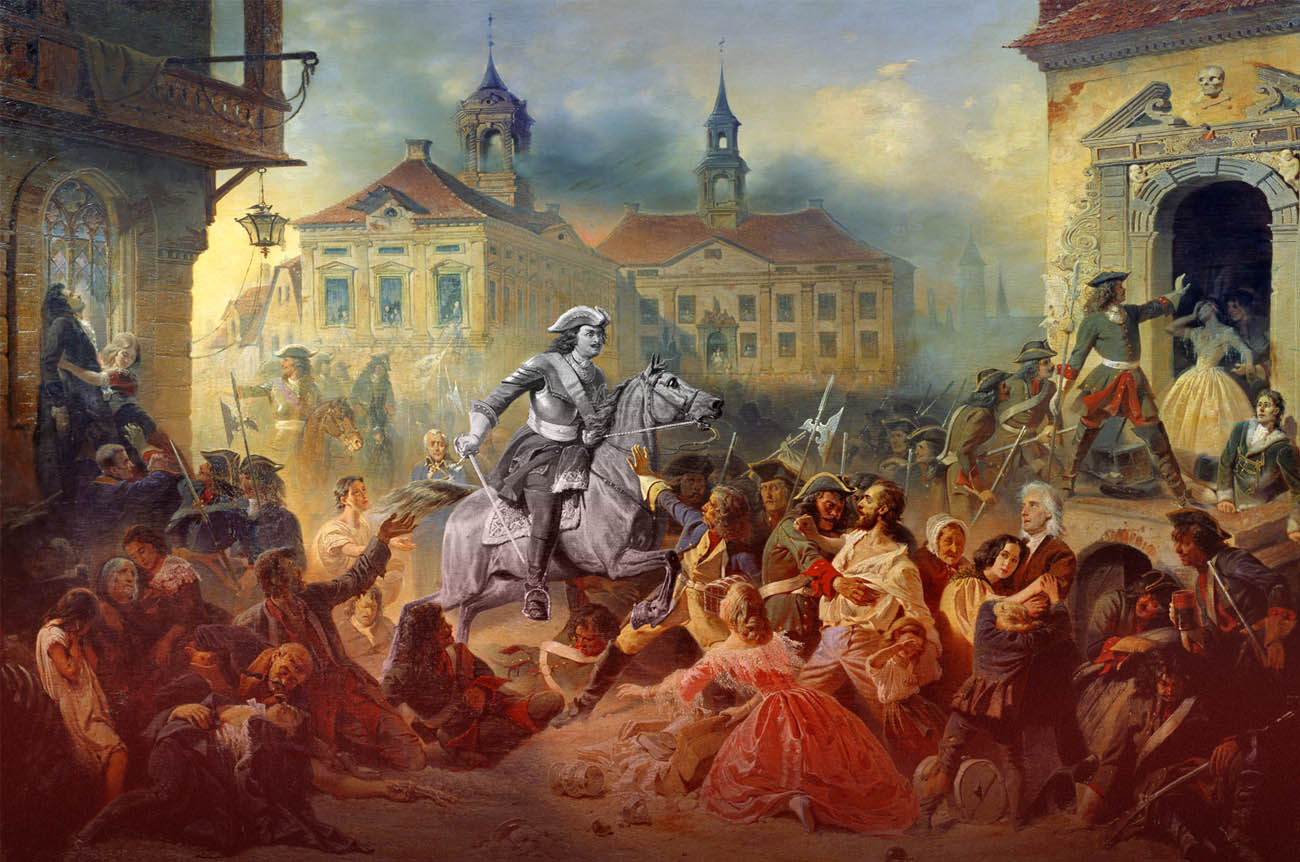
N. Sauerweid. «Peter I pacifies his enraged soldiers during the capture of Narva in 1704». Fragment of the painting
Firstly, there is a methodological inaccuracy here. Not «If Russia Wins», but «If Putin Wins», in Putin's own view. For him and part of his supporters in the establishment and society, victory is indistinguishable from defeat. As for the country of Russia (not the regime), it lost a long time ago, at the latest — in February 2022: from the medium- and long-term political, economic, social, psychological, medical, demographic consequences, the country will not get rid of for a very long time, and we are still at the beginning of the path of involution and degradation. So the escalation scenario is just the spread of weakness, resentment, and degradation outward.
Secondly, perhaps the loss, sometimes irreversible, of political, economic, financial, psychological, and, most importantly, demographic resources is too serious for Putin to embark on another campaign, more serious than the previous one, and his hand would start to feel for the nuclear button. Confirmation of this version is the actual depletion of resources and the absolute irrationality of escalation. Moreover, the depletion is far from over, it is inertial and on the march. Against this version, another argument can be made: what, February 24, 2022, was rational, it did not seem like the collapse of the entire civilizational framework, universal institutions, values, and principles? Nevertheless, what happened happened: «Kyiv was bombed», so why can't «two brigades», according to Masala, enter Narva?
The root of Putin's current policy (if it can be called a policy at all) is the refusal to recognize reality. In this illusory world, the causes of economic degradation are anything but the «special operation», from the «calendar factor» (of course, four years of the «special operation» is a significant prolonged «calendar factor») to the high rate named after Elvira Nabiullina. At the Ministry of Health board, the head of state boasts of low infant mortality, but maybe this indicator simply correlates with a record low birth rate? And how does this relate and will relate to the crippled lives of women as a result of the de facto ban on abortions?
Putin is ready to ignore to the last what should stop him — the fall of the economy, the depletion of resources, and the demographic failure. Moreover, the practical experience of state colonization of society shows that people can be made to do anything, and they adapt to everything — and there are no red lines here: they will endure everything. So, it turns out, Ignatius and Rumer are right?
The Garden of Escalation Delights
Much still depends on the scale of the problems: you can arrest everyone around, raise taxes even higher, fire Nabiullina, replace her with an economist-healer, ban abortions and arrange a total Lebensborn, but this will not fix the situation. Until the hot phase of the conflict ends; moreover, until changes begin in the country and its system of power, the very model of social existence. Because the problems have gone too deep.
The fatigue in society is too great. Discontent, although still muted, is accumulating, turning into an underground fire that can theoretically break out at an unexpected time, in an unexpected place, and for an unexpected reason. Yes, so far nothing has dissuaded the authorities that people can be used like a cartridge in a printer, but no Nobel laureate can give an accurate forecast of what might happen to public consciousness and behavior tomorrow or in two years.
The big question is whether it is possible to arrange an effective and truly mobilizing (once again) rally around the flag at the expense of a hot war with Europe? Society is already dizzy from the previous rallies and wants not just a break, but a stop, and what will happen to mass consciousness and public opinion in the event of an escalation? And perhaps Putin himself does not consider that he is cornered. At least not yet.
«The population of the Russian Federation enjoys the atmosphere of extremity», — wrote Pavlovsky. But it seems that the period of multiple military-field orgasms has caused nothing in the masses but fatigue. After the orgy, even the most aggressive pro-war figures want a little peace, not to mention the largest part of the country's population — passive conformists. Enjoyment has its limit. And it has come for the majority of Russian citizens. But the Russian «reconquista» still brings joy to those in power. They are accustomed to living in extraordinary circumstances. The «besieged fortress», bitterness, resentment, and the resulting escalation are the environment and meaning of their existence, which is now called the pompous word «service». And here new cursed Russian questions arise: will the diverging feelings of the establishment and society enter into a serious contradiction that will exclude the transformation of a nuclear power into an Orthodox shahid? And will the authorities find the risks of growing discontent within the country more significant than the prolonged enjoyment of escalation?
A theatrical pause ensues. Occasionally, a chilly breeze of nuclear winter runs through the government box. There is still an eternity until the curtain closes, and the finale is not predetermined.
* Andrey Kolesnikov is considered a «foreign agent» by the Ministry of Justice of the Russian Federation.