 Here is the Russian rut — to go, for years, to the border of Donbass. The "Russian world" does not end there, it is Russian on the Ganges and the Danube, but there must be an intermediate goal for the current generation of Russian people, just as communism was the goal for the "current generation of Soviet people". Apparently, Putin clearly outlined this position during a closed meeting with the oligarchs. The special operation will continue, no negotiations will move forward initially due to Ukraine's refusal to voluntarily transfer territories of the Donetsk region, then due to different understandings of security guarantees, and later because of the "illegitimacy" of the peace agreement signatory from the Ukrainian side. As Alexander Borodai noted, who somehow got a platform at the Grushin Sociological Conference, war is the "norm of life." (Everything that regime accomplices touch becomes vulgarized and profaned — even the name of Boris Andreevich Grushin has been nationalized and used as a signboard for discussions that would have horrified him.)
"Let's do without bargaining"
The "norm of life" requires money. The Supreme Commander suggested that the Kremlin-affiliated business seize the moment while oil prices are at their peak due to the Iranian war, thus confirming that the only source of existence understandable to the Kremlin remains rent. From the oligarchy of late Putinism, a commission is periodically taken for the mere fact of being able to work in Russia and stay alive, and now a request has been made for additional "voluntary" contributions from large Russian entrepreneurs to support the "norm of life." They have nowhere to go from this submarine — they have worked and continue to work in close union with the state. Although they could have bargained and gotten something in return: for example, ask to return the internet and messengers important for business and reduce the tax burden. "But let's do without bargaining," as one character of Joseph Brodsky said — who would dare to make deals with Putin.
Burning Cow
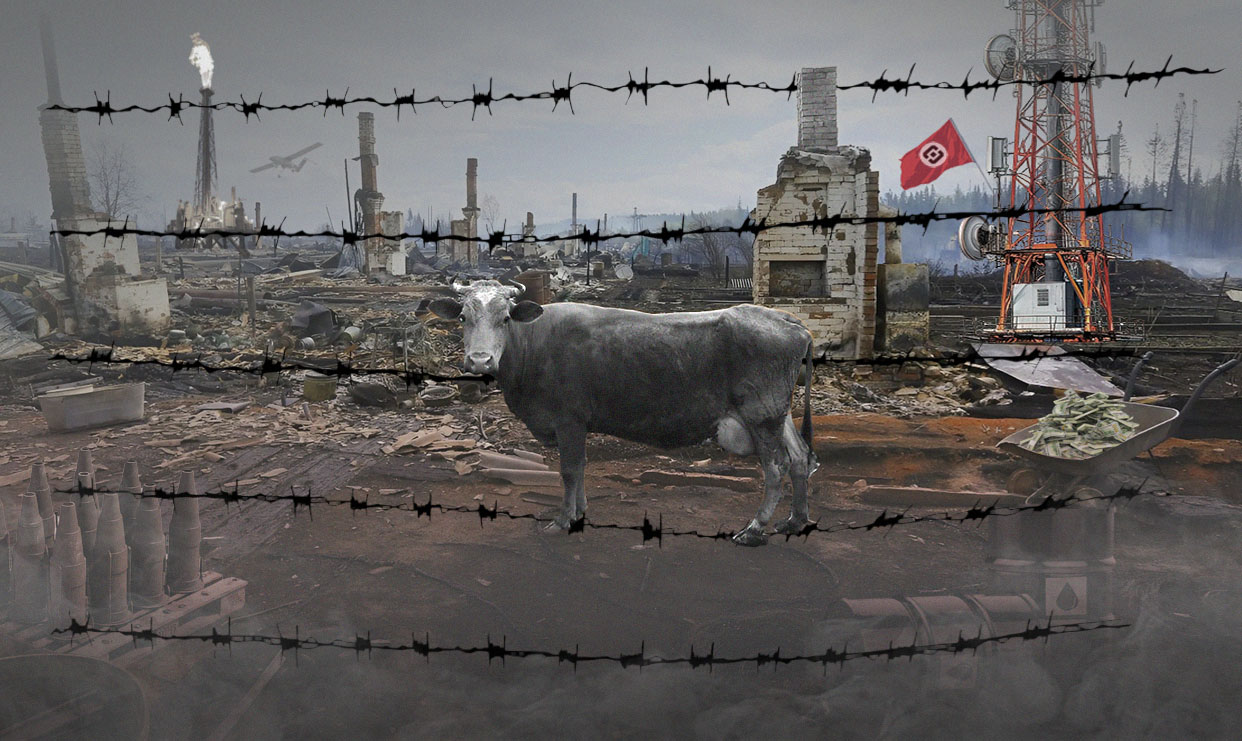
Having deeply entered the communicative and internet environment of Russians' existence, the state has clearly overdone it. Although, undoubtedly, it is used to acting without regard for common sense and with readiness to suppress any resistance — even livestock in Siberia was killed under the cover of security forces, it was a real battle not with the urban part of the population, but with the rural. The burning cow in Tarkovsky's "Andrei Rublev" rests... Livestock in modern Russia is treated the same as people. Such a "cow" will not give milk.
This does not mean that decision-makers will back down — this regime has no reverse gear at all. But perhaps there will be a small pause before the next wave of suppression of private life — people need to be given the opportunity to get used to it, grumble, curse, let off steam, and once again immerse themselves in everyday problems.
The level of anxiety in the orderly ranks of the controlled population has increased — this has been recorded by sociological services. And the monitoring of the Institute of Psychology of the Russian Academy of Sciences noted an increase in anxious-depressive states — due to the prolonged special military operation, economic problems, concern for personal finances, and general uncertainty about the future.
The violation of the unwritten social contract, which still allowed people to stay in their burrows with their internet, turned out to be excessively abrupt and unceremonious, so a consolation prize was needed. Dressed in a Russian folk Batman suit — a trench coat, Dmitry Medvedev announced that there would be no military mobilization, there are enough contract soldiers and volunteers. Society will breathe a sigh of relief and consider the disappearance of familiar communications and the internet a lesser evil. Without the internet, but not in a trench. The social contract has stood. Until the next act of state intrusion into society's life. And it will definitely happen — interested agencies are already demanding additional budget funds to suppress the internet environment. Here the oligarchs' money will help, otherwise the budget deficit will grow even more.
Don't Make Me Laugh with My VPN's
Meanwhile, the Orwellian machine of suppression and control does not leave its main war with society for a minute — the war of memory. The task is to take away from people the last thing they have, what connects them with previous generations of worthy people — memory. Memory of freedom. Memory of resistance to tyranny. Memory of the victims of this tyranny — including family memory. It can now be exclusively official and formal: as the head of the Human Rights Council noted, a special memorial was made for you on Sakharov Avenue, opened by Putin, that's where you should go, not to the Solovetsky Stone, which hinders the work of the security services and poisons their lunchtime... So the Ministry of Justice filed a lawsuit with the Supreme Court demanding to declare "Memorial" an "extremist" organization and ban its activities in Russia. The corresponding session in a closed (!) mode will take place on April 9.
The war of memory is so important for the state that even after clearing the entire field of any variability in understanding history, surrounding the only correct version with articles of the Criminal Code on discrediting and denials, thereby canceling the very possibility of professional historical science, staking a place in minds with a series of unified textbooks, it does not stop. It would seem, out of respect at least for the personal and family memory of the victims of repression, for the colossal work that has been carried out for decades by "Memorial" workers, for the personalities of Andrei Sakharov and Boris Yeltsin, who supported the organization in its formative years, for the gigantic symbolic significance of this structure for the history of post-Soviet Russia, it could have stopped. Already declared a foreign agent, already liquidated in the same Supreme Court (and this destruction — both in time and in meaning — opened the gates for February 2022), forced some people to leave the country, initiated some civil lawsuits, recognized foreign structures of "Memorial" as "undesirable organizations," but another label needs to be hung — this time on the international Russian "Memorial." A label that is frightening and symptomatic — "extremist organization."
What solidarity with Stalin's executioners — they also considered those who were given insane sentences as "extremists" — "enemies of the people." The state gives itself away completely and is no longer embarrassed by anything. When "Memorial" was liquidated at the end of 2021, the prosecutor accused the organization of creating a "false image of the USSR as a terrorist state." Well, of course, you can't "take out your dead", the plague must remain in the house, infecting subsequent generations with the bacillus of violence and hatred. At the same time, the nation's memory must be erased, otherwise the files of unified history will not fit in the heads.
This is the "end of history," but not according to Fukuyama, but according to the Kremlin. The country no longer has history and memory, there are its surrogates, propaganda clichés, and ideological crutches. We will study true history through... VPN?
"Memorial" has no one to protect it, as, indeed, do the farmers whose livestock were slaughtered under the escort of security agencies, the internet population of large cities, and even the seals, from whose meat some deputies propose to make sausage. In control, violence, and imposition, the state roller moves forward without a goal, meaning, or answer to the question "Why?" It is important for them that the ratings do not collapse, as during the periods of pension reform and the pandemic. Therefore, strong feedback signals still hit the radars, and a person in a trench coat comes out and calms the masses, who had already gathered on an imaginary square with a rope and soap — we will not touch you, go home and download your VPN's. As long as this is at least somewhat possible. At least today, it is not obvious that such an opportunity will exist tomorrow.
But everyone will think about this later — if tomorrow comes.
* Andrey Kolesnikov is considered a "foreign agent" by the Ministry of Justice of the Russian Federation.
Photo: Reuters / Ilya Naymushin.