“In this hour of your grief, your husband's deeds will not be in vain”
From a telegram by academician Andrey Sakharov to Nikita Khrushchev's widow Nina Kukharchuk, early morning of September 13, 1971.
 Flowers on the days of the deaths of Boris Nemtsov and Alexei Navalny** this February in many cities of Russia were brought to monuments to the victims of political repression.
The connection of times is obvious. And too obvious for the authorities, who have turned national memory upside down, finally siding with the executioners of Stalin's time. In some sinister symbolic way, the Gulag Museum was destroyed. And precisely in February, the month of the deaths of symbols of resistance Nemtsov and Navalny, and — again by a significant symbolic coincidence — the time of the 95th anniversaries of Boris Yeltsin and Mikhail Gorbachev. The same year, a difference of birth dates in a month — Boris Nikolaevich was born on February 1, 1931, Mikhail Sergeyevich — on March 2, 1931. Two antagonists who entered history together as leaders trying to weaken the iron grip of Leviathan. For the full picture, February is the 70th anniversary of Nikita Khrushchev's report on the cult of personality and its consequences. Who would have thought that these consequences, executed by Stalin's heirs, we would fully feel seven decades later...
And all this against the backdrop of a catastrophic anniversary, the four-year “special operation” that swept off the table of history all the achievements of past eras, leaders who tried to turn the eternally offended empire, bristling with deadly weapons, into a normal free and peaceful country.
Thus, these symbolic figures converged in one time frame — Khrushchev, Gorbachev, Yeltsin, Nemtsov, Navalny. In March, the 70th anniversary of Yegor Gaidar, misunderstood, unread, slandered. Complex and different people from various eras and generations, and this February and March united them under one umbrella concept — freedom. Liberation from tyranny, resistance to autocracy. Each is associated with certain eras of Soviet and post-Soviet history — very short periods of straightening backs and liberating minds, hopes for escaping the vicious rut of the Russian historical spiral, along which the Gogolian Russian troika rushes, seeing nothing ahead of it.
“Terrible Awakening”
Khrushchev “gave away Crimea”, Gorbachev “ruined the Union”, Yeltsin “sold out Russia”. To each his own, depending on what hurts. Rather, one can be blamed for the Cuban Missile Crisis, Novocherkassk, the persecution of Pasternak, another — for inconsistency in economic reforms and Vilnius. The third — for the Chechen war and the choice of Putin as a successor. For the history of freedom and hopes, Khrushchev is the 20th Congress, the removal of the ghoul's corpse from the mausoleum, Gagarin's flight, “One Day in the Life of Ivan Denisovich”. Gorbachev is the return of the people to their history, the liberation of consciousness, the elimination of the fear of nuclear war. Yeltsin is economic reforms that fed, clothed, and shod the country, a time of political freedom and the return of Russia to civilization. Not to the “state-civilization” where it fell, destroying two potential leaders of the country, Nemtsov and Navalny, but, to put it pathetically, to the family of civilized nations.
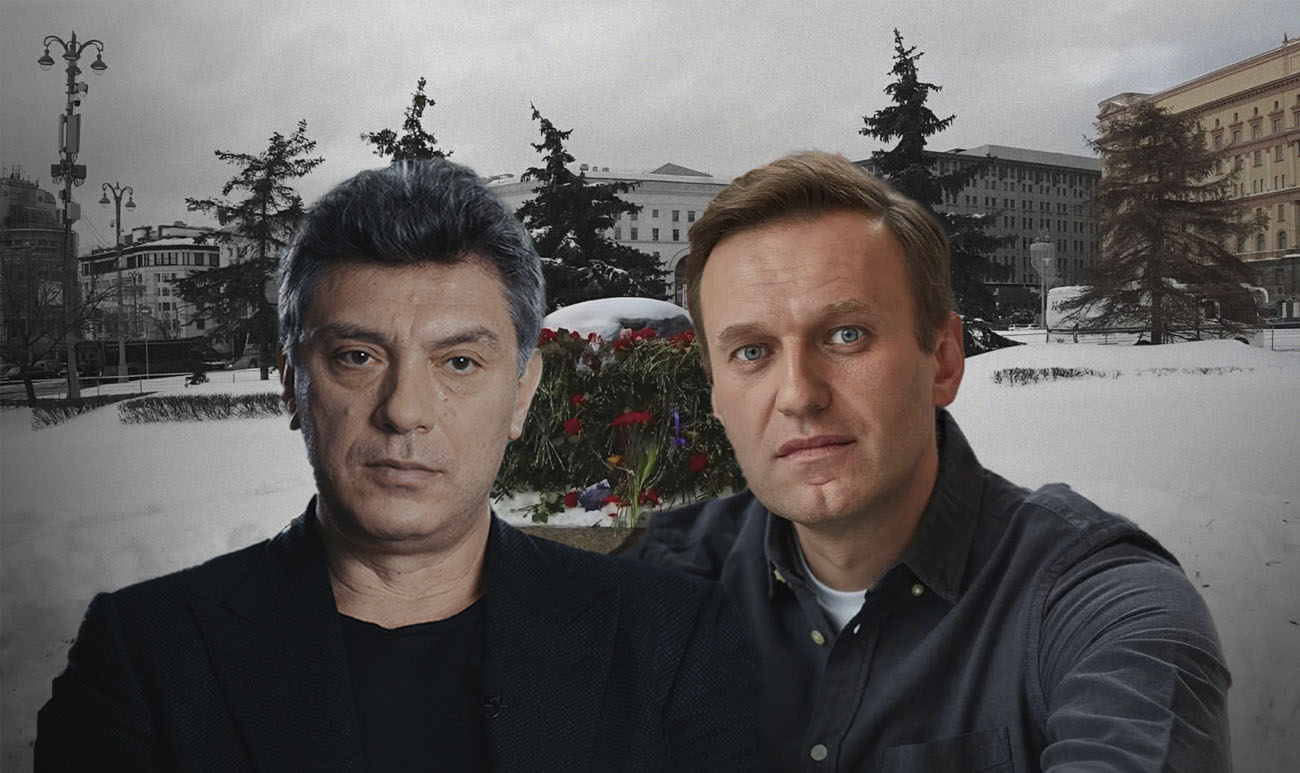
Boris Nemtsov, Alexei Navalny
It didn't work out, they slipped with a demonstrative crash from the main road of history, turning once again onto their Sonderweg, “special path”, into their inexhaustible path dependence, dependence on the historical path taken. Gaidar in his articles and books warned — the post-imperial syndrome and the resource curse can redirect the country's movement to this side road, although considered the only true and “traditionally valuable”, the messianic road of eastern despotism and the Asian mode of production. And so it happened. As Bulat Shalvovich said:
“...Who knew that the awakening would be terrible
and the landscape outside the window?...”
Funeral of Freedom
February 24, 2022, destroyed Russian history. It is now in the cemetery. In both metaphorical and literal senses.
The ashes of victims and executioners mixed in the crematorium of Donskoy. Antagonists Gorbachev and Yeltsin rest a few hundred meters from each other at Novodevichy. The breadth of Boris Nikolaevich's nature is in the generous space of the tombstone. Human, very human — in Gorbachev, he and Raisa Maximovna share a slab. To reach Khrushchev's black-and-white tombstone, you need to pass by the talentless intrusive monuments on the graves of Vladimir Zhirinovsky and Yevgeny Primakov, who have become idols for the current authorities — there is no one else to present from recent history. In the side part of the cemetery — Yegor Gaidar, on his monument — a book, because he was a man of the book. At Troekurovskoye — granite, so fitting for Nemtsov, at Borisovskoye always in flowers — Navalny's grave. Poisoned with burning hatred, “activists” fiercely tear off the “Last Address” plaques from the walls, the memorial plaque to Anna Politkovskaya. Voices are heard in favor of removing the Solovetsky Stone from Lubyanka — it prevents the heart of this power from beating evenly and calmly.
Having buried freedom, they are burying the country. Okudzhava asked a question, much sadder and wiser than “Who is to blame?” and “What to do?”, three decades ago:
“...There is no time left for farewells...
Are tears, which were not shed in vain, really no longer needed,
wings, which were not given in vain?...”
Was it all in vain? The 20th Congress, the return of literature, cinema, thought, humanistic values, rights, and freedoms; “the end of history”, “new thinking”, the elimination of nuclear confrontation, freedom of movement and speech. And all that remains is the jaunty bas-relief of Stalin, the hysterical cry of Zhirinovsky, the bureaucratic bass of Primakov? Back then, when Okudzhava wrote a whole series of almost desperate and, as it turned out, prophetic pre-death poems, the sixties man Yuri Karyakin, learning about Zhirinovsky's stunning success, preventively stated: “Russia, come to your senses! You have gone mad!”
Strength is in Memory
Attempts at liberalization leave traces — in the material world, in the souls of people, even if they do not notice it.
Russia has an experience of freedom, including personalized and symbolic. And this experience of freedom remains in people. What huge masses of sincerely grieving people saw off Yeltsin, Gaidar, Nemtsov, Gorbachev, Navalny. And not by order, because these are leaders of freedom, what kind of coercion is there. Farewells each time turned into a kind of demonstration of civil society — it presented itself. So on February 2, on the day of Gorbachev's 95th birthday, many people came to his grave.
When Nikita Khrushchev was buried on September 13, 1971, Novodevichy Cemetery was cordoned off — trucks, soldiers; a sign “Sanitary Day” hung on the gates (just as now rally bans are explained by “sanitary restrictions”, and people who bring flowers to the leaders of freedom are photographed by “sanitarians” from the authorities). The exit from the “Sportivnaya” metro was closed, city transport going along Bolshaya Pirogovskaya rushed past the stop at Novodevichy. In the square opposite the entrance stood ordinary people who accidentally learned about the time of the funeral (which was not reported, except perhaps by “Voice of America”). Despite the rain, they bared their heads when the transport with the body entered the cemetery grounds. There were not so many people at the farewell, who had the right to penetrate the cemetery, and even more — “stalkers”.
They feared manifestations of people's love — in the literal sense of this strange phrase. They feared sympathy for the disgraced. They feared gratitude for liberation from Stalin.
Entry on September 16, 1971, in Lydia Chukovskaya's diary:
“...I would like to bow to his grave. He is Hungary, he is Brodsky, he is art, he is Cuba, but it seems, it's not he, but they; he is liberation of millions. He is Solzhenitsyn...”
What a rhyme of history — Stalin is with them again, and they, those very “they”, from Lydia Korneevna's diary, more and more often prevent us from bringing flowers to monuments to the victims of political repression. And again Khrushchev is bad for them. In the same row with Gorbachev and Yeltsin.
And on March 19, I will be at Novodevichy again — at Gaidar's grave. Usually, friends and associates come there. Regularly, the most ordinary people appear — defenders of the White House in August 1991. Gaidar was there too inside those days.
Thus, history is closed. The real history, not the history of officials and military leaders. The history of the state, which defends itself from the history of society with its “sanitary days” and cordons.
So far, we only have cemeteries and flowers left. This is not so little. “What is strength?” — “they” like to ask. Strength is in memory.
* Andrey Kolesnikov is considered a “foreign agent” by the Ministry of Justice of the Russian Federation.
** Alexei Navalny is included in the list of “terrorists and extremists” in the Russian Federation.
Photo: A. Navalny: i.mr-7.ru / B. Nemtsov: theunfinishedtime.com.