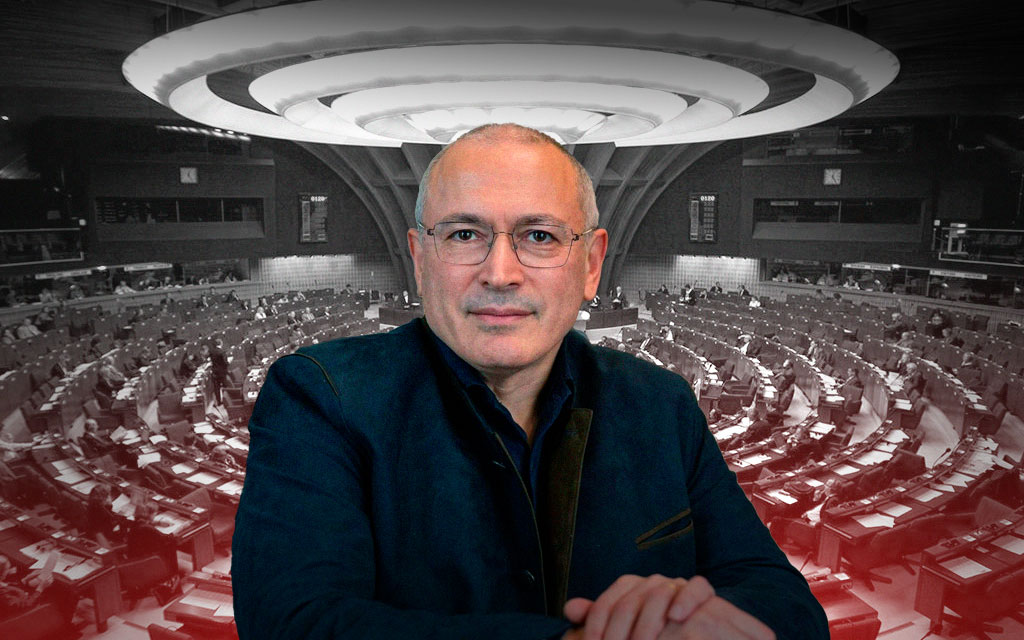
Mikhail Khodorkovsky
Evgenia Albats*: The Russian opposition has its first success, namely, the platform of democratic Russian forces has been established at the Parliamentary Assembly of the Council of Europe. Fifteen people have been selected there. Mikhail Borisovich, Mark Feygin*, who, like you, was selected as a member of this platform, wrote: «I am in PACE». Explain, are you in PACE? Or are you with PACE?
Mikhail Khodorkovsky: No one, of course, has restored Russia's presence in the bodies of the Council of Europe, including the Parliamentary Assembly of the Council of Europe. That is, Russia is still outside the Council of Europe. But we all had quite constant contacts, constant communication with European organizations. In particular, with the Parliamentary Assembly, because its mandate includes what concerns us greatly. This is advocacy, these are human rights. In general, what we have to deal with regardless of our own interests. And at some point, we started talking to them about making this institution more or less permanent. These conversations went on for several years.
The signing of the Berlin Declaration means that those people who joined it have clearly distanced themselves from the Putin regime. Because in this declaration, several passages definitely lead to long-term imprisonment in Russia
In the end, we agreed to create a permanent platform. Why a platform? Because people there will change. It will include the leaders of all party factions present in the Parliamentary Assembly. The president of PACE will join as the president of this platform. And there will be — we discussed from 12 to 18, but it turned out to be 15 — those people with whom the Parliamentary Assembly is already talking and with whom it is ready to continue talking. Already on a permanent basis. But at the same time, they have a certain set of requirements for those people they are ready to talk to. Then, in the process, all this changed a bit bureaucratically. And the position of the Ukrainians was significant. Because the Ukrainians said: if this is perceived as the return of Russia to the Parliamentary Assembly, we do not agree with this, because Russia is at war with us. If this is a representation of all Russians, then we do not agree, because we are at war with the Russians.
Okay, we said, let's then separate the story. There are all Russians, who are represented, so to speak, by Lavrov. Who can go to the consulate, to the embassy, who can live in Russia, and so on. These are the «all Russians». And there are those Russians from whom Russia, by and large, has turned away. Those Russians who are against the war can expect only a sentence and a prison cell from the Russian government. How should they live? We are told — yes, perhaps these Russians really have no representation. And we need to think about who will represent their interests. But we do not want those people who do not oppose the war to be there. As a result of long, long iterations, it was agreed that the first time it would be through the decision of the Parliamentary Assembly and the Council of Europe. And through the signing of the Berlin Declaration, as a document that for Ukrainians and Europeans indicates that those people who joined it have clearly distanced themselves from the Putin regime. Because in this declaration, several passages definitely lead to long-term imprisonment: a statement that the war is criminal, the regime is criminal, and so on.
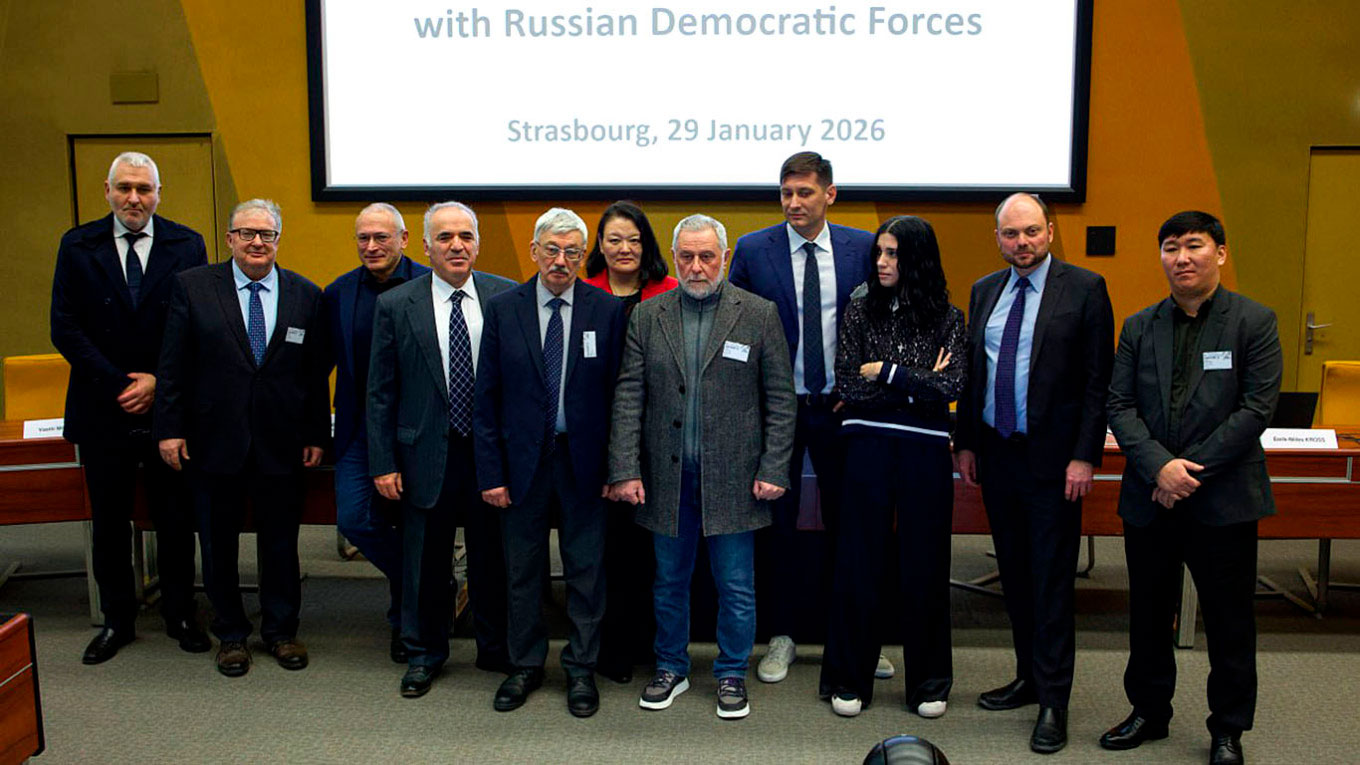
Participants of the Russian platform of democratic forces at PACE. Strasbourg, January 29, 2026. Photo: Khodorkovsky Communications Center
Evgenia Albats: The list includes Vladimir Kara-Murza**, who, as far as I understand, did not sign the Berlin Declaration, which caused a scandal shortly before the PACE decision was made. Did he eventually sign it?
Mikhail Khodorkovsky: Yes, everyone signed the Berlin Declaration, but I am not exactly sure if those representing indigenous and small peoples signed it. I just don't know about that.
Opposition Certificate
Evgenia Albats: You already had a meeting on January 29. How did you get into PACE? Were you issued a certificate or were these one-time passes? I mean, will you be given some kind of certificate that says «Khodorkovsky Mikhail Borisovich — member of the Russian opposition platform»?
Mikhail Khodorkovsky: Honestly, I don't know. If they give it, I'll take it. If nothing offensive is written there, I will use it to enter PACE. If they don't give it, I will, as always, present my usual documents and pass with them.
Evgenia Albats: Will PACE pay for the travel to Strasbourg and other expenses for the members of the Russian democratic platform?
Mikhail Khodorkovsky: A technical worker from the PACE president was present at the meeting. He said he would handle such issues. I will definitely not interfere in this.
Evgenia Albats: So you will not be issuing grants for activities in PACE?
Mikhail Khodorkovsky: No, I won't. Not because I think it's bad, but because considering the sensitivity of this topic, to get dirt for my own money — why?
Evgenia Albats: At the first meeting, you said that representatives of all political parties are included in the platform. But there are so many states in the European Union — did all the states delegate their representatives?
Mikhail Khodorkovsky: No, no. I mean political parties whose factions are represented in the Parliamentary Assembly of the Council of Europe. That's 5–6 parties.
Evgenia Albats: Were they present at the first meeting?
Mikhail Khodorkovsky: Yes, they were present. We all sat in the hall, and representatives of the Parliamentary Assembly factions sat, plus rapporteurs on the areas that were related to us. The rapporteur on Russia, Erik Cross, the rapporteur on human rights, and someone else dealing with issues related to the mandate of the Parliamentary Assembly. All the leadership that exists. The president told us what she expects from us. General words, said to a large extent, as far as I understand, for the press. And she asked each of us to speak. Then each of those present said how they see the tasks of the platform and what they are ready to do. I am ready to work in the field of expertise and counter-propaganda — what I am doing and what I am interested in doing. But if there are any other tasks that need to be solved during this year, I am ready to spend my time on it.
Evgenia Albats: Vladimir Kara-Murza spoke in detail that he considers it necessary to primarily deal with political prisoners. It turns out he has his own fund, where he and his wife transfer all the awards, and they received many, to help political prisoners. There is Dr. Andrey Volna*, a brilliant surgeon, I know him personally. A brave man, he was not afraid when Navalny's**** people and doctors turned to him for expertise. Then he emigrated, fought for a long time to be allowed to consult, to be present at the operation, and he constantly operates on the wounded in Ukraine. And he is without ambitions, without the bravado that often accompanies politicians.
Mikhail Khodorkovsky: It should be noted that during the meeting, everyone behaved quite corporately. Both Vladimir Kara-Murza and Garry Kasparov**, and Lyubov Sobol**, and Natalia Arno*.
Evgenia Albats: Did Kara-Murza and Kasparov shake hands?
Mikhail Khodorkovsky: No, it didn't come to such forgiveness. But for an outside observer, it was not visible that there was any animosity between these people.
Actually, the task at the first meeting was for everyone to get to know each other within an hour. To say what we want to do and what we can do. And we agreed that the next meeting would be in the 20s of April. You see, everyone there is busy. And everyone prefers to prepare documents, discuss them in their groups via videoconference or by transmitting documents. Then gather, discuss issues that need direct discussion, and then approve these documents. And no one is willing to spend more than an hour and a half on this. I think this is an absolutely normal working mode.
Platform and People
Evgenia Albats: I listened to many interviews of your colleagues from the Anti-War Committee*** and various others. Here's what's interesting. The publication «Meduza»***, before it was announced who joined this platform, conducted a survey. Of course, this is not a representative survey, it's specific, but nevertheless. Interestingly, the first place was taken by Ekaterina Schulmann**. She is a very popular person — 25% support, then Kara-Murza — 8%, you 7%, Kasparov — 2%, and the rest of those who joined, 1% each. If Alexei Navalny**** were alive, he would insist on holding primaries. Why wasn't there an attempt to conduct electronic voting?
There are concerns from PACE: who will you slip to us? You — in a broad sense, Russians. We are already afraid to deal with you, and there are certain grounds for this. You know that among the emigration, half are pro-Putin?
Mikhail Khodorkovsky: If Navalny were alive, then from what you said — you know him better than I do — it follows that he would decide not to sabotage the work on creating this platform, but to participate in it. And if he participated in the platform, maybe he would manage to get the Parliamentary Assembly of the Council of Europe to agree to conduct such a procedure. It would be very difficult. Because their arguments during our discussions were based on the fact that, guys, we do not want to deal with representatives of all Russians, we believe that the Kremlin will make efforts to ensure that we deal with various kinds of provocateurs. And we don't want that. And the Ukrainians here, in my opinion, would take a very tough position. Maybe he would manage to convince them. We didn't succeed in two years. I personally asked colleagues from FBK** to participate in this. And, possibly, due to broader representation, incline colleagues from PACE to those forms of interaction that suit us better. We worked, Free Russia Foundation*** worked, the Forum of Free Russia*** of Garry Kasparov worked, and both I and Garry Kasparov, we are for elections. We believe that this is absolutely normal. Other colleagues have different points of view. At this stage, we could not agree. At the next stage of platform formation, which will be in a year, I very much hope that we will be able to agree on conducting some form of electoral procedure.
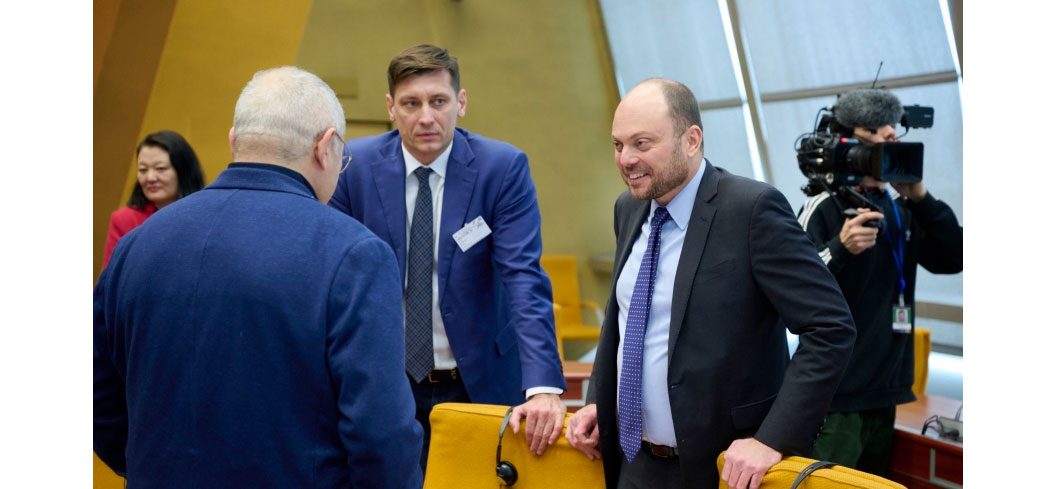
Natalia Arno, Mikhail Khodorkovsky, Dmitry Gudkov, and Vladimir Kara-Murza before the first meeting of the new platform. Photo: Council of Europe (www.coe.int)
Evgenia Albats: At least among the Russian emigration...
Mikhail Khodorkovsky: Yes, at least among those people who will be ready to declare their anti-war position. But I told my colleagues on the platform that I am not ready to take on the responsibility to tell people that we will be able to do all this in a closed manner and that the information will not leak.
Evgenia Albats: But many people in emigration do this quite publicly and openly.
Mikhail Khodorkovsky: I absolutely agree with you. I believe that in the end, some representation is better than none. But it must be understood that there are concerns from PACE. Who will you slip to us? You — in a broad sense, you — Russians. We are already afraid to deal with you, and there are certain grounds for this. You know that among the emigration, at best, half are pro-Putin? It cannot be said that their concerns are unfounded. But we will persuade.
How the List Was Compiled
Evgenia Albats: Ekaterina Schulmann was nominated by the Anti-War Committee. Evgeny Chichvarkin** hinted in an interview that Ekaterina Schulmann herself did not want to work on this platform. Is that so?
Mikhail Khodorkovsky: I don't know about that. Within the Anti-War Committee, the nomination happened simply. We asked: colleagues, who wants to join the composition, — because we understand that this is associated with a significant loss of time. I tried to detach myself from this story. But in the Parliamentary Assembly, they politely hinted to me that if everyone detaches, then they will detach too. Those who agreed (and I agreed that they be nominated), they were nominated.
Evgenia Albats: Why then wasn't she included in the list? She is such a popular person, people listen to her, she speaks quite frankly about the Russian authorities, her anti-war position is already known, she has already been sentenced to some term... I think you are all now immediately declared terrorists and extremists. I'm just trying to understand the logic.
Mikhail Khodorkovsky: I don't know for sure. I can repeat what those people who were responsible for this issue as a whole said. They said: we want those people who will join the platform to be well-known; they must be anti-war; and national delegations should not oppose them. Here is a set of informal criteria that I heard from those people who made the decision. The formal ones are written in the resolution of the Parliamentary Assembly. We submitted the list from the Anti-War Committee. I did not take any part in the decision-making. Yes, they asked me what I know about such and such a person or such and such a person. But they ask me this all the time, for different reasons, different foreigners. I, to the best of my abilities and capabilities, tell people what I know and think. And I always tell only what I can say to people in person. They didn't ask me about Schulmann.
Evgenia Albats: You said earlier that Ukrainians played a big role in forming this list. Probably, it was pressure from the Ukrainian delegation, which for some reason did not want to see Schulmann?
Mikhail Khodorkovsky: I can't say anything about this because I don't know for sure. I can only make assumptions. After the whole procedure was over, they asked me: who do you miss here? I honestly said that I miss Sergey Aleksashenko**, whom I know as a very qualified economist. I miss Schulmann. Because she is a person who can articulate thoughts. And I miss Anastasia Shevchenko**. Anastasia is the executive secretary of the Anti-War Committee, she deals with prisoners of war. And the problem of prisoners of war — this is one of the mandates of the Parliamentary Assembly, something that would make sense to seriously engage in.
Evgenia Albats: I was very surprised that Ilya Yashin** is not on the list. Ilya always wanted to work precisely in the legislative assembly of both Moscow and the State Duma when there were still some options for getting there. And he entered the municipal council of his district, was an extremely effective head of this council until he was imprisoned. Why is Ilya Yashin not there?
Mikhail Khodorkovsky: I don't know.
Evgenia Albats: You don't interact with him?
Mikhail Khodorkovsky: We communicate when we meet. It's not that we have some kind of conflict, it's just that he has his own tasks, and I have mine.
Evgenia Albats: Yulia Navalnaya**** and Ilya Yashin met with the president of PACE together with Vladimir Kara-Murza, who lobbied for this meeting. Everyone somehow decided that since she met with the president of PACE, she would also join this platform.
Mikhail Khodorkovsky: In this case, FBK had a very clear position. When this whole story began, they agreed to give a mandate to Sergey Guriev** to participate on behalf of FBK once. But that was once. After that, they said no, we will not participate in this.
Evgenia Albats: Five people joined this group from the small and indigenous peoples of Russia. Who formed the list of these representatives? Obviously, five people do not represent all the small and indigenous peoples of Russia, in Siberia there are many times more. And why were separate representatives of small and indigenous peoples needed?
Mikhail Khodorkovsky: In the mandate of the Parliamentary Assembly, the story with indigenous and small peoples in European countries generally occupies a special place. They constantly deal with this, they have made many decisions on this topic. And it is written in the resolution that until PACE creates a separate platform for indigenous and small peoples, they will make up a third in the Platform of Democratic Forces of Russia.
Evgenia Albats: Who nominated them?
Mikhail Khodorkovsky: As far as I understand, proposals were sent by organizations of indigenous and small peoples.
Evgenia Albats: Did they say what they are going to do, considering that if they are all in emigration, contacts with Siberia are very limited, very difficult?
Mikhail Khodorkovsky: These are absolutely sane people who want to talk about exactly what is the mandate of the Parliamentary Assembly of the Council of Europe: human rights, the rights of indigenous small peoples. Kremlin propaganda immediately began to say that these are the people who are for the collapse of Russia, and so on. This was not the case. There was a representative from the Chechen part of Russian society, he also spoke, and it was a very balanced speech, normal. People want to talk about human rights issues related to those parts of Russia that we, residents of Moscow, St. Petersburg, other large metropolises, simply do not know about. And there, too, people are imprisoned, beaten, killed. And they want to talk about it. Surely they want to talk about national culture, which is now in decline. Moreover, in Europe, this is a very important part of the agenda. There are a huge number of various associations, organizations of people associated with the indigenous and small peoples of Russia. Take the same Finno-Ugric group, for example — it is transboundary, and interaction with them is important, including in terms of preserving culture. These people have their own tasks, which we simply do not think about, do not know about, and they can and should raise them.
Today in the United States, all issues are resolved ad hoc, on a case-by-case basis. And you have to come every time, talk, ask, persuade. As much as you have the resource of personal relationships, so much you will solve problems
Evgenia Albats: The third or already the fourth plane with deported Russians, who, according to the US government, illegally ended up on the territory of the United States, has flown from the United States. Will you deal with such cases?
Mikhail Khodorkovsky: I am not sure that we will deal with this within the framework of the assembly. After all, this is the Parliamentary Assembly of Europe. But we are dealing with this, I personally too. After the second plane, we turned to the US State Department, and it should be noted, despite my rather critical attitude towards them, on this issue we met with moderate understanding. Unfortunately, today in the United States, all issues are resolved ad hoc, on a case-by-case basis. And you have to come every time, talk, ask, persuade. As much as you have the resource of personal relationships, so much you will solve problems. And institutionally, it is not possible to solve something now.
Epstein Files and Russia
Evgenia Albats: I can't help but ask you about what has now stirred everyone up, I'm not even talking about the Americans, but the Russian public too — the disclosure by the US Department of Justice of three million files of Mr. Epstein. Were you acquainted with him?
Mikhail Khodorkovsky: No.
Evgenia Albats: Do you know that Ilya Ponomarev** is mentioned in these files? As someone said in an interview with Alexander Plyushchev*, Bill Gates' avatar wrote to Epstein that Ilya Ponomarev is the person who can replace Putin.
Mikhail Khodorkovsky: I looked at what was written there. Another nonsense is written there. Someone in the West considers someone an emperor, someone a future president. We ourselves sometimes generate these strange conversations. I try to explain to them that the normal part of Russian society, which takes a pro-European position, at best can grow to 30%. It is clear that this is an influential part of Russian society due to the fact that it is concentrated in large cities. But it is certainly not the part of Russian society that can elect a president, even in the most honest elections.
Evgenia Albats: I have no doubt that in fair elections, Alexei Navalny would defeat Putin.
Mikhail Khodorkovsky: I will not argue whether he would defeat Putin or not, because I don't know. But both of them would lose to some Strelkov-Girkin. In the current conditions, right now.
Evgenia Albats: Perhaps. Returning to Epstein. Everyone is now, of course, rushing to check famous names. Are you convinced that your name will not surface there? The name of Poroshenko****, the former president of Ukraine, has already surfaced.
Mikhail Khodorkovsky: I am convinced that my name as a participant in their amusements or a visitor to this wonderful island will definitely not surface. I don't know when this happened, but I suspect that at that time I was in prison. But that they didn't discuss me anywhere... Well, how can I guarantee that? Maybe they did discuss.
Evgenia Albats: You know this world of rich alpha males? You can't help but know because you were the richest person in Russia before you were imprisoned. Explain what happens to the brains of these rich people that they rape 12-year-old girls?
Mikhail Khodorkovsky: Well, listen, there are sick people everywhere. But let's still separate those who rape 12-year-old girls and those who are mentioned as the emperor of Russia, or those who came there to have fun with quite adult girls. It is clear that a club was created, and many people tried to take advantage of the connections and acquaintances that this club generated. Others were simply mentioned in the context of discussions in this club, as in the case of Ponomarev. He was not there, he was just mentioned as the emperor of Russia or whoever, I don't remember.
Evgenia Albats: As Putin's successor.
Mikhail Khodorkovsky: As Putin's successor, yes. Between these three types of people <from Epstein's files> and it is necessary to divide. Why do sick people arise? My personal experience shows that in Russia, at least until recently, this problem was not as developed as in the United States — this desire to demonstrate one's power through sex in the framework of the production process. In Russia, it was there, but not to say that it was total.
Evgenia Albats: But you, of course, know that among the Chekists it is simply considered good form — to appear at some party with a much younger girl...
Mikhail Khodorkovsky: Women in this sense are considered as jewelry. Once they hung gold discs and chains on themselves, wore crimson jackets. Then they started walking with beautiful young women, who in some cases are much more expensive. If this is with the good consent of the participating parties, then, in my opinion, adults have the right.
Evgenia Albats: These are the same people because of whom we lost our homeland, they are constantly teaching us ethics, morality, «values», what a Russian person can do, what cannot. They stand in church with candles, you understand? And at the same time, we all know perfectly well that these are people completely obsessed with sex. They view sex as a demonstration of power and wealth. They can take a girl to Paris on a private plane or build a yacht «Princess Olga».
Mikhail Khodorkovsky: Well, listen, we all know about Vladimir Putin and Igor Sechin. Well, yes, not models of morality. If they, in general, treated the situation with other people more calmly, then for God's sake, everyone has their own quirks. And since these people are trying to play the role of Orthodox and traditional, it looks, of course, ridiculous. To put it mildly.
I do not exclude deep integration of Putin and Putin's financiers with the dirtiest financial systems within the Western financial structure
Evgenia Albats: In these files, journalists say, who are now exploring this database, a lot more will surface, it has already been calculated that Putin is mentioned a thousand times. And Russia is mentioned 5000 times. And suspicions have already arisen that Epstein had some financial relations with Putin, in any case, no one still understands where he got such money. He didn't actually create anything, he was engaged in managing other people's money. Do you think it is possible that he used Putin and the Russian banking system in the person of Mr. Kovalchuk or Rotenberg to preserve his millions?
Mikhail Khodorkovsky: I do not exclude this. I do not exclude deep integration of Putin and Putin's financiers with the dirtiest financial systems within the Western financial structure. This integration is mutually beneficial, this is known to me for sure. As for Epstein specifically, I would not like to speculate until we study this story. And we are now studying it thoroughly. The fact that they discussed Russia, discussed Putin, does not say anything. Russia — a significant part of the global media space, and it is clear that people chatter even at such parties where the main thing is female beauty. They chatter not only about women but also about politics. In terms of politics, Russia and Putin, alas, albeit as not too positive an example, but participate. And in terms of money, Russia is also a significant aspect of the global system. But was there a financial system here that either moved money in one direction or the other? Was this club used in the interests of Putin's agents or in Putin's interests in general? This is a question to which I do not have an answer now, but I am as interested in the answer as you are.
Evgenia Albats: One economic journalist, who was once very well integrated into various government circles, told me that after sanctions were imposed on the Russian banking system following the annexation of Crimea, banks close to Putin were used as a kind of offshore. And various dictators like Maduro laundered money through them, and then they were thrown into the global financial system. Is this a possible option?
Mikhail Khodorkovsky: I don't see anything unusual or impossible in this. We know that a significant part of Venezuelan gold in one form or another ended up in Russia. I don't know which part and whether it ended up in the hands of Russia as a state or in the hands of certain individuals. I would not mix the interests of Russia and the interests of Putin's gang here. Yes, of course, huge amounts of money, tens and hundreds of billions of dollars, Putin's financial system hid and hides in the West. I am convinced that these funds also move in the opposite direction. After all the sanctions were introduced, until today, there is a purchase of Russian oil, gas, mineral fertilizers, metals, and so on. Even in Europe, it exists. What do they pay for this? Shells, or what? No, of course. Some convertible money. So if they pay for them with convertible money, it's tens of billions of dollars, if not hundreds, even today. I do not take China, I do not take India, because there settlements are in national currencies. I am talking about what is bought in Europe, what is bought in America, what is bought in the West in general. These channels still work.
Video Version
* Evgenia Albats, Mark Feygin, Natalia Arno, Andrey Volna are declared «foreign agents» in the Russian Federation.
** Vladimir Kara-Murza, Ekaterina Schulmann, Ilya Yashin, Lyubov Sobol, Mikhail Khodorkovsky, Garry Kasparov, Evgeny Chichvarkin, Anastasia Shevchenko, Sergey Aleksashenko, Sergey Guriev — «foreign agents», included in the register of «terrorists and extremists». Free Russia Foundation is included in the list of «extremist» organizations. FBK is declared an «extremist» organization.
*** The Anti-War Committee of Russia is recognized as an «undesirable» organization. The Forum of Free Russia is declared an «undesirable» organization, included in the register of «terrorist and extremist» organizations. «Meduza» is recognized as a «foreign agent» and declared an «undesirable» organization.
**** Alexei Navalny, Yulia Navalnaya, Petro Poroshenko are included in the list of «terrorists and extremists».
Cover photo: Vincent Kessler/Reuters / khodorkovsky.com.