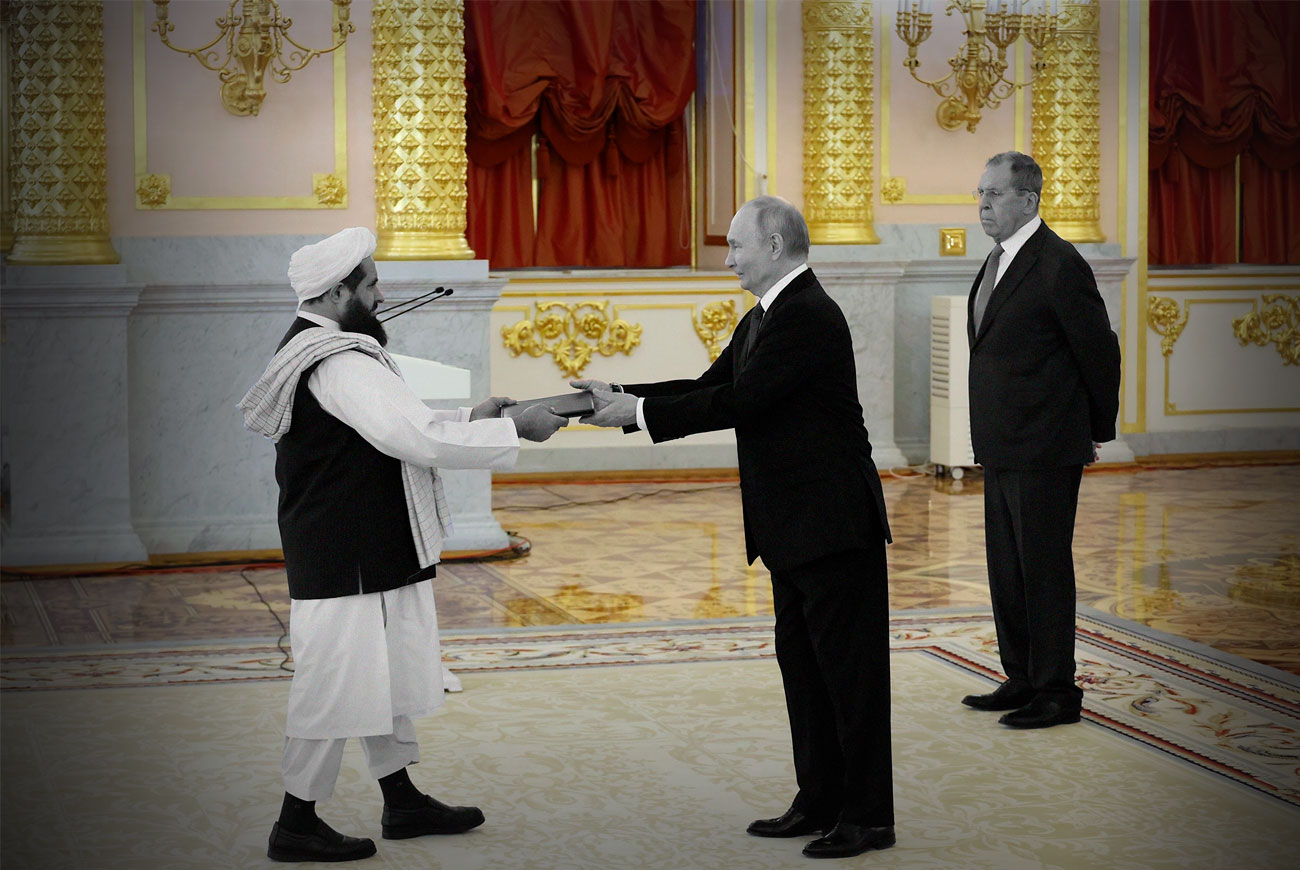
 Vladimir Putin and the Ambassador of Afghanistan to Russia Gull Hassan Hassan. Photo: K. Zavrazhin / RG
The photo with the Afghan ambassador turned out to be particularly striking — a former Soviet official stands in the Alexandrovsky Hall of the Kremlin Palace next to a typical, in old terms, "mujahideen." The Brezhnev Politburo collectively — as collective was the leadership — turns in its grave.
Thugs instead of diplomats
 The procedure for presenting credentials, which for some ambassadors was long overdue — some have been working for a long time, others for more than a year, resembled a graceful political minuet mixed with a theater of mimicry and gesture. Partly — gesture, as the envoys of "unfriendly" states felt somewhat uncomfortable standing next to the Kremlin's master. Norwegian Ambassador Heidi Olufsen chose a very strict black dress, Swedish Ambassador Kristina Johannesson emphasized the solemnity of the ceremony with a scarf of exquisite colors, Czech Ambassador Daniel Kostoval tried to keep a straight face from his hockey height. And only Nicolas de Rivière, invariably friendly, was honored with the best Putin smile. It was more cheerful for the "friendly" comrades, mainly from countries, as they were called in the blessed times of balance of power, the "third world." Putin spared no mimicry and gesture for everyone, was extremely jovial, almost as much as during the meeting with Trump.
The absence of the American ambassador was eloquently gaping — after the departure of Ms. Lynn Tracy in the summer of 2025, Trump's new envoy to Moscow did not arrive. Either the US president is not interested, or the rumors are true that Steve Witkoff, who became native to Moscow, refused such a career offer, or they cannot find a worthy candidate due to the complexity of the diplomatic mission. The penultimate ambassador, John Sullivan, writes in his memoirs that both Donald Trump and Joe Biden were very surprised by his sincere desire to work in Russia, did not quite believe in such an exotic interest — and this was even before the special operation times...
It is characteristic that after working in Russia, many ambassadors retire — staying in the Russian Federation, as in the USSR, is often the peak of a career, but burnout occurs rapidly. And this is not surprising — especially during the period of the Special Military Operation and the erosion of the world order. Especially in those times when many "unfriendly" ambassadors have very weak contacts even with foreign ministry officials. In an era when Western diplomats are met not by their Russian colleagues, but by well-prepared and cheaply paid street thugs.
Thugs, not polished MGIMO graduates, now make politics. Which was once again demonstratively emphasized when recently the deputy head of the British mission, the fragile woman Deyni Dalakia, was met by an aggressive crowd of "concerned citizens" at the exit from the Stalinist (in every sense) Foreign Ministry, mostly slightly over twenty, chanting monotonous slogans in unison. This was by no means a Greek chorus. And after all, one could have been concerned about the life and health of the diplomat, remembering the recent well-tempered attack on the Polish ambassador in St. Petersburg. After all, our organs and departments are primarily staffed by talented directors of mise-en-scène; everything else, including ensuring the work of housing and communal services, obstetrics, the economy, and actually diplomacy, is much worse for them.
In calmer times, international relations scholar Andrey Kortunov composed a humorous but very accurate classification of foreign ambassadors in Russia, which the most informed of them still enjoy quoting. Ambassadors in this taxonomy are divided into "Romantics," "Businessmen," "Pedants," "Martyrs," "Hedonists," "Philosophers." Even in the current circumstances, even in "unfriendly" states, all these types are present. But "Romantics" and "Philosophers" find it increasingly difficult to practically apply their sincere love for Russia and the Russian language, cautious "Pedants" are met by the aforementioned thugs, "Businessmen" have nothing to do, and "Hedonists" find pleasure for themselves in the improved Moscow and its surroundings like the cities of the Golden Ring. They are all now "Martyrs." Well, what can you do — there has been a failure in time: many of the envoys of "imperialist states," not to mention the "Anglo-Saxons," should now read the memoirs of George Kennan, who was almost under siege at various times on Mokhovaya or in Spaso House, constantly searching for bugs in the residence's premises, and at the peak of his career declared persona non grata.
Reading lips
And now comes the moment of Putin's speech. Some observers criticized him for not saying a word about Venezuela and Iran. Well, this is still a speech before diplomats, not in Luzhniki, and it should be deciphered not so much by the text as by lips, mimicry, and gestures. By the rounded formulas, according to which the President of Russia is the most passionate advocate of the struggle for peace and the triumph of international law (interpreted in the most extravagant way). "Peace requires effort, responsibility, and conscious choice." Wow, that's Soviet diplomat Valentin Falin with his formula "Confrontation is not fate, but choice." So who chose confrontation? Let's look around in the Alexandrovsky Hall. Do we see this person? It seems not.
However, we do see. Despite the fact that maintaining a specific friendship with the current American administration is a priority for the Kremlin, and the main enemy in the "Anglo-Saxon" bundle is now the United Kingdom (how can we not recall Stalin in 1946: they want there to "replace the dominance of the Hitlers with the dominance of the Churchills"), there is one such unnamed Mephistophelean force:
"...instead of dialogue between states, there is a monologue of those who, by right of the strong, consider it permissible to dictate their will, teach life, and give orders..."
Here is your answer to Venezuela and Iran. This formidable statement with subtle hints and winks is still somewhat strange — when you see the phrase "teach life," you want to suggest to the Kremlin resident... oops, referent to hire a professional editor with the provision of clinic number one in Sivtsev Vrazhek and sanatorium-resort service in boarding houses on Uspenka. But that's not the main thing. It is important that the adversary is verbally wounded — either a friend or an enemy. If the adversary, of course, noticed this umbrella jab...
"...Dozens of countries in the world suffer from disrespect for their sovereign rights, from chaos and lawlessness, and do not have the strength and resources to stand up for themselves..."
Pure truth. Great powers, including those that are no longer great but suffer from phantom pains over the lost empire, behave exactly this way towards "small" nations. They were assigned the role of buffer dependent states within the zones of influence of large and heavily armed imperial formations. The world Putin is striving for, as was emphasized once again, is multipolar. And we know these "polar" poles — the USA, China, Russia. Or according to the concept of Core 5, let's say — also Japan and India.
And where is Europe here? Here it is:
"...Dialogue and contacts — not at all through our fault, I want to emphasize this, — have been reduced to a minimum both along official lines and business and public circles. Interaction on key international and regional issues is frozen..."
One wants to ask the new cursed Russian question: "What happened?"
With Africa, it turned out just fine:
"...Our country made a significant contribution to freeing African countries from colonial oppression, to the formation of their statehood, to the development of national economies, the social sphere, to the training and equipping of armed forces..."
"Our country" — this is the USSR. It turns out that Ukraine, for example, or Tajikistan, as well as, in particular, Estonia, contributed to the liberation of the peoples of the continent because they were parts of the Soviet Union. Especially piquant is this "equipping of armed forces." The exposure, so to speak, of the technique. Here, as reported by the Russian Ministry of Defense, representatives of the ministry "in January held negotiations on military-technical cooperation (MTC) with the military leadership of São Tomé and Príncipe (although it is not Africa, but a "zone of influence" in the logic of the USSR, which the Kremlin regime caricatures. — A. K.) Equatorial Guinea and Cameroon". As always in Russia, everything changes in a year, over decades — nothing.
Well, and, as they say, about the weather. This is our response to Curzon, more precisely, to Kennedy in 1962, more precisely, to Trump in 2026:
"...We have always provided and continue to provide assistance and support to Cuban friends. We are in solidarity with their determination to defend their sovereignty and independence by all means..."
Did Trump hear these messages from the home fortress (in every sense) of the Kremlin theater of mimicry and gesture? Who knows. He is terribly busy. But to the Kremlin's delight, the US president recently noted that the "deal" on Ukraine is not concluded through no fault of Putin. 2026 imitates 2025. The terrible human catastrophe continues. And the world order is consistently eroded. Ambassadors can continue their martyr's path. In the sense of ambassadors of "unfriendly" states, behind whose stone faces the former Russian Permanent Representative to the UN Lavrov and the former adviser-envoy of the USSR/RF embassy in Denmark and the Russian ambassador to the USA Ushakov observed with equally stone faces. They have reasons for nostalgia.
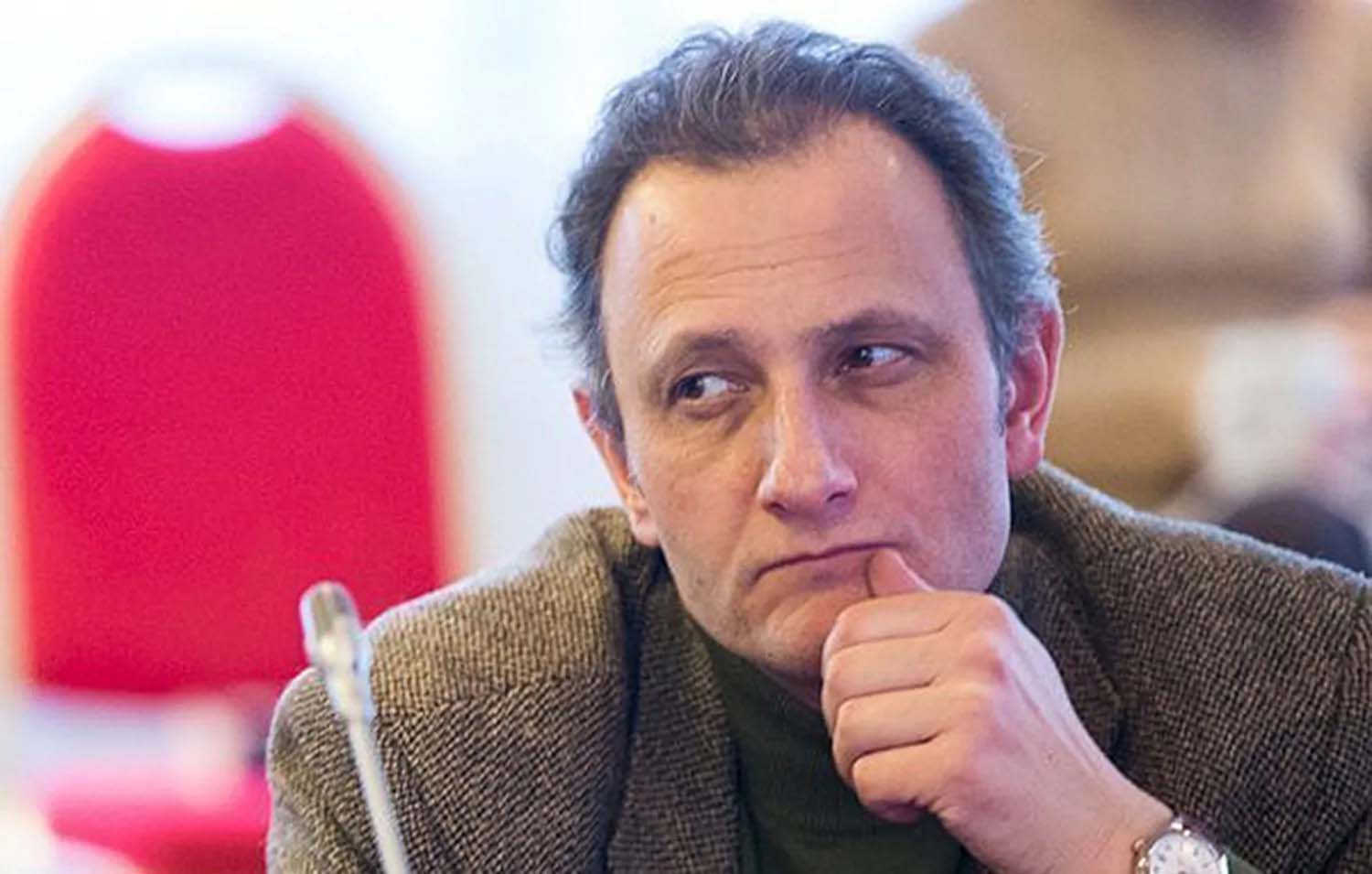
* The Russian Ministry of Justice considers Andrey Kolesnikov a "foreign agent."