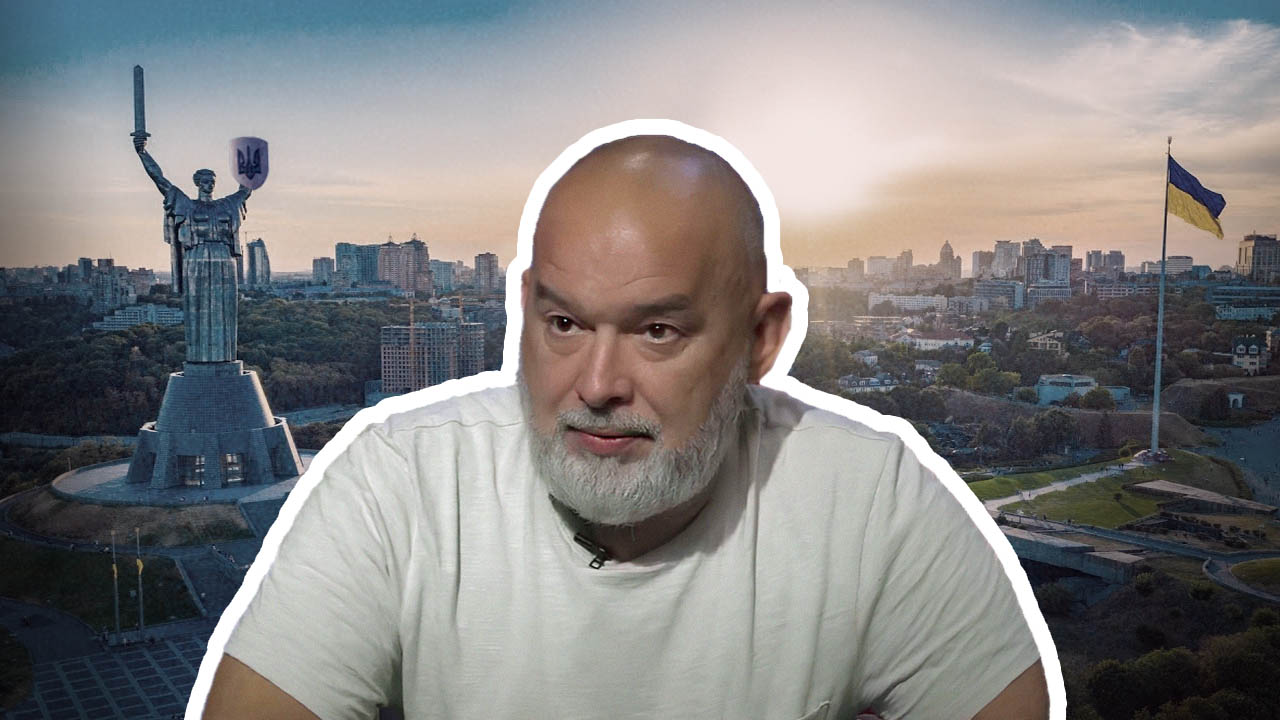
Mikhail Sheitelman
Evgenia Albats*: Mikhail, are you currently in Kyiv?
Mikhail Sheitelman: Yes, I am in Kyiv. In general, I've been in Kyiv throughout the war with rare trips.
The Bomb Shelter Story
Evgenia Albats: How was last night in Kyiv?
Mikhail Sheitelman: Last night was calm, with a short alarm, literally for an hour, when a couple of drones flew over. The massive shelling of the last few days almost didn't affect Kyiv. The targets were Ukrainian nuclear plants. Not the reactors, of course, the Russians are not bombing the reactors yet, they are bombing the connectors of the nuclear plants, and there are none in Kyiv. So the shelling of the last week didn't affect Kyiv.
Evgenia Albats: Do you have heat in your home?
Mikhail Sheitelman: There is heat, but no electricity. Ukrainians have adapted over 4 years. I have a huge number of various batteries on different devices. Naturally, fiber optics are installed everywhere so that it doesn't depend on electricity. Lots of backup options. If the power outage lasts less than a day, I can give interviews. If longer, then special measures will need to be taken.
If I hadn't refused to go to the shelter, I would have spent about 400 nights on the floor in the subway or in a bomb shelter over the last four years
Evgenia Albats: And when there are bombings, do you go to the bomb shelter or stay at home?
Mikhail Sheitelman: I don't go, but that's purely from my life philosophy that whatever will be, will be. I formulated this for myself when I set up a real bomb shelter at the beginning of the war. I lived in a large apartment building, and it had a Stalin-era atomic bomb shelter. Together with other residents, I organized everyone, and we greatly improved it. 10 rooms, children lived there then, dogs, cats. Everything was very cool, with water, with bio-toilets, we did it all quickly, but I looked at it all and thought that I wasn't ready to sacrifice the quality of life. I want to sleep on a sofa or in a bed, I don't want to sleep in a bomb shelter. Yes, they might kill me, but if I hadn't gone for it, I would have spent about 400 nights on the floor in the subway or in a bomb shelter over the last four years. I'm not ready, I don't have much time left.
Evgenia Albats: And what's happening in Kharkiv? It's often written that in some areas of the city there's no heating, no electricity.
Mikhail Sheitelman: The same in Kyiv. Not everyone has heat or hot water. It all happens in periods. It's a matter of luck. Electricity is turned off according to a schedule, so it's convenient, you accumulate electricity, then you can sit without it. But heating, water — it depends on how the system is set up. A person on the 12th floor most likely has an autonomous pump. The same in Kharkiv. It depends on the area, the location, the height. People on the lower floors, of course, live much more comfortably. People who have gas also live more comfortably because when there's no electricity, you can cook on gas. I haven't been to Kharkiv during the war. But I get messages from there, I've made thousands of acquaintances in Kharkiv during this time. In general, everyone who stayed there has adapted. Before the war, it was a city with almost 2 million people. Now there's still more than a million, I think. People have adapted.
Evgenia Albats: And what about Odessa? Someone from Odessa wrote that the heating was turned on.
Mikhail Sheitelman: Of course, it was joyful news because this year the heating was introduced later than usual, usually, the heating season starts in mid-October, but this year it only started in early November, much later, due to a lack of gas, as almost the entire system of domestic production is destroyed. Gas comes only from Europe, now also from Azerbaijan and Turkey. And every time the gas networks, which the Russians also destroy, need to be repaired. And so there was joy that the heating was provided. And so the heating, I think, is available throughout the country. I'm not considering extreme cases like Kramatorsk, for example, I don't know what's happening with the heating there. There are small frontline towns where everything is very difficult. Odessa lives, I think, approximately like Kyiv. We are adapted and more or less know what's happening. Why don't I have electricity now? Three days ago it was almost all day. And now it's given for 8 hours. Because the Russians again broke the transformers and some systems connecting with the nuclear plants. The nuclear plants reduce the reactor load because of this, so as not to explode. And gradually, as the networks are restored, the load is increased. If there are no new bombings, everything will return to the mode that was a week ago within a week. And everyone lives like that. My grandmother during the blockade knew where the water was, right? She told me that those who survived the first winter didn't die afterward. Everyone knew where to go for water, how to live, how to adapt. Everyone was selling something, and so on.
Danish Gift
Evgenia Albats: When I was in Mykolaiv in the winter of 2023, there were big problems with water. Drinking water was delivered in large blue tanks, special trolleybuses distributed it. As I understand it, this was after the Russians broke the water supply. What's the situation with water in those Ukrainian cities you know about?
Mikhail Sheitelman: The Danes, the Danish government, gifted Mykolaiv hundreds of millions of dollars for the construction of a new water supply system. And it was launched, I think, this spring. As they write, the water problem in Mykolaiv has been solved. I don't know, of course, if it's in all apartments, but in general, the Danes ensured the water supply. I think they even built it themselves, their specialists came. And in Kyiv, the real sufferers are the residents of high-rise buildings because in many high-rise buildings, if there's no generator, the water stops pumping, it just doesn't reach the upper floors. And many have such a life: a person lives on the 25th floor and goes for water to the 8th. Naturally, they go on foot. The elevator doesn't work. If there was a generator, the elevator would work first, and then the water supply. So it's a common problem — when you don't have electricity, the water doesn't flow either. I had such a situation, I was without water for several days. Well, they brought it, everything is very well organized, you can't complain about the city services in this sense, a tanker came, you go out with buckets, collect water, it's enough for a day. In my building, it didn't last long, I was lucky.
With a Suitcase on Wheels
Evgenia Albats: I remember, it was once said that Ukrainians know how to survive because they go to the villages, everyone has some kind of farm. Do people really move from the cities to the villages for the winter?
Mikhail Sheitelman: The situation is completely different now. The story at the beginning of the war in 2022 scared people when many did exactly as you say. I remember those first days. I lived right on the extension of Khreshchatyk, that is, the center. The street was filled with people, and the sound of the beginning of the war is the sound of a suitcase on wheels being dragged over the tiles: din-din-din. Crowds of people with suitcases. And you know, these were the first three days, and then the people with wheeled suitcases ran out, and people with bags over their shoulders, with some bundles, started coming. And I watched it all from the window. And endless cars. Some people were leaving the country, those who had the opportunity. It's not cheap, and in general, well, you arrive, and what will you do there? Not quite clear. And some went to these very villages. And many ended up under occupation. Many were killed, many suffered, or were subjected to torture, or something else. Some died of hunger in basements, this happened in the Chernihiv region. And many other different cases, I'm only taking those described by the UN. And so people realized that it's more reliable in the city.
Kyiv has undergone significant changes over these four years. If at the beginning of the war, in March, we had 800 thousand left out of the three and a half million pre-war population of Kyiv, now there are more than 4 million. Now Kyiv is just packed with people. Because a huge number of people, the main mass, I think, of Kyiv residents returned from abroad. Not everyone returned to more dangerous cities — to Kramatorsk, and to Kharkiv. But almost all Kyiv residents returned to Kyiv. Because Kyiv residents are a certain way of life, like Odessa residents. And secondly, many people from affected cities, where it was either impossible or difficult to survive, came here. Plus from occupied cities. Literally, the entire geography of occupation is present in Kyiv. Therefore, Kyiv is packed. And it's not like someone is going to the village, you don't see that. Moreover, we have a day in Kyiv — the day of taking Kyiv, it's a joke. Sunday evening is the day of taking Kyiv when people return from the dacha in the summer. That is, you can't get through, endless traffic jams, and so on. But in general, as one of my friends, a foreigner who is here on a diplomatic mission, said, Kyiv during the day is Monaco, and at night Afghanistan. That's how we live here now.
Evgenia Albats: Afghanistan in the sense of both the Taliban and reconnaissance groups?
Mikhail Sheitelman: No, it means shelling. During the day Kyiv lives normally, restaurants are open, new ones are opening, an endless number of theaters — by the way, new ones have also opened, premieres are already based on plays written during the war. And at night you sit under shelling, everything around just explodes. Shelling is very scary, really very scary. I have a large-caliber machine gun constantly firing behind the wall. Separately, anti-aircraft guns, it's a completely different sound. Separately, the Patriots take off, it's another sound. New sounds are constantly being added in connection with the invention of new air defense systems. For example, when anti-drone systems work or something else new. It's scary. And plus the sky is just glowing from explosions. And when something lands nearby and car alarms start blaring, you don't know if it hit your house or not.
In Kyiv, everyone is sure that the Patriot battery is in their yard: the sound is so strong that even if it takes off many kilometers away from you, you're sure it's nearby
Evgenia Albats: And are there Patriots? It was always said that the missiles for them had run out, that the Americans promised but didn't deliver.
Mikhail Sheitelman: They are definitely there because I personally hear them. This sound cannot be confused with anything. We all heard it in childhood when we were shown how the Soyuz spacecraft takes off. In Kyiv, everyone is sure that the Patriot battery is in their yard: the sound is so strong that even if it takes off many kilometers away from you, you're sure it's flying out of your apartment. No one has ever seen a Patriot because where they are located is well secreted and hidden, and they naturally change location. But the sound of a rocket taking off is cosmic, it can't be confused with anything. And there's also statistics, you involuntarily become a military expert. In the morning you read the General Staff report, which is constantly published, and you know how many ballistic missiles have been shot down: Patriots only shoot at ballistic missiles, at Iskanders and hypersonic Daggers. It's not worth spending them on anything else. Cruise missiles are more effectively dealt with by aircraft, F-16s and Mirages. And there are also new Israeli Hetz missiles that can shoot down ballistic missiles, so in the morning we look at the statistics, aha, if they shoot at Kyiv, then two-thirds of ballistic missiles are usually shot down.
There is no district left in Kyiv that hasn't been shelled. There were hits in the government quarter, on Bankova, and on the street where diplomats live
Evgenia Albats: I talked to people who are quite often in Kyiv, live there for several weeks, businessmen who, in particular, are developing various plans for the reconstruction of Ukraine after the end of the war, and so on. And they say that supposedly the Russians know certain houses where, for example, diplomats, people from the US or German embassy live, and they don't hit those houses. Is this really true or is it a myth?
Mikhail Sheitelman: I'm inclined to think it's a myth. There is no district left in Kyiv that hasn't been shelled during this time. There were hits in the government quarter, on Bankova. But right next to it, literally the next street, is the Writer's House, there was a direct drone hit, a beautiful historical building was destroyed. And I know that diplomats live on that street, I know personally. It definitely got hit there. It's impossible to do it selectively, the X-22 missile has a radius of impact plus or minus a kilometer. It's a cruise missile, very old, Soviet, launched from strategic bombers. Fortunately, they have run out for the Russians now. They were from the Soviet era, from the 50s-60s-70s, very old, on liquid fuel, very complex, heavy. They cause enormous damage. For example, the shopping center, remember, in Kremenchuk was destroyed. It shoots randomly, choosing nothing. They are very difficult to shoot down due to their high speed. Therefore, I'm not ready to believe that the Russians are saving something there. Maybe they try not to hit the American embassy? Well, probably. But with such a volume of shelling, when there were 800 air targets a day, such cases were — you won't save anything.
Daily Bread
Evgenia Albats: What about food? Where is it brought from? Is it available in grocery stores, in shops?
Mikhail Sheitelman: Ukraine produces everything itself, most of the products are Ukrainian, they are produced as they were. Ukraine is a huge supplier to the world market, I think in terms of per capita, maybe the largest supplier of agricultural products in the world.
Evgenia Albats: So when they say that all of Ukraine's agricultural lands are mined, it's not true?
Mikhail Sheitelman: That's only in the occupied territories or near them. And the main agricultural lands are not there, it's mostly industrial there. So there's as much food in the stores as you want, all local and plus as much foreign as you want. There were problems in 2022, the first two months when Kyiv was in semi-surrounding, when Russian troops were on our Victory Avenue.
Evgenia Albats: In one of the Ukrainian blogs, I read a quote from Yulia Mendel, the former press secretary of President Zelensky. Here's what she says. Ukraine reports a massive outflow of the population from October 3 to November 14. 128,000 Ukrainians left the country. Almost as many as in the previous 9 months combined. How reliable is this?
Mikhail Sheitelman: I think, approximately not at all. Yulia Mendel, I think, last had anything to do with state power several years ago, she doesn't have access to any data that isn't open. These are all fantasies. I don't know where she got it from. Listen, there are a huge number of people spreading rumors. Another thing is that around these dates there was a change in legislation: men aged 18 to 21 were previously prohibited from leaving the country because they are liable for military service. They are not subject to mobilization, we have mobilization from 25 years, but there was a ban on leaving. And then they allowed it, such a decision was made by the government. And then indeed many people left at once: some to study, some to relatives. For example, the most common situation: the father is at the front, the mother with the younger child is in Germany, and the older child is not allowed to leave. And he, accordingly, went to see the family. Many, by the way, returned later.
War and Corruption
Evgenia Albats: The New York Times published a major investigation into a corruption case related to Energoatom. Naturally, before that, a lot was written about it by Ukrainska Pravda and other Ukrainian media. When in 2022 the question arose of how to help Ukraine, it was well known about corruption in our part of the world. So the American, for example, authorities were deciding how to help Ukraine with money so that the money didn't end up in the pockets of dishonest officials. And then an oversight board was created, in particular, related to energy, where a lot of money was going. And now The New York Times writes that gradually in this oversight board people were replaced with those loyal to the president's office and generally high officials. In particular, that Andriy Yermak was somehow involved in this. And gradually this oversight board ceased to have any significance. In short, this is a story that shocked many, including because there is a war going on. It seems, how can you steal when there's a war. Although I will immediately say, Anne Applebaum published in Atlantic, this is one of the best American weeklies, a column in which she writes that yes, there is corruption in Ukraine, but the government itself is investigating corruption in the government itself. Of course, she means NABU, this is a special anti-corruption agency in Ukraine, which, in fact, conducted the investigation. The most high-profile resignation has already happened — the head of the president's office Andriy Yermak, who was called the second person in the Ukrainian state. How can you comment on this?
Mikhail Sheitelman: Well, first of all, corruption, as you said, is not news, and the fact that it exists in Ukraine is also not news. Ukraine ranks 108th in the world in the Corruption Perceptions Index, and it is 33 percent free from corruption. The numbers change every year. And before the war, what really interested us was the dynamics. After the Revolution of Dignity, it rose from 22 percent to 33, and from 160th place to 108th. The fact that with the start of the war, corruption would become zero would be hard to believe. That's one. Secondly, in this corruption story, Ukrainians were really worried about only one thing — the name Mindich, because he was a personal friend of Zelensky, at least at some point. He led a criminal group, according to NABU. Therefore, the only concern is whether Zelensky is involved in this. There were corruption scandals before, even during the war, someone was sent into retirement. If it weren't for Mindich, I think there wouldn't be any scandal. Yes, it's no joke, 100 million dollars is a lot of money, but several things need to be pointed out immediately: these are crooks who are being prosecuted. It's very important that they are being prosecuted by a Ukrainian organization, that is, they weren't caught by the EU, not by the USA.
Evgenia Albats: There are rumors that the FBI passed the data to NABU.
Mikhail Sheitelman: The FBI couldn't have collected this data anywhere, the FBI cooperates with NABU in any case. And, of course, data on dollar accounts is stored in the Federal System of the USA, nowhere else. Therefore, of course, they cooperated. It's important that Ukraine did this, that NABU is an organization established by Ukrainians, by the Ukrainian Verkhovna Rada, and it itself is engaged in cleaning up the system, which is its role.
By the way, about the "embezzlement of foreign aid." It's not like that. In the spring of last year, there was a report by three chairmen of US Congressional committees when there was a debate about allocating 60 billion to Ukraine. And they wrote that during the time of allocating only American aid, more than 100 audits were conducted, and the audits that were completed at that time — 60 — revealed zero violations in usage. This is an American audit, not a Ukrainian one. But I think that no one will, of course, steal money that directly comes from the EU or the United States of America. They go into the budget, not into Energoatom. Everyone understands where the line is.
Evgenia Albats: But were there kickbacks?
Mikhail Sheitelman: In Energoatom, not in the budget. And I really hope that the investigation will be completed.
The Fate of Yermak
Evgenia Albats: As a result of this scandal, such a powerful person as Andriy Yermak, the head of the president's office, was sent into retirement. Andriy Yermak is an extremely well-known person, including because he somehow at one point became both the head of the president's office and replaced the foreign minister. What has changed, how serious is this story for both Volodymyr Zelensky and the president's office?
Mikhail Sheitelman: Indeed, Yermak was a very influential person, but it should be understood that he was an influential person within the bureaucracy, not within Ukrainian society.
Evgenia Albats: Such a gray cardinal, as always.
Yermak was almost always next to the president during his trips. For the negotiation process, he is certainly not a loss at all. But for managing the bureaucracy — yes
Mikhail Sheitelman: Yes, it's important that it didn't concern society, by and large. Yermak is not the boss of Ukrainian society and the people. I think that before the war, few even heard this name. He wasn't a public politician. For Ukrainians, important politicians are Zaluzhny, Budanov, Poroshenko, Tymoshenko... Yermak wasn't an important person on whom people's lives depended. But for the bureaucracy — yes. I think it's a big loss for Zelensky simply because it's very difficult for him. He has to take and change everything now, rearrange a lot. Yermak really occupied more and more space in the life of leadership, in the life of the bureaucracy. By the way, he very rarely represented Ukraine in negotiations. It's just that we remember, as Shtrilitz's words, the last news. The last representative at the negotiations in Geneva was Yermak, but before that, he never headed the delegation. Yermak was just almost always next to the president during his trips. For the negotiation process, he is certainly not a loss at all. But for managing the bureaucracy — yes. Zelensky shifted a huge number of
But at the same time, what are the advantages for Zelensky? I think it's a huge chance for Zelensky now, as they say, to shoot off the spent rocket stage. Zelensky can play this card to his advantage. Despite the fact that it is probably very difficult for him now to survive politically and maneuver in the new reality without Yermak. But it has happened before, when he replaced Zaluzhny, Zelensky lost 10-11% of the trust rating. And he knew he would lose. That is, he was making a sacrifice for some of his thoughts. Now, by dismissing Yermak, he understands that he is increasing the trust rating. Therefore, there are both pros and cons for Zelensky. And the bureaucracy will somehow manage.
Evgenia Albats: Will the Prime Minister change?
Mikhail Sheitelman: Only if Yulia Svyrydenko is appointed head of the office instead of Yermak, which is theoretically considered. Otherwise, there's no point in changing her, on the contrary.
Evgenia Albats: And if she becomes the head of the office, will Yermak retain any strings to Zelensky?
Mikhail Sheitelman: I don't think that being in Yermak's position, it's possible to retain strings. You can only crawl away, lick your wounds, and prepare for the next round of your life.
Evgenia Albats: Yermak said he was going to the front as a soldier. Did he go?
Mikhail Sheitelman: I don't know. We'll see. I think so. He's not stupid, it seems to me. It was a very correct, strong statement. If he does it, it will work. It's something that can create a new political career for him. Because in some polls his trust rating was not zero at all. In 2022, it was under 50%, then it decreased and by the end of 2024, it was 25%, I think. It's a very high trust rating. In Ukraine, maybe four people have a higher one. There is a base to start from. He can quite, if he behaves correctly now, earn a new political career.
Evgenia Albats: Now it seems that the main negotiator has become the head of the National Security Council of Ukraine, Umerov. But Ukrainian media write that NABU has some materials on Umerov in connection with the Energoatom case. Won't the story with Yermak repeat, and Umerov will also be sent into retirement?
Mikhail Sheitelman: Maybe he was even questioned in this case, I don't know. But he is definitely not irreplaceable. The head of the NSDC, that is, the National Security and Defense Council, is not such a memorable position. Therefore, it's hard to say what will happen... I think they have already more or less closed the list of suspects. Maybe it will grow, but it seems to me that now they will dig deeper. Now people expect results from NABU not like "here we suspect this one too". You suspected, well, then tell us, where's the prosecutor's office, where are the processes. Because so far they have only leaked some tapes, because of which, I think, they even fired the NABU investigator who leaked them. It's forbidden to publish them, it's prohibited by law. Therefore, now people expect something completely different from NABU. Not tapes where nothing is clear, but specifically: who, how much, where — and why these people were released on bail and what will happen to them next? That's what seems important in this case now. Where have you been for a year and a half, people ask. What, you listened to them for a year and a half and did nothing? And how much did they steal during these one and a half years? And why is that?
Now there are many questions for NABU. And I think NABU now has something to do besides looking for new suspects...
Reference
Mikhail Sheitelman lives in Kyiv, is engaged in political consulting, develops strategies for political campaigns in post-Soviet countries and Israel. He studied in Leningrad at the Polytechnic, then at Bar-Ilan University in Israel. He worked as a programmer, then created his own business. His company promotes the rule of law in post-communist countries, provides assistance and consultation in conducting social and economic reforms.
Video Version
* Evgenia Albats, Mikhail Sheitelman are declared "foreign agents" in the Russian Federation.