 Almost four years of absolute anthropological catastrophe. Almost fourteen years since the 2012 elections, when the Kremlin finally decided on the construction of a national-imperial semi-totalitarian political model. Soon it will be six years since the moment when the established model of practically eternal autocratic rule was enshrined in the Constitution and the doors were opened to subsequent dictation from Moscow to the world on how it should be. And the imposition of the Kremlin's worldview using not soft power — due to its obvious deficit, but the power of weapons.
The Putin regime cannot establish a new world order, but a new world disorder has already been formed by it, and at the center of the strategy is the permanent production and export of chaos, by military or hybrid means. There is no place for classical diplomacy here. And what seems like it is only PR operations covering the unwillingness to conduct real peace negotiations. Putin — in his view — still has resources and time to prolong the hot phase of confrontation with the West, more precisely, with what was recently considered civilization as such and the framework of universal human values. The hot phase will eventually turn into a cold one, but clearly not soon: what is called the SVO is not a classic conflict of the 20th century, but a permanent confrontation in the manner of intermittent medieval wars, like the Hundred Years' War. As it was sung in one of the programmatic songs of the Soviet period, «there is a beginning to the revolution, there is no end to the revolution». So it is here: Putin's conservative revolution had a beginning, but it cannot have an end, and here foreign and military policy is merely a continuation of domestic policy: authoritarian and totalitarian measures against its citizens have acquired an external contour. This is inevitable — such a regime cannot organically exist without two fronts, without internal and external enemies.
«Shocked by what?»
In parallel with the hybrid war with the West, Putin is building his geopolitical arc, which requires tension and elbow work for influence in the East, where it seems the Kremlin regime turned long ago. As soon as five Central Asian leaders visited Washington, Putin urgently arranged an unprecedentedly solemn reception for the President of Kazakhstan, and then did not hesitate to personally fly to Kyrgyzstan. The agenda of the Indian meeting was reduced to the main thing — the understandable desire to replenish the depleted assets of the state budget and saturate the labor market with people, that is, with the organized recruitment of Indian workers, and simply the market — with goods. In fact, the Kremlin thereby admitted the inefficiency of the military model of the economy: buy weapons and oil from us, otherwise there is not enough money to continue the SVO; give us labor, otherwise there is no one to work; send us consumer goods, otherwise our supply is not enough to satisfy the internal demand, which is gradually collapsing due to the predicted decline in the population's purchasing power.
As for Putin's unwavering position in the Ukrainian conflict, he confirmed it during a ceremonial meeting with Utikoff and Kushner, and then in an interview with Indian media on the eve of the visit. It was there that the phrase of the year was born, which was uttered in response to a question about the destruction of the foundations of people's existence in eastern Ukraine, motivated by their «liberation»: «I didn't understand the question.» Simply because such a question, in the view of the Kremlin's master, cannot stand.
From the transcript:
«V. Putin: <...> And we will finish when we achieve the goals set before the start of the special military operation, — we will liberate these territories. That's all.
A. Kashyap: What are these goals? What is Vladimir Putin's ultimate goal in Ukraine?
V. Putin: As I said. <...>
G. Mohan: <...> But they (people in eastern Ukraine. — A. K.) were also shocked: how could Putin do this to us, we are his people! Many women I spoke to were shocked.
What can you say to the people in eastern Ukraine, who have families actually in Russia, who constantly move between Russia and Ukraine? What would you tell them?
V. Putin: I didn't understand the question: shocked by what?
G. Mohan: The people I met were shocked that an operation was started during which their homes were destroyed. They lived in eastern Ukraine, they always loved Russia, the Russian people, they were Russian-speaking themselves.»
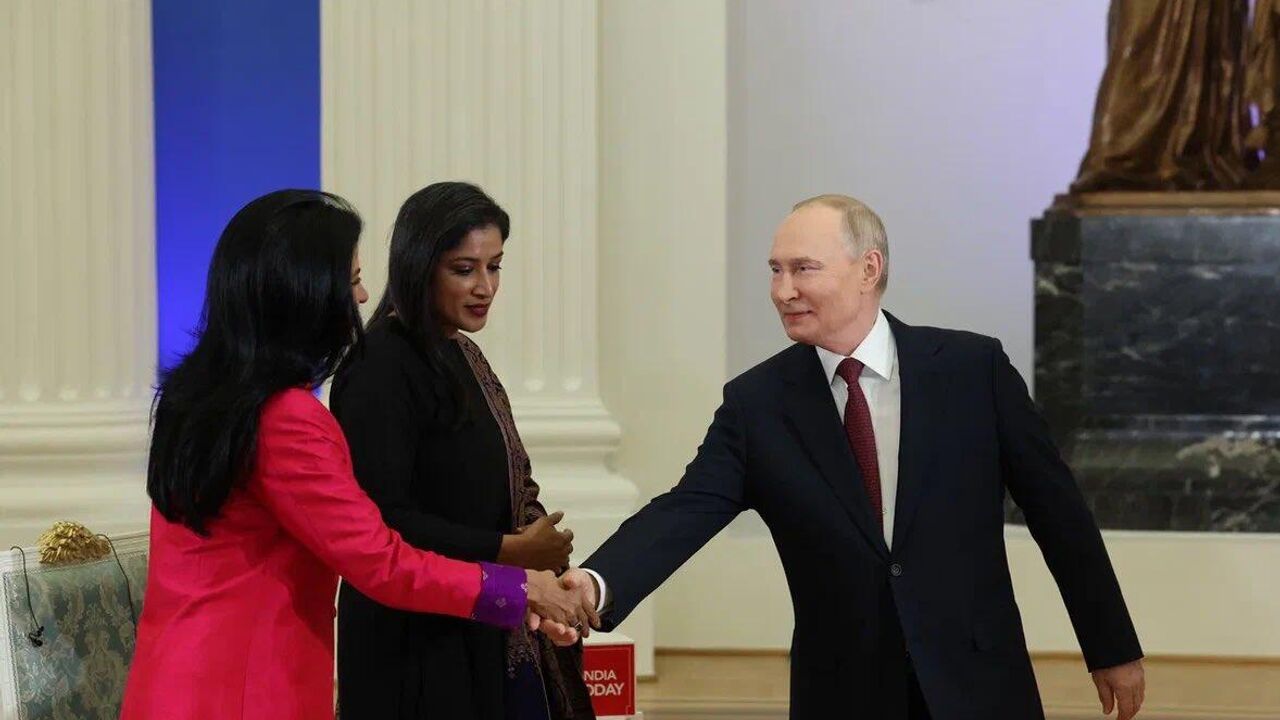
Vladimir Putin gives an interview to the channels Aaj Tak and India Today in the Kremlin
What questions can be asked to Putin, it has been completely unclear for at least four years. There is only one Hamletian, but rhetorical question left: «Why?» Of course, two ladies from the Indian media did not receive an answer to it, who behaved minimally professionally in some moments of the interview, although, as they later admitted, they were absolutely charmed by the Russian autocrat and his «sense of humor». Perhaps unexpectedly for Putin, who probably expected ceremonial questions in the Chinese style of bows and thanks.
Imitation of diplomacy
Just as the Kremlin was not going to conduct real negotiations four years ago, in the fall of 2021-winter 2022. The decision was made, everything else was not diplomacy or an attempt to think about the advisability of the military-political choice that collapsed both the world order and all the achievements of Putin's predecessors aimed at avoiding wars and the death of people, as well as establishing universal rules of conduct in the world after World War II.
Of course, the circumstances of four years ago are somewhat forgotten. A detailed report on them was left in his memoirs, the details of which can still shock, by the then US ambassador to Moscow, John Sullivan (with the characteristic title Midnight in Moscow — «Midnight in Moscow. Memoirs from the Frontlines of Russia's War with the West»). An experienced and intelligent diplomat was one of those who felt as early as the beginning of autumn 2021 that the conflict would grow into a full-fledged military confrontation, and this would be the very conscious choice of the Kremlin. The American business community did not believe him even a few days before the February catastrophe, because everyone relied on the notorious «rationality» of the Russian president. Not understanding that there is a significant difference between rationality and cynicism.
Sullivan describes all the attempts of the Americans to overcome the wall of well-tempered intransigence of the Russian side. In October 2021, he accompanied Deputy Secretary of State Victoria Nuland to a meeting with Deputy Head of Administration Dmitry Kozak, who was called the «Cheshire Cat» for his broad smile. Kozak conveyed the Kremlin's principled position: the US should pressure its «client» Vladimir Zelensky to negotiate directly with the Donbas leaders, Russia is not a party to the conflict. At that time, Sullivan assessed the situation, the concentration of Russian troops on the border was part of a pressure campaign. But only at that moment. Less than a month later, a visit by then-CIA Director Bill Burns was required, considered the most talented diplomat of his generation. He conveyed to Security Council Secretary Nikolai Patrushev — of which Sullivan was a witness — Joe Biden's message: the US knows about military preparations and if they are implemented, the response will be truly tough. Patrushev neither confirmed nor denied the existence of a military plan by the Kremlin, but reported in a somewhat arrogant manner that Russia is now very strong militarily and ready to solve problems in its geographical environment on its own. Burns met with the same result with Bortnikov and Naryshkin and spoke via video link with Putin.
At the end of November, the Kremlin, through Kozak, continued to press the pedal of the need for direct negotiations between Kyiv and Donbas, and in Sullivan's depiction, the «Cheshire Cat» does not look like a major peacemaker. Including when, in mid-December, he blew cigarette smoke in the eyes of the visiting Assistant Secretary of State Karen Donfried. She met, among others, with Deputy Foreign Minister Sergey Ryabkov — it was then that the imitation of frantic pseudo-diplomatic activity began with the urgent transfer (and specifically in Russian without translation into English) of memorable ultimatum demands that would force the States to urgently abandon, in fact, the foundations of their foreign policy, and at the same time NATO policy. An exchange of papers began — formal, because, of course, no one was going to conduct serious negotiations in a situation where, in Sullivan's words, «the gun was on the table». Subsequently, among American officials, the debate was only about whether hostilities would begin before the end of the Beijing Olympics (in the joint communique of the Russian Federation and China, words about «friendship without limits» were then recorded) or after it. It happened after, but the beginning of events was expected every day and every minute.
In a metaphorical sense, «midnight in Moscow» continues even now, and again without any diplomacy. Putin still buys time and at the same time does not lose the United States as a potential future economic partner. Trump, however, is tired. And the Kremlin has a chance to continue the SVO and at the same time not receive additional US sanctions, since there seems to be a «negotiation process», some points are still being discussed. But doesn't this resemble in its genre the discussion of the points of Russian ultimatum papers of the December 2021 — January 2022 model?
Everything continues as it has been throughout 2025 with its sporadic bursts of euphoria and activity of the American side as mediators and regulators. The Nobel Peace Prize-2026 for Trump is again in question, instead he received some impressive medal from FIFA — like, don't leave your efforts, maestro... And Putin, «not understanding the question» and ignoring the cost of the conflict for his country, continues what he started with the sluggish observation of events by the conformist part of Russians, who warm themselves in the lights of the city's pre-New Year illumination and in the warmth and light of the heated «spiral of silence».
* Andrey Kolesnikov is considered a «foreign agent» by the Ministry of Justice of the Russian Federation.
Photo: account Anjana Om Kashyap on the social network X.